
You noticed it months ago.
A soft lump somewhere on your arm, back, neck, or thigh.
You pressed it. It moved beneath the skin. It didn’t hurt. So you ignored it.
Then it slowly got bigger.
Maybe another one appeared.
You started choosing clothes that covered it. You became aware of it while exercising. Someone pointed it out once, and although the conversation lasted only a few seconds, the thought stayed with you much longer.
That quiet, constant awareness is what brings many people for consultation.
Not because lipomas are dangerous.
Not because they are cancerous.
But because they become something you think about every day.
A lipoma may be harmless medically, yet still affect how comfortable you feel in your own body.
At our clinic in Nagpur, we regularly see patients with single lipomas, multiple lipomas, recurrent lipomas, and large lipomas that have gradually increased in size over many years. Treatment is tailored according to the number, size, location, and characteristics of each lipoma.
This guide explains what lipomas are, why they develop, when removal makes sense, and what modern treatment options can realistically achieve.
Quick Summary
✓ Lipomas are benign fatty growths and are not cancerous.
✓ Surgery remains the only proven method for permanent removal.
✓ Multiple lipomas can often be treated during the same surgical session.
✓ Liposuction-assisted removal may be suitable for selected soft and mobile lipomas.
✓ Traditional excision remains the preferred option for firm, deep, or encapsulated lipomas.
✓ Most patients return to routine activities within a few days, depending on the procedure performed.
✓ Health insurance may cover treatment in selected medically necessary situations.
✓ Treatment plans are individualized based on the size, number, and location of the lipomas.
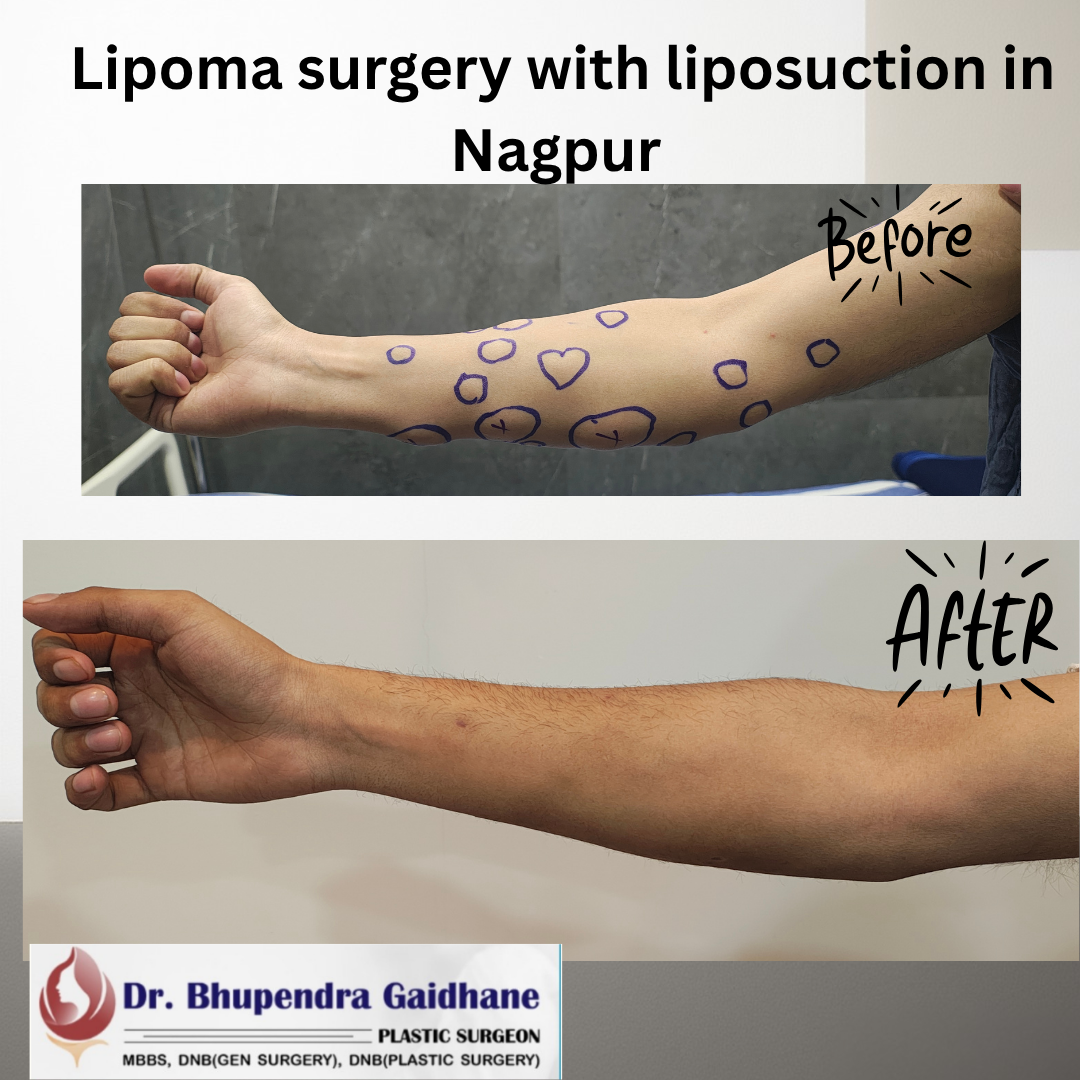
Multiple forearm lipomas treated using a liposuction-assisted approach in Nagpur.
In selected patients, this technique may help reduce the number and length of scars while addressing multiple lipomas in the same region.
What Is a Lipoma?
A lipoma is a benign (non-cancerous) growth made up of mature fat cells. It develops beneath the skin, usually between the skin and the underlying muscle layer, which is why it often feels soft, movable, and well-defined when touched.
Lipomas are among the most common soft-tissue lumps seen in adults. They can occur almost anywhere on the body where fat is present, but are most frequently found on the:
- Neck
- Shoulders
- Back
- Chest
- Abdomen
- Arms and forearms
- Thighs
Most lipomas grow slowly over several years. Some remain small and stable, while others gradually increase in size. A person may develop a single lipoma, while others may develop multiple lipomas over time, sometimes affecting several areas of the body.
Common Characteristics of a Lipoma
Most lipomas share the following features:
✓ Soft and doughy to touch
✓ Easily movable beneath the skin
✓ Usually painless
✓ Slow-growing
✓ Well-defined margins
✓ Located just beneath the skin surface
Because lipomas are generally painless and grow slowly, many people live with them for years before seeking treatment.
Can a Lipoma Turn Into Cancer?
One of the most common concerns patients have is whether a lipoma can become cancerous.
A true lipoma is a benign tumour and does not transform into cancer.
However, not every lump under the skin is necessarily a lipoma. A lump that is rapidly growing, unusually firm, fixed to deeper tissues, painful without explanation, or located deep within the muscle should be evaluated by a qualified surgeon. In such situations, further investigations such as ultrasound or MRI may be recommended to confirm the diagnosis.
Why Do Lipomas Matter If They Are Benign?
Although lipomas are not dangerous in most cases, they can still become bothersome.
Patients commonly seek treatment because:
- The lipoma continues to enlarge
- It becomes visible through clothing
- It causes self-consciousness
- Multiple lipomas have appeared over time
- It causes discomfort during exercise or daily activities
- They want certainty regarding the diagnosis
For many people, the issue is not pain or danger—it’s the constant awareness of a lump that wasn’t there before.
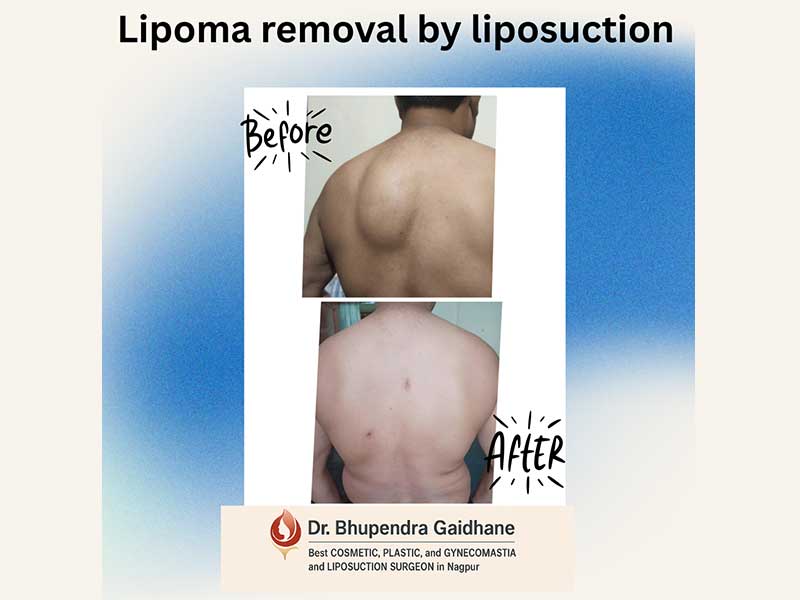
Types of Lipomas: Not All Lipomas Are the Same
When most people hear the word “lipoma,” they imagine a single soft lump beneath the skin. In reality, lipomas can vary significantly in their size, number, location, and consistency. Understanding the type of lipoma helps determine which treatment approach may be most appropriate.
Single (Solitary) Lipoma
This is the most common presentation.
A solitary lipoma appears as a single soft lump beneath the skin and may remain unchanged for years or slowly increase in size over time.
Common locations include:
- Back
- Shoulders
- Neck
- Arms
- Chest wall
- Thighs
Many patients seek removal when the lipoma becomes noticeable through clothing or gradually enlarges.
Multiple Lipomas
Some individuals develop several lipomas over different parts of the body.
These may appear on:
- Forearms
- Upper arms
- Back
- Abdomen
- Thighs
In certain families, multiple lipomas can occur across generations, a condition known as hereditary multiple lipomatosis.
Patients with multiple lipomas often seek treatment because the number of lumps gradually increases over the years, making them more noticeable and difficult to ignore.
Superficial Lipomas
These are located just beneath the skin and represent the majority of lipomas seen in clinical practice.
Characteristics include:
✓ Soft
✓ Mobile
✓ Easily felt beneath the skin
✓ Usually suitable for surgical removal
Many superficial lipomas are good candidates for minimally invasive liposuction-assisted techniques, depending on their size and consistency.
Deep Lipomas
Deep lipomas develop beneath the muscle covering (fascia) or within deeper tissues.
Compared to superficial lipomas, they may:
- Feel less mobile
- Be harder to detect
- Cause discomfort due to pressure on nearby structures
- Require imaging such as ultrasound or MRI before treatment
Deep lipomas often require a different surgical approach than superficial lipomas.
Fibrolipomas
Some lipomas contain a greater amount of fibrous tissue.
These are known as fibrolipomas.
They tend to feel:
- Firmer
- Less compressible
- Less suitable for liposuction-assisted removal
Traditional surgical excision is often preferred for these lesions.
Angiolipomas
Angiolipomas are a less common type of lipoma that contain a higher concentration of blood vessels.
Unlike typical lipomas, they may be:
- Tender
- Painful
- More sensitive to pressure
Because of their vascular nature, treatment planning differs slightly from that of a standard lipoma.
Why Identifying the Type Matters
Not every lipoma should be treated in the same way.
The best treatment depends on several factors:
- Size
- Location
- Number of lipomas
- Depth
- Consistency
- Symptoms
- Cosmetic concerns
A soft superficial lipoma may be suitable for a minimally invasive approach, while a deeper or firmer lipoma may be better managed with traditional surgical excision.
The goal is not simply to remove the lump, but to choose the technique that offers the safest and most appropriate result for that particular patient.
What Causes Lipomas?
One of the most common questions patients ask is:
“Why did I develop a lipoma?”
The honest answer is that the exact cause of lipoma formation is not completely understood. However, medical research has identified several factors that appear to play a role.
Genetics Often Plays a Major Role
For many patients, lipomas tend to run in families.
If a parent, sibling, or close relative has a history of multiple lipomas, there is a higher likelihood of developing them yourself.
This is particularly true in individuals with hereditary multiple lipomatosis, a condition where multiple lipomas gradually appear over time, often affecting the arms, trunk, thighs, and back.
Many patients with multiple lipomas recall that their father, mother, or another family member had similar lumps.
Age and Natural Changes in Fat Tissue
Lipomas can occur at any age but are most commonly seen in adults between 40 and 60 years of age.
They usually develop slowly and may remain unnoticed for years before becoming visible or bothersome.
Does Trauma Cause a Lipoma?
Some patients notice a lump after a minor injury and wonder whether the trauma caused the lipoma.
While this association has been reported, there is currently no strong evidence proving that injury directly causes lipoma formation.
In many cases, the injury simply draws attention to a lipoma that was already developing beneath the skin.
Does Being Overweight Cause Lipomas?
No.
Lipomas are not caused by obesity.
People of all body types can develop lipomas, including individuals who are physically active and maintain a healthy weight.
A lipoma is a localized growth of fat cells and should not be confused with general body fat.
Can Diet Cause Lipomas?
There is no scientific evidence showing that any particular food, diet, or eating habit causes lipomas.
Patients often ask whether:
- Eating fatty foods causes lipomas
- Reducing oil intake can shrink lipomas
- Weight loss can remove lipomas
The answer is generally no.
Although overall weight may change, an established lipoma usually remains present.
Can Exercise Shrink a Lipoma?
Exercise offers many health benefits but does not eliminate a lipoma.
Even significant weight loss does not typically remove an existing lipoma because the lipoma consists of fat cells enclosed within its own structure.
This is why patients often notice that the lump remains even after losing weight.
Why Do Some People Develop Multiple Lipomas?
This is usually related to genetics rather than anything the patient has done.
In people with multiple lipomas, new lumps may appear gradually over several years.
Some individuals develop only a few, while others may develop dozens throughout their lifetime.
The appearance of new lipomas does not mean that previous treatment has failed. It simply reflects the underlying tendency of that person’s body to form additional lipomas.
Can Lipomas Be Prevented?
Unfortunately, there is currently no proven method to prevent lipoma formation.
Because genetics appears to be one of the most important factors, lifestyle changes alone cannot reliably stop new lipomas from developing.
The good news is that lipomas are benign, and treatment can be considered when they become symptomatic, cosmetically bothersome, or progressively enlarge.
The Bottom Line
For most patients, lipomas develop because of factors beyond their control.
They are not caused by poor lifestyle choices, lack of exercise, or eating the wrong foods.
Understanding this is important because many patients spend years trying home remedies, supplements, or dietary changes in the hope that the lipoma will disappear.
In reality, once a lipoma has formed, the most reliable treatment option is surgical removal when clinically indicated or when the patient feels it is affecting their comfort, confidence, or quality of life.
When Does a Lipoma Need to Be Removed?
One of the most important things to understand is that not every lipoma requires treatment.
Many lipomas are small, painless, and remain unchanged for years. In such cases, observation is often perfectly reasonable.
However, there are situations where removal becomes worth considering — either for medical reasons, cosmetic concerns, or simply because the lipoma has become a constant source of discomfort or worry.
A Growing Lipoma
A lipoma that continues to increase in size over time often becomes more noticeable and may eventually interfere with clothing, movement, or appearance.
Many patients initially ignore a small lump, only to seek treatment years later when it has become significantly larger.
Removing a lipoma while it is smaller is often simpler than waiting until it becomes very large.
Pain or Discomfort
Most lipomas are painless.
However, some can become uncomfortable due to:
- Pressure on nearby nerves
- Friction from clothing
- Repeated irritation during daily activities
- Their location over a pressure point
A painful lipoma should be evaluated by a surgeon to determine whether removal may provide relief.
Multiple Lipomas
Patients with multiple lipomas often describe a different problem.
It is not necessarily one lipoma that bothers them—it is the growing number of them.
Over time, multiple lipomas may:
- Become increasingly visible
- Affect clothing choices
- Cause self-consciousness
- Create anxiety about new lumps appearing
In suitable cases, several lipomas can often be addressed during the same treatment session.
Cosmetic Concerns
This is one of the most common reasons patients seek treatment.
Lipomas located on the:
- Forearms
- Arms
- Neck
- Shoulders
- Chest
- Legs
can become difficult to hide, particularly in warm climates where lighter clothing is common.
Wanting a lipoma removed for cosmetic reasons is entirely valid.
Quality of life matters, and many patients simply want to stop thinking about the lump every time they look in the mirror or wear certain clothes.
Uncertainty About the Diagnosis
Although most soft, mobile, slow-growing lumps are lipomas, not every lump beneath the skin is necessarily a lipoma.
Further evaluation may be recommended when a lump:
- Grows rapidly
- Feels unusually firm
- Is fixed to deeper tissues
- Causes persistent pain
- Is located deep beneath the muscle layer
- Has atypical features on examination
In such situations, ultrasound or other imaging studies may be advised before treatment planning.
Functional Problems
Certain lipomas can interfere with everyday activities because of their location.
Examples include:
- A lipoma rubbing against backpack straps
- A lipoma causing discomfort while exercising
- A lump near a joint restricting comfortable movement
- Repeated pressure during sitting or sleeping
Even when medically benign, these symptoms can significantly affect day-to-day comfort.
When Observation May Be Appropriate
Not every lipoma needs surgery.
Observation may be reasonable when the lipoma:
✓ Is small
✓ Is painless
✓ Has remained stable in size
✓ Does not affect appearance or confidence
✓ Has typical features of a benign lipoma
Regular review is advisable if any changes occur over time.
The Decision Is Personal
There is no specific size at which a lipoma must be removed.
For one person, a small visible lipoma on the forearm may be bothersome enough to seek treatment. For another, a larger lipoma on the back may not cause any concern.
The decision ultimately depends on:
- Symptoms
- Growth pattern
- Location
- Cosmetic impact
- Personal preference
The goal of a consultation is not to convince you to undergo surgery. It is to help you understand your options, confirm the diagnosis, and decide whether removal is appropriate for your particular situation.
Treatment Options for Lipoma Removal
Many patients spend months—or even years—searching for alternatives to surgery.
They try creams, home remedies, dietary changes, supplements, or internet-recommended treatments hoping the lump will shrink or disappear.
Unfortunately, once a lipoma has formed, there is currently no proven non-surgical treatment that permanently removes it.
The most reliable treatment remains surgical removal.
The good news is that modern treatment options can often be tailored according to the size, location, number, and characteristics of the lipoma.
Traditional Surgical Excision
Traditional excision remains the gold standard for many lipomas.
The procedure involves making an incision directly over the lipoma, carefully separating it from the surrounding tissues, and removing it along with its capsule.
This approach is particularly useful for:
- Large lipomas
- Deep lipomas
- Firm or fibrous lipomas
- Painful lipomas
- Lipomas requiring histopathological examination
- Lipomas with atypical features
Advantages of Surgical Excision
✓ Complete removal of the lipoma
✓ Allows tissue examination when necessary
✓ Low recurrence rates when fully removed
✓ Suitable for most types of lipomas
The main trade-off is that the incision generally needs to be large enough to allow removal of the entire lipoma.
Liposuction-Assisted Lipoma Removal
For selected patients, a minimally invasive liposuction-assisted approach may be an excellent option.
Instead of making an incision directly over the entire lipoma, a small access point is created through which a specialized cannula is introduced to remove the fatty tissue.
This technique may be particularly useful for:
- Soft lipomas
- Mobile lipomas
- Multiple lipomas
- Lipomas in cosmetically sensitive areas
- Patients concerned about multiple scars
Potential Advantages of Liposuction-Assisted Removal
✓ Smaller access incisions
✓ Reduced visible scarring
✓ Ability to address multiple lipomas through limited entry points
✓ Faster recovery in selected cases
✓ Particularly useful for patients with numerous lipomas
However, not every lipoma is suitable for this approach.
Firm, fibrous, deep, or unusually large lipomas may still be better managed with traditional excision.
Combination Techniques
In real-world practice, treatment is not always limited to a single technique.
Some patients present with a mixture of:
- Soft lipomas
- Firm lipomas
- Small lipomas
- Large lipomas
- Superficial lipomas
- Deep lipomas
In these situations, combining liposuction-assisted removal with selective excision can often provide the best balance between effective removal and cosmetic outcome.
The treatment plan is customized after clinical examination and, when required, imaging studies.
Is Liposuction Better Than Surgery?
This is one of the most common questions patients ask.
The answer is simple:
Neither technique is universally better.
The best technique is the one that matches the type of lipoma being treated.
A soft, mobile lipoma may be an excellent candidate for a minimally invasive approach.
A firm, deep, or complex lipoma may be better treated with conventional surgical excision.
The goal is not to force every patient into the same procedure, but to select the approach that offers the safest and most appropriate outcome for that individual.
What Happens During Your Consultation?
During your consultation, the following factors are assessed:
- Number of lipomas
- Size of each lipoma
- Location
- Mobility
- Consistency
- Previous surgeries
- Cosmetic concerns
- Recovery expectations
Based on these findings, a personalized treatment plan is developed and the available options are discussed in detail.
The Bottom Line
The ideal treatment depends on the individual patient and the specific characteristics of the lipoma.
Whether treatment involves traditional excision, liposuction-assisted removal, or a combination of both, the goal remains the same:
Safe removal, appropriate diagnosis, and a result that addresses both the physical and cosmetic concerns that brought the patient for consultation in the first place.

Liposuction-Assisted Lipoma Removal: A Low-Scar Approach for Selected Patients
One of the biggest concerns patients have about lipoma removal is not the procedure itself—it is the scar.
This concern becomes even more important when there are multiple lipomas scattered across the arms, forearms, chest, abdomen, back, or thighs.
Traditional excision often requires a separate incision for each lipoma. While these scars usually heal well, patients with numerous lipomas may be concerned about the cumulative number of scars that can result from treating each lump individually.
For selected patients, a liposuction-assisted approach offers an alternative.
What Is Liposuction-Assisted Lipoma Removal?
Liposuction-assisted lipoma removal uses a small access point, usually just a few millimetres in size, through which a specialized cannula is inserted beneath the skin.
The fatty tissue forming the lipoma is then carefully broken down and removed through this small opening.
Instead of creating a separate incision directly over every lipoma, multiple lipomas may sometimes be treated through a limited number of access points, depending on their size and location.
This approach can be particularly useful in patients who have numerous soft and mobile lipomas.
Who May Be a Suitable Candidate?
Liposuction-assisted removal is generally most suitable for:
✓ Soft lipomas
✓ Mobile lipomas
✓ Superficial lipomas
✓ Multiple lipomas
✓ Lipomas located in cosmetically sensitive areas
✓ Patients wishing to minimize visible scarring
A detailed examination helps determine whether this technique is appropriate for a particular lipoma.
When Traditional Excision May Be Better
Not all lipomas behave the same way.
Traditional surgical excision is often preferred when the lipoma is:
- Firm or fibrous
- Deep beneath the muscle covering
- Unusually large
- Painful
- Associated with diagnostic uncertainty
- Requiring complete capsule removal
In many situations, traditional excision remains the most predictable treatment option.
A Combination Approach Is Often Ideal
Many patients have a mixture of different lipomas.
Some are soft and suitable for liposuction-assisted removal, while others are firmer and better managed through direct excision.
In these situations, combining both techniques during the same procedure can provide an effective balance between complete removal and scar minimization.
Rather than applying a single technique to every lipoma, treatment is tailored to the characteristics of each lesion.
Local or General Anaesthesia?
The choice of anaesthesia depends on:
- Number of lipomas
- Size of the lipomas
- Location
- Planned treatment technique
- Patient preference
A small number of lipomas may often be treated under local anaesthesia.
When numerous lipomas are being addressed during the same session, short general anaesthesia may provide greater comfort and efficiency.
This decision is made during pre-operative planning.
What Are the Advantages?
Potential advantages of a liposuction-assisted approach include:
✓ Smaller access incisions
✓ Reduced visible scarring
✓ Ability to treat multiple lipomas during one session
✓ Faster recovery in selected cases
✓ Particularly useful for patients with numerous lipomas
For patients who are concerned about the cosmetic impact of multiple scars, these advantages can be significant.
Recovery After Liposuction-Assisted Lipoma Removal
Recovery is usually straightforward.
Most patients experience:
- Mild soreness
- Temporary swelling
- Mild bruising
- Gradual improvement over the first few weeks
Many individuals return to routine daily activities within a few days, depending on the extent of treatment performed.
When multiple lipomas are treated during the same session, recovery may take slightly longer because a larger area has been addressed.
What About Recurrence?
No surgical technique can prevent new lipomas from forming elsewhere in the future.
This is particularly relevant in patients with hereditary multiple lipomatosis.
The goal of treatment is to remove existing lipomas that are causing concern, discomfort, or cosmetic issues.
During your consultation, the advantages and limitations of each treatment option are discussed openly so that the chosen approach matches both the clinical findings and your expectations.
The Bottom Line
Liposuction-assisted lipoma removal is not a replacement for traditional surgery—it is another valuable tool that may be appropriate in selected patients.
For individuals with multiple soft lipomas, it can offer effective treatment with fewer and smaller scars compared to removing every lipoma through separate incisions.
Managing Multiple Lipomas: Can Several Lipomas Be Removed in One Session?
One of the most common questions patients with multiple lipomas ask is:
“Can all of my lipomas be removed at the same time?”
The answer depends on several factors, including the number of lipomas, their size, their location, and the overall area of the body involved.
While it is technically possible to remove multiple lipomas during a single procedure, treatment planning should prioritize patient comfort, safety, recovery, and the quality of the final result.
Our Approach: Treating One Body Region at a Time
In patients with numerous lipomas, treatment is often planned by body region rather than by attempting to remove every lipoma throughout the body in a single session.
For example:
- Both forearms in one session
- Both upper arms in one session
- Chest and upper abdomen in one session
- Back and torso in one session
- Thighs in a separate session
This approach allows treatment to remain focused and controlled while keeping recovery more predictable.
Why Staged Treatment Often Makes Sense
Patients with hereditary or multiple lipomas may have dozens of lipomas affecting different parts of the body.
Attempting to address every area at once can result in:
- Longer operative times
- Increased post-operative discomfort
- More extensive swelling and bruising
- A more demanding recovery period
By concentrating on one anatomical region at a time, treatment can be tailored more precisely to that area while allowing the patient to recover comfortably before proceeding with the next stage if required.
Disease Load Matters
Not every patient requires multiple procedures.
Some patients may have:
- Three or four lipomas confined to one area
- Ten to twenty lipomas affecting both forearms
- Numerous lipomas spread across several body regions
The treatment plan is individualized based on the overall disease burden.
In some patients, a single session may be sufficient.
In others, a staged approach provides a more practical and comfortable solution.
Combining Techniques When Appropriate
Patients with multiple lipomas often have a mixture of:
- Small lipomas
- Large lipomas
- Soft lipomas
- Firm lipomas
Depending on the characteristics of the lesions, treatment may involve:
- Liposuction-assisted removal
- Traditional excision
- A combination of both techniques
The goal is not simply to remove as many lipomas as possible in one day, but to achieve effective treatment while maintaining a sensible recovery and minimizing unnecessary scarring.
What Patients Often Tell Us
Many patients have lived with multiple lipomas for years before seeking treatment.
Initially, they are concerned about the number of procedures that may be required.
However, once treatment is planned systematically—one region at a time—the process often feels far more manageable than they expected.
The Bottom Line
Multiple lipomas can often be treated effectively through a planned, staged approach.
Rather than focusing on the total number of lipomas present throughout the body, treatment is organized according to the areas that bother the patient most and the regions that can be addressed safely and efficiently during a given session.
The result is a treatment plan that is practical, individualized, and designed around both surgical outcomes and patient recovery.
Recovery After Lipoma Removal: What to Realistically Expect
One of the most common concerns patients have before treatment is:
“How long will recovery take?”
The answer depends on several factors, including the number of lipomas removed, their location, the treatment technique used, and whether a single lipoma or multiple body areas are being treated.
Most patients are pleasantly surprised by how manageable the recovery process is.
Immediately After the Procedure
Lipoma removal is usually performed as a day-care procedure, allowing patients to return home on the same day.
Depending on the treatment performed, you may notice:
- Mild discomfort
- Temporary swelling
- Bruising around the treated area
- A feeling of tightness or soreness
These symptoms are expected and generally improve over the first few days.
Recovery After Liposuction-Assisted Removal
Patients treated with a liposuction-assisted approach typically experience:
✓ Small access wounds
✓ Mild to moderate swelling
✓ Temporary bruising
✓ Early return to routine activities
Most patients can comfortably resume desk-based work and light daily activities within a few days.
Swelling gradually settles over the following weeks, and the final contour continues to improve as healing progresses.
Recovery After Traditional Surgical Excision
Recovery after excision depends largely on the size and location of the lipoma.
Patients can generally expect:
- Mild to moderate discomfort for a few days
- Temporary activity restrictions
- Wound care instructions
- Follow-up visits when required
Most individuals return to routine activities within one to two weeks.
Recovery After Multiple Lipoma Removal
When multiple lipomas are treated during the same session, recovery is usually related to the total area treated rather than the number of lipomas alone.
For example:
- Treating both forearms may cause temporary soreness while lifting objects
- Treating the back may cause discomfort while sleeping or changing position
- Treating the thighs may temporarily affect strenuous physical activity
These effects are usually temporary and improve steadily with healing.
Typical Recovery Timeline
Day 1–3
- Mild soreness
- Swelling and bruising begin
- Normal walking and household activities
Week 1
- Most patients feel significantly more comfortable
- Daily activities become easier
- Wounds continue to heal
Week 2
- Most swelling starts settling
- Return to routine work and exercise is often possible, depending on the area treated
Weeks 4–6
- Continued improvement in contour and comfort
- Residual swelling gradually resolves
- Scars begin maturing
Will There Be a Scar?
Any procedure involving the skin leaves some form of mark.
The goal is not scar-free surgery, but scars that are far less noticeable than the lipoma itself.
Traditional excision typically leaves a linear scar.
Liposuction-assisted techniques generally leave much smaller access points.
Scar appearance continues to improve over several months and often becomes significantly less noticeable with time.
The Bottom Line
Recovery after lipoma removal is usually straightforward and predictable.
Most patients return to normal daily activities relatively quickly, with the exact timeline depending on the size, location, and number of lipomas treated.
During your consultation, you will receive individualized guidance regarding recovery, activity restrictions, wound care, and what to realistically expect during the healing process.
Lipoma Removal Cost in Nagpur
One of the most common questions patients ask is:
“What is the cost of lipoma removal?”
The honest answer is that there is no single fixed price because lipoma treatment is highly individualized.
The cost depends on several factors, including the number of lipomas, their size, their location, the complexity of removal, and the type of procedure required.
Factors That Influence Lipoma Removal Cost
Number of Lipomas
A single small lipoma is very different from a patient with multiple lipomas affecting both forearms, arms, trunk, or thighs.
As the number of lipomas increases, treatment planning becomes more extensive and operative time increases accordingly.
Size of the Lipoma
Larger lipomas generally require:
- More surgical dissection
- More operating time
- Larger treatment areas
- More detailed closure and post-operative care
Very large lipomas may also require additional investigations before treatment.
Location of the Lipoma
Certain locations require more careful planning because of nearby nerves, blood vessels, joints, or cosmetically sensitive areas.
Examples include:
- Neck
- Forearm
- Face
- Chest wall
- Axilla (underarm)
- Areas near joints
Type of Procedure Performed
Treatment may involve:
- Traditional surgical excision
- Liposuction-assisted removal
- Combination techniques for multiple lipomas
The surgical approach influences the complexity and overall treatment plan.
Local vs General Anaesthesia
Small lipomas are often removed under local anaesthesia.
However, when multiple lipomas are being treated in the same session, short general anaesthesia may be more appropriate for patient comfort.
Anaesthesia requirements can influence the overall cost.
Hospital or Day-Care Requirements
Some procedures can be performed as minor day-care surgeries, while others may require:
- Operating theatre facilities
- Anaesthesia support
- Recovery room monitoring
- Additional investigations
These factors are assessed during treatment planning.
Is Lipoma Removal Covered Under Insurance?
This is another common question.
In many situations, lipoma removal is considered an elective or cosmetic procedure and may not be covered under standard health insurance policies.
However, insurance approval may be possible in selected cases where there is documented medical necessity, such as:
- Persistent pain
- Functional limitation
- Nerve compression symptoms
- Rapid increase in size
- Diagnostic uncertainty
- Need for histopathological evaluation
Coverage depends on the specific policy, insurer requirements, and clinical findings.
Where appropriate, our team can assist with the medical documentation required for insurance processing.
Why an Accurate Estimate Requires Examination
Two patients may both say:
“I have a lipoma.”
Yet their treatment requirements may be completely different.
One patient may have:
- A single small lipoma on the arm
Another may have:
- Multiple lipomas affecting both forearms and upper arms
The surgical planning, operative time, recovery, and overall treatment approach differ significantly between these situations.
For this reason, meaningful cost estimation is usually possible only after clinical examination.
Choosing Treatment Based on More Than Cost
Cost is understandably an important consideration.
However, patients should also consider:
- Accurate diagnosis
- Appropriate treatment planning
- Surgical experience
- Scar placement
- Management of multiple lipomas
- Recovery guidance
- Long-term follow-up
The goal is not simply removing a lump, but choosing the most suitable treatment approach for the specific type and distribution of lipomas present.
The Bottom Line
Lipoma removal cost varies according to the complexity of the case rather than a single fixed price.
During consultation, the lipomas are examined, the treatment options are discussed, and a clear estimate is provided based on the number, size, location, and planned treatment approach.
This allows patients to understand both the treatment plan and the expected costs before making a decision.
Why Patients Choose Lipoma Removal in Nagpur
When considering lipoma treatment, patients are often looking for more than just removal of a lump.
They want a clear diagnosis, a treatment plan that makes sense for their specific situation, and realistic information about recovery, scarring, and expected outcomes.
At our clinic in Nagpur, treatment planning begins with understanding the individual patient rather than applying the same approach to every lipoma.
Careful Assessment Before Treatment
Not every lump beneath the skin requires immediate surgery.
During consultation, factors such as:
- Size
- Location
- Number of lipomas
- Growth pattern
- Symptoms
- Previous treatment history
are carefully evaluated before recommending a treatment plan.
When necessary, additional investigations such as ultrasound may be advised to confirm the diagnosis and assist surgical planning.
Experience Managing Both Single and Multiple Lipomas
Some patients present with a single lipoma that has gradually increased in size over the years.
Others may have multiple lipomas affecting the forearms, arms, back, chest, abdomen, or thighs.
Treatment planning differs significantly between these situations.
Patients with multiple lipomas often benefit from a structured approach that prioritizes the areas causing the greatest concern and, when appropriate, stages treatment region by region to allow comfortable recovery.
Individualized Surgical Planning
No single technique is ideal for every lipoma.
Depending on the characteristics of the lipoma, treatment may involve:
- Traditional surgical excision
- Liposuction-assisted removal
- A combination of both techniques
The choice depends on the size, location, depth, consistency, and number of lipomas present.
Attention to Cosmetic Considerations
Many lipomas occur in visible areas such as the forearms, arms, shoulders, neck, and chest.
For many patients, concerns about scarring are almost as important as concerns about the lipoma itself.
Treatment planning therefore includes discussion regarding:
- Scar placement
- Incision size
- Alternative treatment approaches when appropriate
- Expected scar maturation over time
The goal is always to achieve an effective result while respecting cosmetic considerations whenever possible.
Clear and Honest Communication
Patients are often relieved to learn that most lipomas are benign and do not represent a serious medical condition.
At the same time, it is equally important to have realistic discussions about:
- Recovery
- Expected scars
- Potential recurrence
- Formation of new lipomas elsewhere in the future
- Limitations of each treatment option
An informed patient is able to make better decisions and approach treatment with realistic expectations.
Convenient Location in Central Nagpur
Consultations and treatment are provided at:
Prime Polyclinic
Cabin No. 3, First Floor
Diamond One Building
Dhantoli, Nagpur
Patients frequently visit from Nagpur as well as nearby cities across Vidarbha and surrounding regions.
Frequently Asked Questions About Lipoma Removal
Can a lipoma turn into cancer?
A true lipoma is a benign growth of fat cells and does not transform into cancer. However, not every lump beneath the skin is necessarily a lipoma. A rapidly growing, firm, painful, or unusually deep lump should be evaluated by a qualified surgeon to confirm the diagnosis.
Do lipomas go away on their own?
No. Lipomas generally do not disappear without treatment. Some remain stable in size for years, while others gradually enlarge over time.
Can exercise reduce or eliminate a lipoma?
Exercise provides many health benefits but does not remove a lipoma. Even significant weight loss usually does not eliminate an existing lipoma because it is a localized growth of fat cells beneath the skin.
What happens if I leave a lipoma untreated?
In many cases, nothing serious happens. Most lipomas are benign and can simply be observed. However, some continue to enlarge, become more noticeable, cause discomfort, or affect quality of life, leading patients to eventually consider removal.
Why do I keep getting new lipomas?
This is often related to genetics. Some individuals have a tendency to develop multiple lipomas over time, particularly if other family members have experienced similar lumps.
Can multiple lipomas be removed together?
In many cases, yes. Treatment planning depends on the number, size, location, and overall disease burden. For patients with numerous lipomas, treatment is often planned region by region to allow a more comfortable recovery.
Is lipoma removal painful?
The procedure is performed under appropriate anaesthesia, so patients should not experience pain during treatment. Mild soreness and swelling are expected during recovery and usually improve over the first few days.
Will I have a scar after lipoma removal?
Any procedure involving the skin leaves some form of mark. Traditional excision leaves a linear scar, while liposuction-assisted techniques typically leave much smaller access points. Scars usually continue to improve over several months.
Can a lipoma come back after removal?
A completely removed lipoma is unlikely to recur. However, patients who have a tendency to develop multiple lipomas may form new lipomas in other areas of the body in the future.
Is ultrasound required before lipoma removal?
Not always. Many lipomas can be diagnosed through clinical examination alone. Ultrasound may be recommended when the diagnosis is uncertain, when the lipoma is unusually large, or when it appears to be located deeper beneath the tissues.
Is lipoma removal covered by insurance?
Insurance coverage depends on the policy and the reason for treatment. Removal performed for cosmetic reasons is often not covered, whereas coverage may be possible when there is pain, functional limitation, diagnostic uncertainty, or other medically necessary indications.
How long does lipoma removal take?
The duration depends on the number and size of the lipomas being treated. A single lipoma may take less than an hour, while treatment of multiple lipomas can take longer depending on the complexity of the procedure.
Schedule a Consultation
If you have a lipoma that has been gradually increasing in size, causing discomfort, becoming more noticeable, or if you simply want clarity regarding the diagnosis, a consultation is the best place to start.
During your consultation, we will:
- Examine the lump clinically
- Discuss whether ultrasound or further investigations are required
- Explain the available treatment options
- Discuss the likely scar, recovery, and expected outcome
- Answer any questions you may have regarding treatment
There is no obligation to proceed with surgery. The purpose of the consultation is to provide a clear diagnosis, explain your options, and help you make an informed decision.
Clinic Details
Dr. Bhupendra Gaidhane
DNB Plastic & Cosmetic Surgeon
Prime Polyclinic
Cabin No. 3, 1st Floor
Diamond One Building
Dhantoli, Nagpur – 440012
Phone: 9960961451
Whether you have a single lipoma or multiple lipomas affecting different areas of the body, treatment planning is individualized based on your symptoms, goals, and clinical findings.
Early evaluation often makes treatment planning simpler and helps you understand all available options before the lipoma becomes larger or more bothersome.