
LIPOSUCTION IN NAGPUR
Liposuction in Nagpur
Body contouring for localized fat deposits — planned around
your anatomy, proportions, skin quality and goals.
Dr. Bhupendra Gaidhane, MBBS, DNB General Surgery,
DNB SS Plastic Surgery
is a plastic surgeon in Nagpur whose clinical practice includes
aesthetic and reconstructive plastic surgery and body-contouring
procedures.
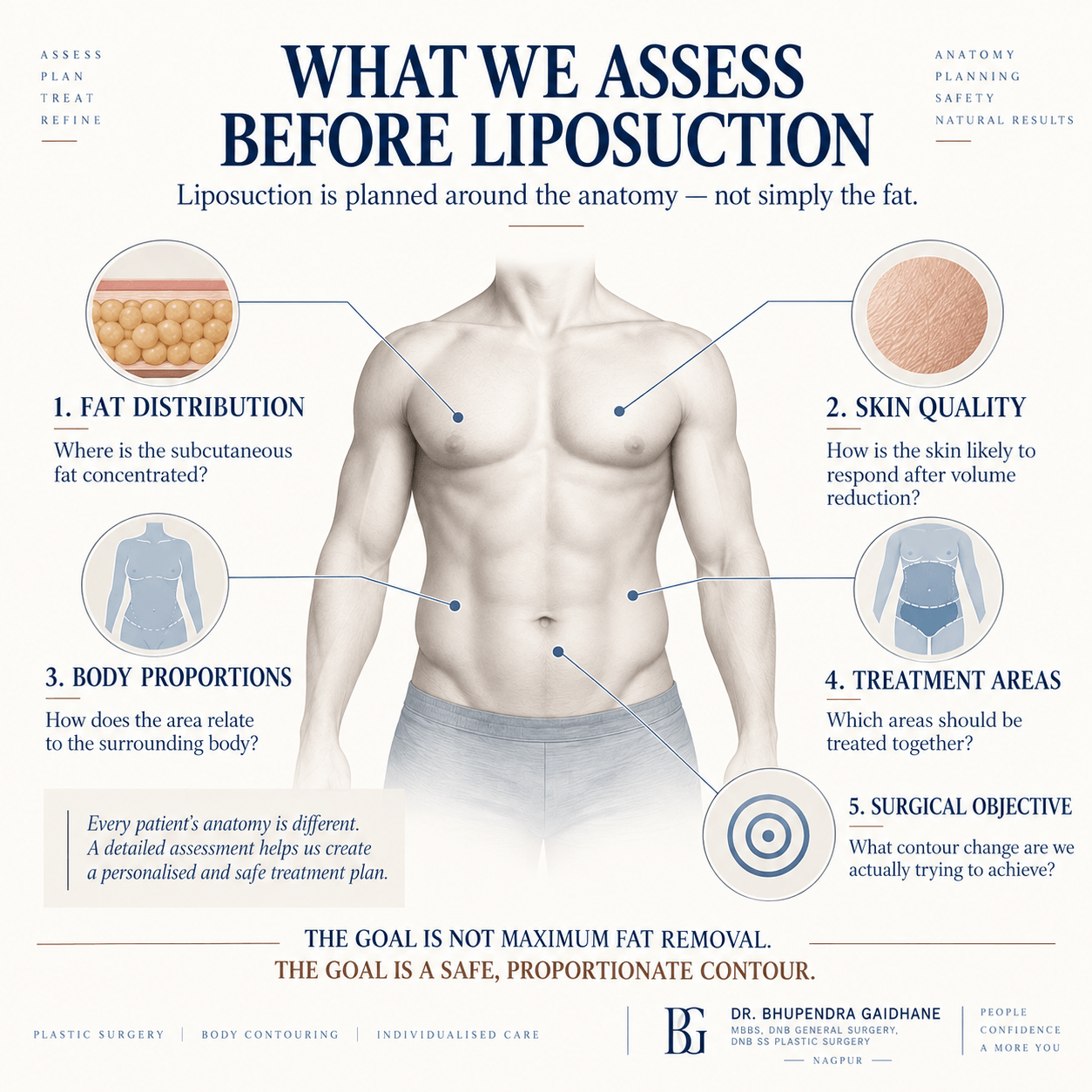
Liposuction is not simply about removing as much fat as possible.
The objective is to improve body contour and proportion while
maintaining a natural relationship between treated and untreated areas.
BEFORE YOU CONSIDER SURGERY
What Is Liposuction Actually Designed to Do?
Liposuction is a body-contouring procedure designed to reduce
localized deposits of subcutaneous fat — the fat
beneath the skin that contributes to visible fullness in areas such
as the abdomen, flanks, back, thighs, arms, chest and under the chin.
It is not primarily a weight-loss procedure. It is most useful when
a person is reasonably healthy, has a relatively stable weight and
has specific areas that remain disproportionate despite appropriate
diet and exercise.
Targets selected subcutaneous fat deposits.
Improves shape, proportion and transitions between areas.
Treatment is based on anatomy, skin quality and goals.
ON THIS PAGE
Liposuction in Nagpur — What You’ll Find Here
THE PROBLEM MANY PATIENTS EXPERIENCE
Why Does This Fat Refuse to Go Away?
You’ve been exercising for years. You’ve changed the way you eat.
You’ve lost weight and become fitter — yet somehow, one area hasn’t moved.
The lower abdomen is still there. The love handles haven’t budged.
The back rolls remain, or the thighs and arms still don’t look the way
the rest of your effort suggests they should.
It can feel unfair. You’ve done the work, but one part of your body
didn’t get the message.
Many people notice the same frustrating pattern: the areas where they
preferentially store fat can be among the last to change with weight loss
— and can become noticeable again when weight is regained.
Losing weight and changing your shape are not the same thing
This is one of the most important things to understand before considering
liposuction.
Diet and exercise reduce overall body fat. They don’t work area by area.
Your body doesn’t take instructions like, “Lose 800 grams from my lower
abdomen, but leave everything else alone.”
Where your body stores and loses fat is influenced by factors including
genetics, hormones, sex and age. That’s why two people with similar
weight, BMI and exercise habits can have very different body contours.
You can be lean, active and disciplined and still have a lower abdominal
pouch, love handles or another localized area of fullness that doesn’t
reflect the rest of your effort.
What’s actually underneath: subcutaneous vs. visceral fat
The fat you can pinch beneath the skin is
subcutaneous fat. This is different from
visceral fat, which lies deeper around the internal organs.
Liposuction targets subcutaneous fat. It does not remove visceral fat
and is not a treatment for obesity or a substitute for managing overall
weight.
Liposuction is not a shortcut around diet and exercise.
It is a way of addressing specific pockets of subcutaneous
fat that remain after you’ve already done the hard work.
Why does this particular area seem to go last — and come back first?
There is no universal rule that one particular body area is always
the last to lose fat or the first to regain it. Fat distribution is individual.
But the areas where your body preferentially stores fat may remain
relatively prominent even after meaningful weight loss. If your weight
increases again, those same areas may become noticeable early.
So the problem isn’t necessarily that your effort failed.
Your body simply does not distribute or mobilize fat evenly.
So what can actually be done?
When someone is reasonably fit, at a relatively stable weight, and has
a persistent pocket of subcutaneous fat that has not responded adequately
to diet and exercise, liposuction can directly remove fat from that area
and improve its contour.
This is why patients choose liposuction — not to avoid exercise and not
primarily to lose weight, but because they want to change a specific
aspect of their body shape:
“I’ve already changed my body. Now I want to change its proportions.”
And that means liposuction is about more than removing fat.
It involves decisions about:
- Where fat should be removed
- How much should be removed
- Which areas should be treated together
- How treated areas transition into surrounding areas
- How the skin is likely to respond
- What proportions will look natural for that individual
Those decisions require surgical judgment. The technology used is
only one part of the equation.
If this sounds like you…
- I exercise regularly, but my abdomen still bothers me.
- I’ve lost weight, but my love handles haven’t gone away.
- When I gain weight, it seems to show up around my waist.
- I’m not trying to lose 10–20 kg. I want to improve a specific area.
- I’m at a weight I’m comfortable with, but my body still doesn’t feel proportionate.
This is the type of localized contour problem liposuction
is designed to address.
SETTING REALISTIC EXPECTATIONS
What Liposuction Can — and Cannot — Do
It can:
- Reduce localized subcutaneous fat
- Improve body proportions
- Create a smoother contour
- Improve transitions between treated areas
- Permanently remove fat cells from treated areas
It cannot:
- Replace overall weight loss
- Remove visceral abdominal fat
- Guarantee a flat abdomen in every patient
- Correct significant loose skin on its own
- Eliminate cellulite
- Prevent future weight gain
The goal is not to remove the maximum amount of fat.
It is to achieve the best contour that can be safely created
for your particular body.
THE SURGEON MATTERS
Why Choose Dr. Bhupendra for Liposuction?
A good liposuction result is not simply about removing fat.
It is about understanding where fat should be removed, where it
should be preserved, and how different areas should transition
into one another.
Body contouring requires three-dimensional planning rather than
treating each area as an isolated pocket of fat.
Individual assessment
Treatment is planned after assessing fat distribution,
skin quality, proportions, symmetry and the patient’s goals.
Three-dimensional planning
The relationship between the abdomen, waist, flanks and back
matters when creating a balanced contour.
Safety-first decisions
The extent of surgery is determined by the individual patient,
not by a predetermined volume target.
Appropriate technology
VASER/Lipovase may be used when its characteristics are
appropriate for the patient’s anatomy and surgical objective.
Realistic goals
The expected improvement, limitations, alternatives and
recovery are discussed before surgery.
Dr. Bhupendra Gaidhane, MBBS, DNB General Surgery,
DNB SS Plastic Surgery
is a plastic surgeon in Nagpur with a clinical practice that includes
aesthetic and reconstructive plastic surgery and body-contouring procedures.
BEFORE SURGERY
What Is Assessed Before Recommending Liposuction?
Good body contouring starts with choosing the right operation,
not with choosing the machine.
Medical history, medications and fitness for surgery.
Weight stability and the distribution of body fat.
Which areas contain fat that can reasonably be addressed.
How well the skin is likely to redrape after fat removal.
How individual areas relate to the rest of the body.
Whether combined treatment creates a more balanced contour.
Whether liposuction alone is appropriate or another procedure is better.
A more detailed discussion of candidacy, contraindications and the
consultation process is available in the dedicated guide.
Learn more: Am I a Good Candidate for Liposuction in Nagpur →
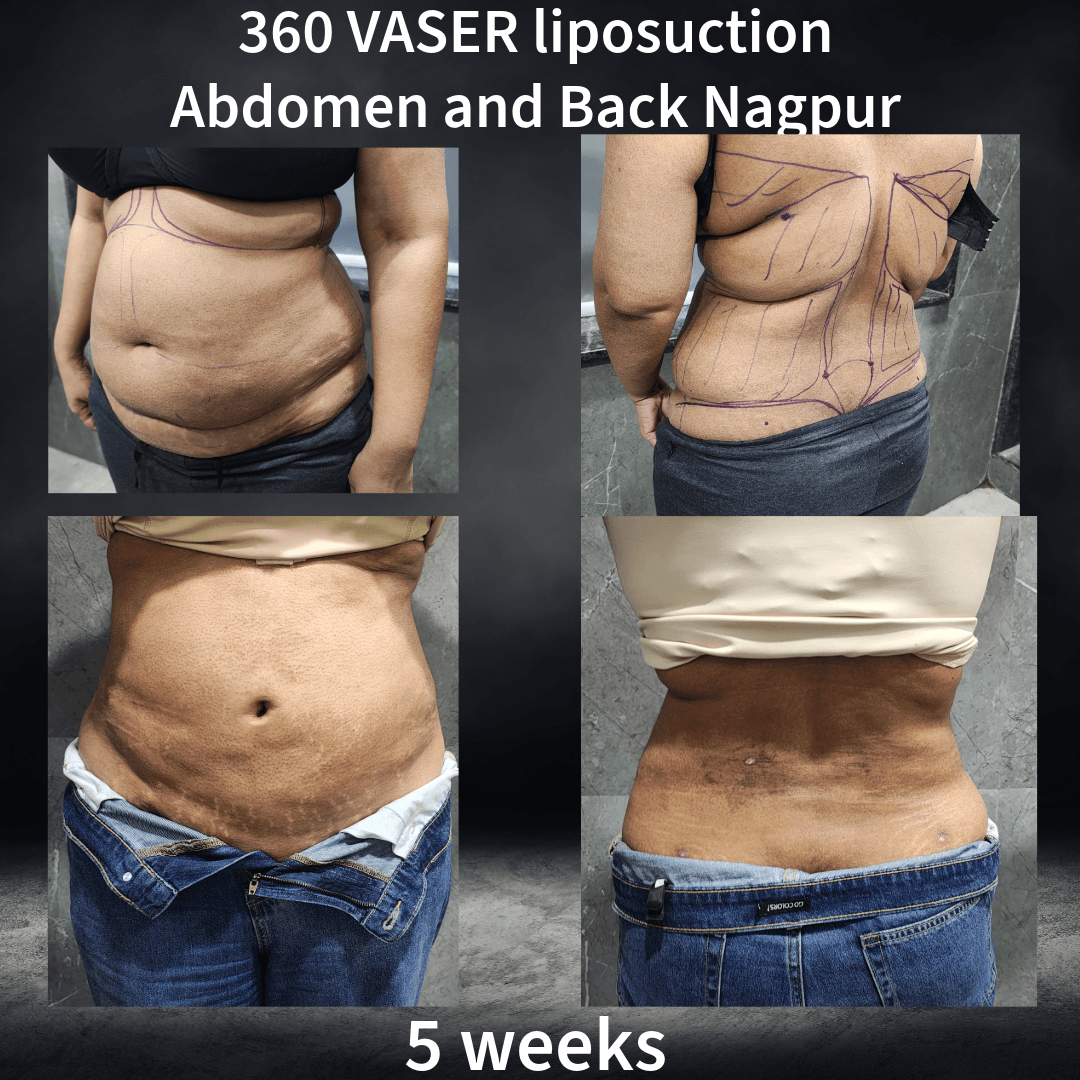
CLINICAL RESULTS
Liposuction Before & After Results
Before-and-after photographs are useful for understanding what
body contouring can achieve, but every result is individual.
Differences in anatomy, skin quality, fat distribution, treatment
areas and healing can affect the outcome.
The purpose of these photographs is to document contour change,
not to suggest that the same result can be reproduced in every patient.
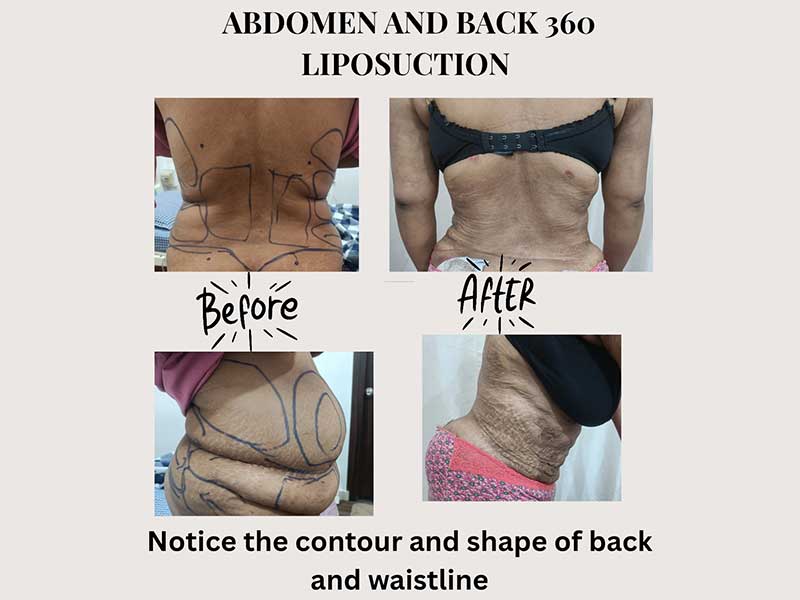
Body Contouring — Torso / Waist
Before-and-after photographs demonstrating change in
abdominal and waist contour following liposuction.

Axillary fullness treated with liposuction. Individual results vary.
Axillary / Underarm Fullness
Selected cases of fat-predominant axillary fullness may
be treated with liposuction after appropriate assessment.
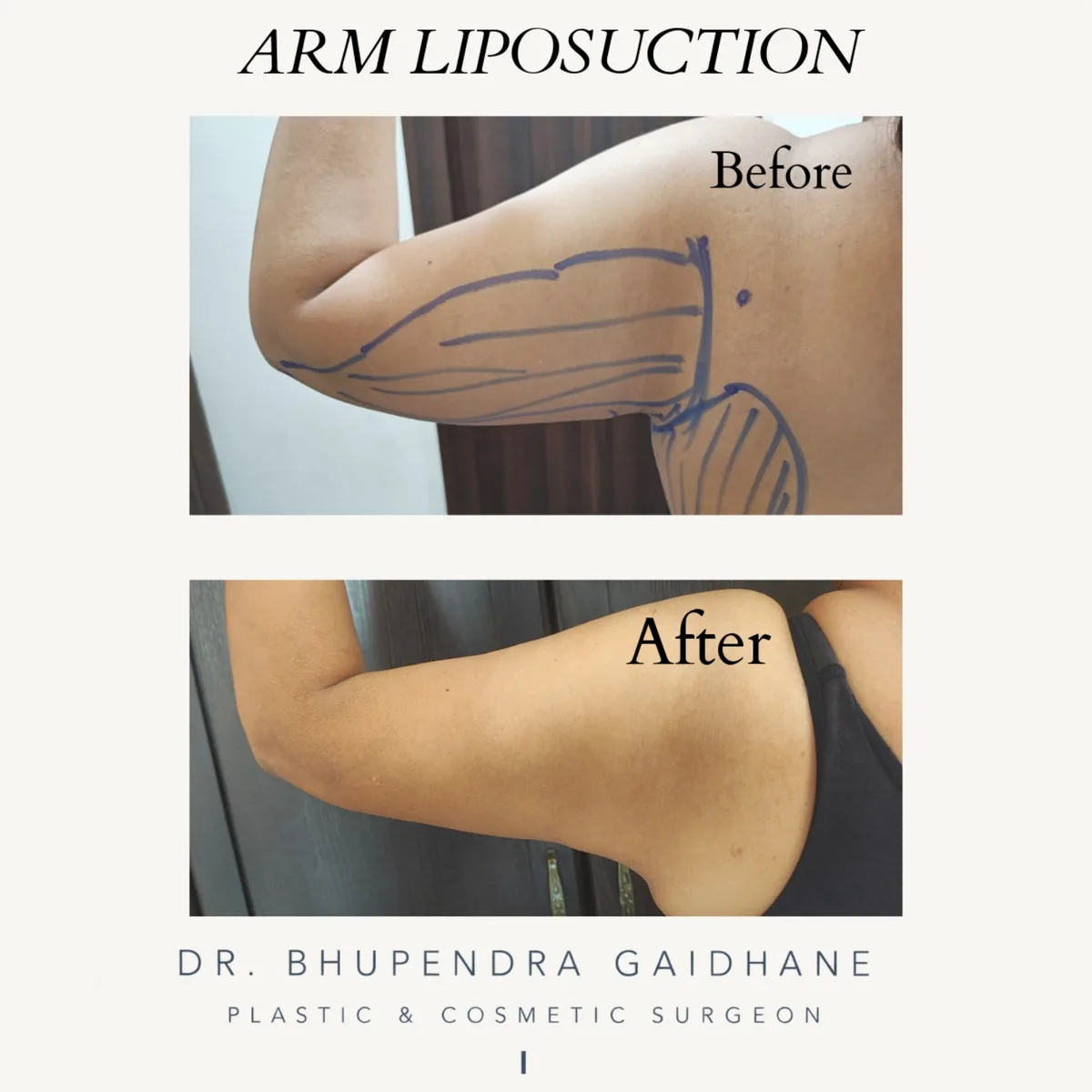
Arm Liposuction — Upper-Arm Contouring
Before-and-after photographs demonstrating change in
upper-arm contour following liposuction. Individual
results vary depending on anatomy, skin quality,
fat distribution and healing.
BEYOND FAT REMOVAL
What Makes a Good Liposuction Result?
A successful result should not simply be judged by how much fat
was removed. It should be judged by how the body looks as a whole.
Contour
The treated area should have a smoother and more defined shape.
Proportion
The treated area should remain balanced with the rest of the body.
Transitions
Changes should flow naturally into neighbouring untreated areas.
Symmetry
Appropriate attention should be given to differences between
the two sides of the body.
Skin response
The quality and elasticity of the skin influence the final contour.
Restraint
Removing more fat is not automatically the same as creating
a better contour.
A successful result should look like a better version of
the patient’s own body — not like every possible gram of
fat has been removed.
VASER / LIPOVASE
How VASER / Lipovase Works
VASER stands for
Vibration Amplification of Sound Energy at Resonance.
It is an ultrasound-assisted liposuction technology.
Unlike conventional suction-assisted liposuction, where the cannula
mechanically disrupts and removes fat, ultrasound-assisted liposuction
adds an energy-assisted step before aspiration.
01
Infiltration
The treatment area is prepared with the appropriate
infiltration solution.
02
Ultrasound-assisted treatment
VASER energy is used within the planned fat layer to
assist fat disruption.
03
Aspiration
The loosened fat is removed through controlled suction.
04
Contour refinement
The surgeon refines the treated areas according to the
planned three-dimensional contour.
The word selective does not mean that the machine
independently decides what to remove. The surgeon determines the
treatment planes, areas, depth and extent of contouring.
VASER is a technology. Its value depends on using it for
the right patient, in the right areas, for the right
surgical objective.
UNDERSTANDING THE TECHNOLOGY
VASER vs. Traditional vs. Laser Liposuction
Patients often encounter several different liposuction technologies
while researching surgery. These techniques share the same broad goal —
removing subcutaneous fat — but use different mechanisms.
| Feature | Traditional Liposuction | Laser Liposuction | VASER / Lipovase |
|---|---|---|---|
| Primary mechanism | Mechanical disruption and suction | Laser energy followed by aspiration | Ultrasound-assisted treatment followed by aspiration |
| Energy-assisted fat treatment | No | Yes | Yes |
| Contour refinement | Depends strongly on surgical technique | Depends on technique and treatment area | May be useful where ultrasound-assisted contouring is appropriate |
| Fibrous / dense areas | Can require greater mechanical effort | Different mechanism | May be useful in selected fibrous areas |
| Skin response | Depends mainly on natural skin retraction | May produce thermal effects | May contribute to tissue retraction in selected patients |
| Cost | Generally lower | Varies | Generally higher because of technology and consumables |
No technique is automatically superior for every patient.
The appropriate approach depends on the anatomy, treatment area,
skin quality, surgical objective and overall treatment plan.
Learn more: VASER vs Traditional Liposuction — a detailed surgeon’s comparison →
IMPORTANT LIMITATIONS
What VASER Cannot Do
VASER does not replace patient selection or surgical judgment.
Using an advanced device does not automatically create a better result.
- It does not replace appropriate patient selection.
- It does not guarantee skin tightening.
- It does not guarantee a particular contour.
- It does not remove visceral abdominal fat.
- It does not replace significant skin excision when excess skin is present.
- It does not turn liposuction into a weight-loss procedure.
VASER may contribute to tissue retraction in appropriately selected
patients, but significant loose or hanging skin may require a
procedure involving skin excision, such as abdominoplasty.
I don’t recommend VASER simply because it is available.
The technique should match the patient’s anatomy and the
surgical objective.
WHO MAY BENEFIT
Who Is a Good Candidate for Liposuction?
Liposuction is generally most useful for people who are reasonably
healthy, have a relatively stable weight, and have localized areas
of subcutaneous fat that remain disproportionate despite diet and exercise.
Stable weight
Significant ongoing weight change can alter the final contour.
Localized fat
The main concern is a specific area rather than a need
for overall weight reduction.
Reasonable skin quality
Skin elasticity influences how well the skin redrapes after
fat removal.
Realistic expectations
The aim is improvement, not a guarantee of a particular
body shape.
Suitable medical fitness
Overall health and medications are assessed before surgery.
A stable weight is helpful because significant future weight changes
can alter the result. However, candidacy is not determined by body
weight or BMI alone.
A patient with a higher body weight may still be appropriate for
selected contouring after individual assessment. Conversely, being
slim does not automatically make someone suitable if skin quality,
fat distribution or the underlying problem is not appropriate for
liposuction.
Candidacy depends on the problem being treated, the patient’s
health and anatomy, and whether the expected benefit justifies
the procedure.
Learn more: Am I a Good Candidate for Liposuction? — detailed assessment →
TREATMENT AREAS
Which Areas Can Be Treated With Liposuction?
Liposuction can be used for localized fat deposits in different
parts of the body. The appropriate combination depends on the
patient’s anatomy and the overall surgical plan.
Multiple areas may sometimes be treated during the same operation
when this is appropriate from both a contouring and safety perspective.
Treating related areas together can be particularly important when
the goal is to improve transitions rather than simply reduce the
volume of one isolated pocket.
CIRCUMFERENTIAL BODY CONTOURING
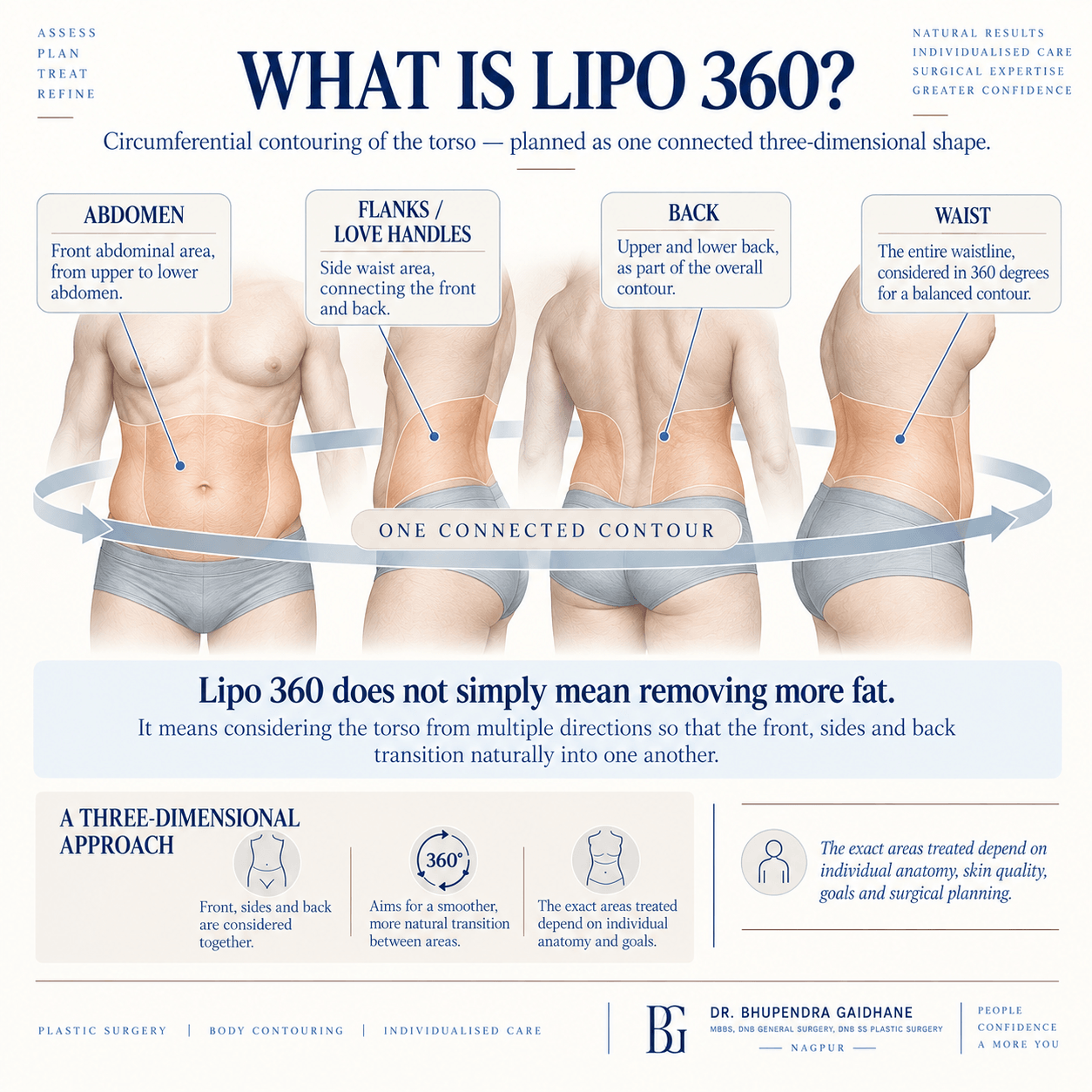
What Is Lipo 360?
Lipo 360 refers to circumferential contouring of the torso rather
than treating only the front of the abdomen.
Depending on the individual plan, this may involve the abdomen,
flanks, waist and back so that the torso is considered as one
connected three-dimensional contour.
Lipo 360 is not simply “more liposuction.”
It is a way of planning the torso as one connected
three-dimensional contour.
AN IMPORTANT DECISION
When Liposuction Is Not the Right Procedure
One of the most important parts of a consultation is deciding
when not to perform liposuction.
- The primary goal is significant overall weight loss.
- The main problem is visceral abdominal fat.
- There is substantial loose or hanging skin.
-
Skin elasticity is unlikely to produce an acceptable
liposuction-only contour. - Expectations are unrealistic or focused on a guaranteed result.
- Another structural problem requires a different procedure.
For some patients, a tummy tuck or another body-contouring procedure
may be more appropriate than liposuction alone. In other situations,
a staged approach may be safer than trying to accomplish everything
in one operation.
The important question is not simply,
“Can fat be removed?”
It is whether liposuction is the right operation for the problem
the patient actually wants corrected.
THE PROCESS
Your Liposuction Journey
01
Consultation
Your concerns, health, anatomy, skin quality and goals
are assessed.
02
Planning
Treatment areas, contour transitions, technique and
surgical extent are planned.
03
Standing marking
The body is assessed and marked before surgery so that
treatment follows the planned three-dimensional contour.
04
Procedure
Fat is treated and removed in a controlled manner using
the selected surgical technique.
05
Recovery
Swelling, bruising, firmness and tissue remodeling
gradually settle over time.
06
Follow-up
Progress is reviewed and postoperative care is adjusted
according to healing.
Good liposuction is a process — not simply the few hours
spent in the operating room.
AFTER SURGERY
What Is Recovery Like After Liposuction?
Recovery varies according to the areas treated, extent of surgery,
individual healing and whether multiple areas were treated together.
Swelling, bruising, soreness, tightness and areas of firmness can
occur during recovery. The body continues to remodel after the
initial postoperative period, so early appearance should not be
mistaken for the final contour.
A useful way to understand this process is to follow a real
week-by-week recovery rather than relying on a single fixed
“recovery time.”
Learn more: 360° VASER Liposuction Recovery Timeline — a real week-by-week healing journey →
COST
What Does Liposuction Cost in Nagpur?
Liposuction cost depends on the treatment areas, extent of surgery,
technique, anaesthesia, facility requirements and the individual
surgical plan.
Rather than placing a single generic price on every patient,
the final surgical plan and package are determined after assessment.
Want the detailed 2026 pricing breakdown?
The dedicated cost guide explains package structure, what is
included, additional charges, treatment-area pricing and how
the final cost is determined.
Learn more: Liposuction Cost in Nagpur — 2026 Pricing Guide →
SAFETY
Is Liposuction Safe?
Liposuction is a surgical procedure and, like any surgery,
has potential risks.
Safety depends on factors including:
- Overall health and medical fitness
- Body composition
- Skin quality
- Number and size of treatment areas
- Planned surgical extent
- Anaesthesia
- Fluid management and blood loss
- Whether other procedures are performed at the same time
Potential complications include bleeding, infection, fluid
collections, temporary or persistent changes in sensation,
contour irregularities, asymmetry, blood clots and
anaesthesia-related complications. Rare serious complications
can also occur.
There is no single volume that is safe for every patient.
The amount of aspirate has to be considered in the context
of the individual patient, the areas being treated, the
overall procedure and the surgical setting.
The objective is meaningful contour improvement while keeping
the procedure appropriate for the individual patient.
When the desired extent of treatment would make a single operation
unnecessarily extensive, a staged approach may be considered.
Safety starts before the first incision — with appropriate
patient selection, planning and surgical judgment.
THE CONSULTATION
What Happens During a Liposuction Consultation?
The consultation is where the treatment is designed —
not where a machine is selected.
What do you want to change?
The consultation starts with understanding what bothers
you and what improvement you are actually seeking.
What does the anatomy show?
Fat distribution, skin quality, proportions and symmetry
are assessed clinically.
Which areas should be treated?
Areas may be planned individually or together depending
on the desired contour.
Is liposuction enough?
If loose skin or another structural issue is present,
another procedure may be more appropriate.
Which technique?
If VASER/Lipovase is appropriate, its role is explained
alongside alternatives.
What should you realistically expect?
Expected improvement, limitations, risks, recovery and
alternatives are discussed before surgery.
TRAVELLING TO NAGPUR
Coming to Nagpur From Another City?
Patients travel to Nagpur from across Vidarbha, Madhya Pradesh,
Chhattisgarh and surrounding regions for body-contouring procedures.
For patients travelling from outside Nagpur, planning the visit
around consultation, surgery and the first postoperative review
can make the process considerably easier.
Preliminary discussion and photograph review may be possible
for selected outstation patients.
Final clinical assessment and surgical planning are completed
in person.
The initial postoperative review helps assess healing and
readiness for travel.
Appropriate follow-up can often be supported remotely,
with in-person review when clinically required.
Learn more: Travelling to Nagpur for Plastic Surgery — Outstation Patient Guide →
COMMON QUESTIONS
Frequently Asked Questions About Liposuction in Nagpur
Is liposuction a weight-loss procedure?
No. Liposuction is a body-contouring procedure designed to
reduce localized subcutaneous fat. It is not a substitute
for overall weight management.
How much fat can be safely removed during liposuction?
There is no single volume that is safe for every patient.
The appropriate amount depends on health, body composition,
treatment areas, surgical extent, fluid management and the
surgical setting.
Is VASER better than traditional liposuction?
Not automatically. VASER adds ultrasound-assisted treatment
before aspiration and may be useful for selected contouring
situations. The appropriate technique depends on anatomy,
skin quality and the surgical objective.
Does VASER tighten loose skin?
VASER may contribute to tissue retraction in selected patients,
but it does not guarantee skin tightening. Significant excess
or hanging skin may require a procedure involving skin excision.
What areas can be treated with liposuction?
Common areas include the abdomen, flanks, waist, back, arms,
thighs, hips, chest, axillary fullness and under the chin.
The appropriate areas are determined during assessment.
Can multiple areas be treated in one session?
Multiple areas can sometimes be treated during the same
operation when the overall plan is appropriate and the extent
of surgery remains suitable for the patient.
What is Lipo 360?
Lipo 360 refers to circumferential torso contouring, which may
involve the abdomen, flanks, waist and back rather than treating
only the front of the abdomen.
Does liposuction remove visceral fat?
No. Liposuction targets subcutaneous fat beneath the skin.
Visceral fat lies deeper around the internal organs and is not
removed by liposuction.
Will the fat come back after liposuction?
Fat cells removed from the treated area are permanently removed.
However, remaining fat cells can enlarge with significant weight
gain, which can alter the overall result.
Can liposuction remove loose skin?
No. Liposuction removes fat, not excess skin. Patients with
significant skin laxity may need a procedure involving skin
excision instead of, or in addition to, liposuction.
How long does recovery take after liposuction?
Recovery varies according to the areas treated and the extent
of surgery. Swelling, bruising, soreness and firmness can persist
for weeks, while the final contour continues to refine over time.
What does liposuction cost in Nagpur?
Cost depends on the treatment areas, extent of surgery,
technique, anaesthesia and facility requirements.
Am I a good candidate for liposuction?
Candidacy depends on your health, weight stability, fat
distribution, skin quality, expectations and the problem
you want to correct.
Can patients from outside Nagpur undergo liposuction here?
Yes. Patients from surrounding cities and regions can plan
consultation, surgery and early postoperative review in Nagpur.
The exact schedule depends on the procedure and recovery.
CONTINUE READING
Learn More Before You Decide
Liposuction is a surgical decision, and the more specific your
questions are, the more useful your consultation can be. These
detailed guides cover the questions patients most commonly ask
before deciding whether and how to proceed.
Am I a Good Candidate for Liposuction?
Understand candidacy, skin quality, localized fat,
expectations and when liposuction may not be appropriate.
Read the guide →
Liposuction Cost in Nagpur
Detailed 2026 pricing, package structure, treatment areas
and what is included.
Read the cost guide →
VASER vs Traditional Liposuction
Understand the practical differences between ultrasound-assisted
and conventional suction-assisted techniques.
Read the comparison →
360° VASER Recovery Timeline
Follow a real week-by-week recovery journey and understand
why swelling and contour continue to change after surgery.
Read the recovery guide →
Travelling to Nagpur for Surgery
A practical guide for patients travelling from Vidarbha,
Madhya Pradesh, Chhattisgarh and surrounding regions.
Read the patient guide →
YOUR NEXT STEP
Is Liposuction Right for You?
The answer cannot be determined from a photograph, a machine,
a price list or a generic BMI cutoff alone.
A proper consultation looks at your fat distribution, skin quality,
proportions, health, goals and the extent of change you are seeking.
From there, the appropriate procedure and technique can be discussed.
If liposuction is appropriate, the aim is to create meaningful
improvement while keeping the operation proportionate to your anatomy
and maintaining safety as the first priority.
Dr. Bhupendra Gaidhane, MBBS, DNB General Surgery,
DNB SS Plastic Surgery
Plastic Surgeon · Nagpur