
Quick Answer
Axillary breast tissue (also called accessory breast tissue) is extra breast tissue that develops in the underarm region. Unlike ordinary fat, it may become more noticeable during puberty, pregnancy, breastfeeding, or hormonal changes and often does not disappear completely with weight loss. Treatment depends on the tissue composition and may involve liposuction, surgical excision, or a combination of both techniques.
Key Takeaways
- Axillary breast tissue is a developmental condition, not simply excess fat.
- It most commonly appears as fullness or a bulge in the underarm area.
- The tissue may enlarge with hormonal changes, pregnancy, or weight fluctuations.
- Weight loss may reduce the fatty component but usually cannot remove true glandular tissue.
- Treatment may involve liposuction, excision, or a combination approach.
- Most procedures are performed as day-care surgery with a relatively quick recovery.
-
Feature Axillary Breast Tissue Underarm Fat Cause Accessory breast tissue Excess fat deposits May enlarge during hormonal changes Yes Usually no Responds completely to weight loss Often no Usually improves Can contain gland tissue Yes No Treatment Liposuction, excision, or both Weight loss or liposuction
Introduction
Many women notice a persistent bulge or fullness near the underarm and assume it is simply excess fat. They try weight loss, exercise, or different clothing styles, yet the area remains unchanged.
In many cases, the cause is not ordinary fat at all. It may be axillary breast tissue, also known as accessory breast tissue, a developmental condition in which breast tissue develops in the underarm region.
Although usually harmless, axillary breast tissue can become more noticeable during puberty, pregnancy, breastfeeding, or weight changes. Some women experience discomfort, swelling before periods, difficulty wearing fitted clothing, or self-consciousness about the appearance of the underarm area.
Fortunately, axillary breast tissue can be evaluated accurately and treated surgically when appropriate. Depending on the type of tissue present, treatment may involve liposuction, surgical excision, or a combination of both techniques.
This guide explains everything you need to know about axillary breast tissue removal, including causes, symptoms, treatment options, recovery, scarring, cost, and what to expect from surgery in Nagpur.
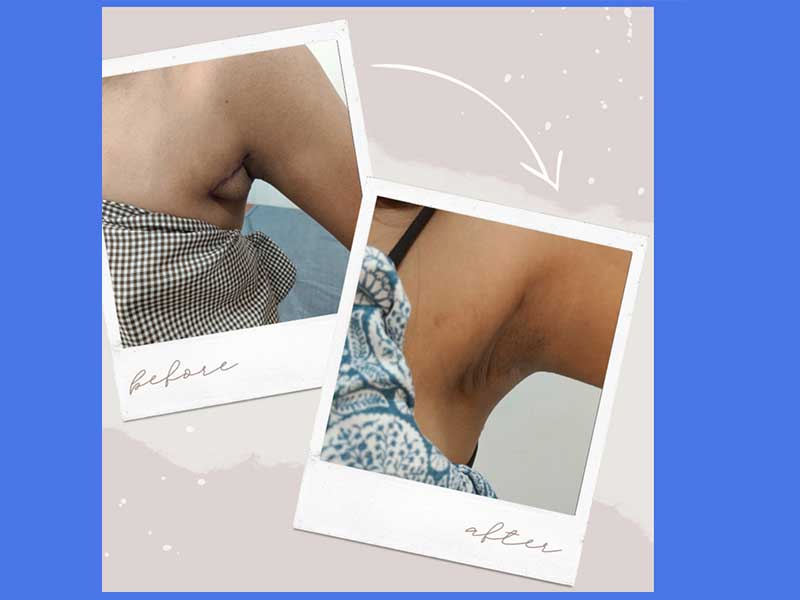
Who Should Consider Treatment?
A consultation may be helpful if:
- The underarm bulge persists despite weight loss.
- Clothing, bras, or sleeveless outfits become uncomfortable.
- There is cyclical swelling or tenderness.
- The fullness causes cosmetic concerns.
- You are unsure whether the lump is fat, breast tissue, or another condition.
Living With Axillary Breast Tissue: A Common Patient Experience
Many women live with axillary breast tissue for years before seeking medical advice.
The fullness may first become noticeable during the teenage years and gradually enlarge over time. Others first notice it during pregnancy or breastfeeding, when hormonal changes stimulate the tissue and make it more prominent.
Some patients feel uncomfortable wearing sleeveless clothing, fitted dresses, gym wear, or swimwear because the fullness becomes visible from certain angles. Others experience rubbing, irritation, tenderness, or cyclical swelling before their menstrual periods.
By the time they attend a consultation, many patients have already attempted weight loss and exercise without significant improvement. Understanding that axillary breast tissue is a recognised medical condition—not simply excess fat—is often reassuring.
While not every patient requires treatment, understanding the diagnosis is often the first step toward deciding whether surgery is appropriate.
What Is Axillary Breast Tissue?
Axillary breast tissue, also called accessory breast tissue or polymastia, refers to breast tissue that develops outside the normal breast area, most commonly in the underarm (axilla).
Accessory breast tissue most commonly occurs in the axillary region, which is why terms such as axillary breast tissue, underarm breast tissue, and accessory breast tissue are often used interchangeably.
During early fetal development, breast tissue forms along two vertical lines called the milk lines, which extend from the armpits down to the groin. Normally, all breast tissue along these lines disappears before birth except for the tissue that forms the breasts. In some individuals, small amounts of tissue remain, most commonly in the underarm region.
This is not a disease. It is a developmental variation. However, because this tissue behaves like normal breast tissue, it can enlarge with hormonal changes, pregnancy, breastfeeding, or weight gain and may occasionally cause discomfort.
Published studies suggest accessory breast tissue occurs in approximately 2% to 6% of women, although many cases go undiagnosed because patients assume the fullness is simply excess fat.
The most common presentation is a soft bulge or fullness in the underarm that becomes more noticeable during the menstrual cycle, after weight gain, or during pregnancy. Some patients may also have a small nipple or areola within the area, although many cases consist of breast tissue alone.

Types of Axillary Breast Tissue
Not all underarm fullness is the same. Some patients have predominantly fatty tissue, while others have true glandular breast tissue or a combination of both. Understanding the type of tissue present is important because it directly influences treatment planning and the surgical technique required.
Predominantly Fatty Axillary Tissue
Some patients have fullness in the underarm region that consists mainly of fatty tissue with little or no glandular breast tissue. This type often becomes more noticeable with weight gain and may partially reduce with weight loss.
Because the tissue is largely fatty, these patients are often good candidates for liposuction-assisted removal, which can improve contour through very small access incisions.
True Glandular Axillary Breast Tissue
True accessory breast tissue contains glandular breast tissue similar to that found within the normal breast.
This tissue is usually firmer than ordinary fat and often does not respond to weight loss. Many women notice swelling, tenderness, or enlargement before their menstrual cycle, during pregnancy, or while breastfeeding.
When significant glandular tissue is present, surgical excision is usually required for complete removal.
Mixed Fatty and Glandular Tissue
The most common presentation is a combination of both fatty tissue and glandular breast tissue.
In these situations, treatment often involves a combination of liposuction and direct excision to achieve smooth contouring while removing the glandular component effectively.
Accessory Nipple or Areola
Some individuals have a small nipple or areola associated with the accessory breast tissue. This is known as polythelia or a supernumerary nipple.
Although uncommon, its presence may influence surgical planning and incision placement.
Want to see what the results can look like?
Explore our [Axillary Breast Before & After Results in Nagpur] to see examples of patients treated for axillary breast fullness, including cases managed with liposuction.
Axillary Breast Tissue vs Underarm Fat vs Lipoma
Many patients are unsure whether the fullness they notice near the underarm represents accessory breast tissue, ordinary fat, or a lipoma. Although these conditions may appear similar, they behave differently and require different treatment approaches.
| Feature | Axillary Breast Tissue | Underarm Fat | Lipoma |
|---|---|---|---|
| Contains breast tissue | Yes | No | No |
| Responds to hormones | Yes | No | No |
| Swells before periods | Common | No | No |
| May enlarge during pregnancy | Yes | No | No |
| Improves with weight loss | Partial | Often | Minimal |
| Usually feels | Diffuse fullness | Soft fat deposit | Localized lump |
| Typical treatment | Liposuction, Excision, or Both | Liposuction if desired | Surgical removal |
While this table provides a general guide, clinical examination and sometimes ultrasound imaging are often required to determine the exact diagnosis.
Why Does Axillary Breast Tissue Develop?
One of the most common questions patients ask is, “Why did this happen to me?”
The reassuring answer is that axillary breast tissue is a developmental condition rather than something caused by lifestyle choices.
It Develops Before Birth
During fetal development, breast tissue forms along structures known as the milk lines, which extend from the armpits to the groin.
Normally, this tissue disappears everywhere except the chest. In some individuals, small remnants remain, most commonly within the underarm region.
Although present from birth, the tissue often becomes noticeable only later in life.
Hormonal Changes Can Make It More Prominent
Puberty, pregnancy, breastfeeding, and menstrual hormonal fluctuations can all stimulate accessory breast tissue.
This explains why many women first notice underarm fullness during adolescence or pregnancy.
Family History May Play a Role
Studies suggest a genetic tendency in some families. Patients occasionally report similar findings in their mother, sister, or other close relatives.
Weight Gain Can Increase Size
Although weight gain does not cause accessory breast tissue to develop, it can enlarge the fatty component and make the fullness more noticeable.
Weight loss may improve the appearance in some patients but rarely eliminates true glandular tissue completely.
Is Axillary Breast Tissue Dangerous?
In the vast majority of patients, axillary breast tissue is a benign condition and does not pose a serious health risk.
However, because accessory breast tissue behaves similarly to normal breast tissue, it can develop the same benign and malignant conditions that occur within the breast.
Examples include:
- Fibroadenoma
- Breast cysts
- Fibrocystic changes
- Rarely, breast cancer arising within accessory breast tissue
For this reason, any new lump, sudden increase in size, persistent pain, skin changes, nipple discharge, or unusual symptoms should be evaluated by a qualified doctor.
Most patients never experience these problems, but awareness and timely evaluation are important.
When Does Axillary Breast Tissue Need Treatment?
Not every patient with axillary breast tissue requires surgery.
If the tissue is small, stable, and not causing physical or cosmetic concerns, observation may be entirely reasonable.
However, many patients seek treatment because the condition affects comfort, clothing choices, confidence, or quality of life.
Treatment may be worth considering when:
- The underarm bulge is visible through clothing
- The area becomes swollen or tender before menstrual periods
- The tissue enlarged during pregnancy and did not reduce afterward
- There is friction, rubbing, or discomfort during daily activities
- The fullness affects confidence in sleeveless clothing, swimwear, or fitted outfits
- A new lump or change in the area requires evaluation
- The patient wants a permanent solution rather than ongoing concealment
The decision to proceed with treatment is highly personal. While the condition is usually harmless, many patients feel relieved after finally addressing a concern they may have lived with for years.
Why Patients Choose Axillary Breast Removal in Nagpur
Choosing treatment for axillary breast tissue is not only about removing a visible bulge. Patients want an accurate diagnosis, an appropriate treatment plan, and realistic expectations regarding recovery and scarring.
Accurate Diagnosis Before Treatment
Not every underarm swelling represents accessory breast tissue.
Conditions such as lipomas, enlarged lymph nodes, cysts, and simple fatty deposits can sometimes appear similar. A thorough clinical examination and, when necessary, ultrasound imaging help establish the correct diagnosis before treatment planning begins.
Treatment Tailored to Tissue Type
Successful treatment depends on understanding whether the tissue is predominantly fatty, glandular, or mixed.
A patient with mostly fatty tissue may benefit from liposuction-assisted contouring, while significant glandular tissue often requires surgical excision. Many patients achieve the best outcome through a combination approach.
Advanced Liposuction-Assisted Techniques
For suitable patients, Lipovase (4th Generation VASER Technology) can assist in removing fatty tissue while helping create smoother contour transitions around the underarm region.
The goal is not simply volume reduction but achieving a natural contour that blends smoothly with the surrounding area.

Clear Recovery Guidance
Patients are often concerned about downtime, scarring, and returning to normal activities.
A detailed discussion regarding recovery, compression garments, scar care, activity restrictions, and expected timelines helps patients understand exactly what to expect before making a decision.
Treatment Options for Axillary Breast Tissue Removal
Currently, surgery remains the only reliable treatment for permanently removing axillary breast tissue.
The most appropriate technique depends on the amount of fatty tissue, glandular tissue, skin excess, and overall anatomy.
Liposuction-Assisted Removal
Liposuction is most effective when the underarm fullness consists primarily of fatty tissue.
Using small access points, excess fat can be removed while improving contour and minimizing visible scarring.
Benefits may include:
- Small incisions
- Improved contour
- Minimal visible scars
- Faster recovery
- Day-care surgery in most cases
However, liposuction alone cannot reliably remove dense glandular breast tissue.
Surgical Excision
When significant glandular tissue is present, direct excision is often required.
Through a carefully placed incision, the glandular tissue can be removed more completely than would be possible with liposuction alone.
Excision may also be required when:
- The tissue is firm and glandular
- An accessory nipple or areola is present
- Histopathological examination is required
- Significant skin excess exists
Combination Liposuction and Excision
In clinical practice, many patients have a mixture of fatty and glandular tissue.
A combination approach often provides the most balanced result by removing the glandular component while simultaneously contouring the surrounding fatty tissue.
This allows smoother transitions and more natural overall contours.
What Happens During Axillary Breast Removal Surgery?
The exact procedure varies depending on the type and extent of tissue present.
After anaesthesia is administered, the treatment area is carefully marked and prepared.
If liposuction is planned, small access points are created through which specialized cannulas remove excess fatty tissue.
When glandular tissue is present, a carefully positioned incision allows direct removal of the accessory breast tissue.
In many patients, both techniques are combined to optimize contour and tissue removal.
The procedure is typically completed as a day-care surgery, allowing patients to return home the same day.
Removed tissue may be sent for histopathological examination when appropriate.
Anaesthesia for Axillary Breast Removal
The choice of anaesthesia depends on the amount of tissue being treated and the complexity of the procedure.
Options may include:
Local Anaesthesia With Sedation
Suitable for selected patients with smaller areas requiring treatment.
General Anaesthesia
Often preferred for:
- Bilateral procedures
- Larger tissue volumes
- Combined liposuction and excision
- Patients who prefer maximum comfort
During consultation, the most appropriate anaesthesia option is discussed based on the planned procedure and individual patient factors.
Recovery After Axillary Breast Tissue Removal
Most patients are pleasantly surprised by how manageable recovery is after axillary breast tissue removal.
Although the underarm is a sensitive area, the surgery is generally well tolerated, and most patients return to routine daily activities relatively quickly.
Recovery varies depending on the amount of tissue removed, whether liposuction, excision, or both techniques were used, and individual healing characteristics.
Typical Recovery Timeline
Day 1–3
- Mild soreness, tightness, and swelling
- Arm movement is possible but should be gentle
- Compression garment or dressing is usually worn
- Most patients can perform light household activities
Week 1
- Swelling and bruising begin to improve
- Most patients return to desk-based work
- Daily activities become more comfortable
- Follow-up visits are usually scheduled during this period
Weeks 2–4
- Significant reduction in swelling
- Improved contour becomes noticeable
- Most routine activities can be resumed
- Gradual increase in arm movement and exercise may be permitted
Weeks 4–6
- Continued softening of the treated area
- Most patients return to full daily activities
- Exercise restrictions are usually lifted gradually
Months 2–3
- Final contour becomes more apparent
- Residual swelling continues to settle
- Scars begin to mature and fade
Individual recovery varies, and patients are provided with personalized instructions following surgery.
Will There Be a Scar?
Scarring is one of the most common concerns patients have when considering axillary breast tissue removal.
The visibility of the scar depends largely on the surgical technique required.
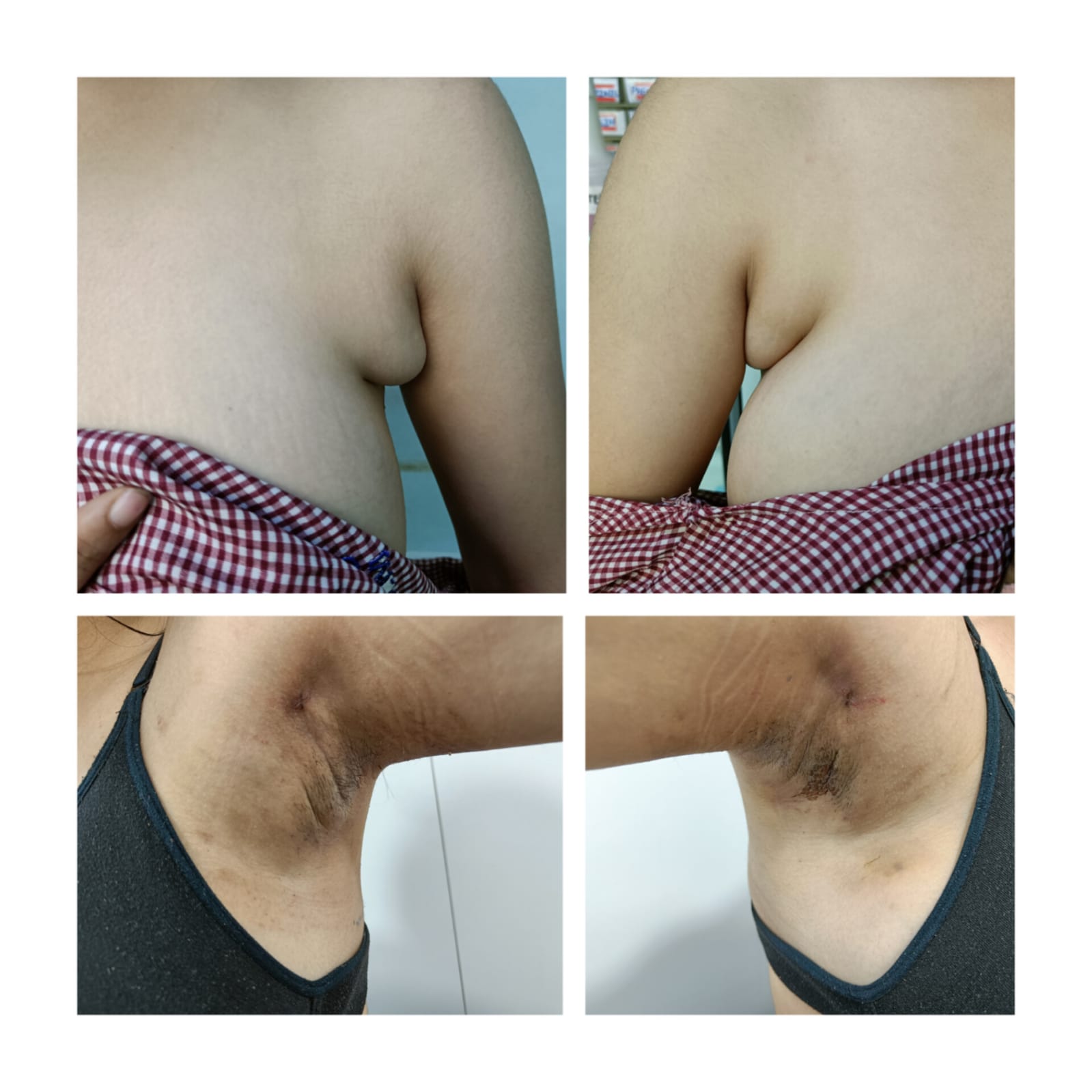
Liposuction-Assisted Removal
When treatment is performed primarily with liposuction, the access incisions are typically only a few millimetres long.
These small incisions are usually placed within natural skin creases and often become difficult to identify once fully healed.
Surgical Excision
When glandular tissue requires removal, a longer incision may be necessary.
Every effort is made to position the incision within the natural folds of the underarm to help camouflage the scar.
How Long Does Scar Maturation Take?
All scars undergo a maturation process.
Most scars appear:
- Pink or slightly raised initially
- Softer and flatter over time
- Less noticeable over several months
Scar maturation typically continues for 6 to 12 months after surgery.
Most patients find the scar significantly less noticeable than they anticipated before surgery.
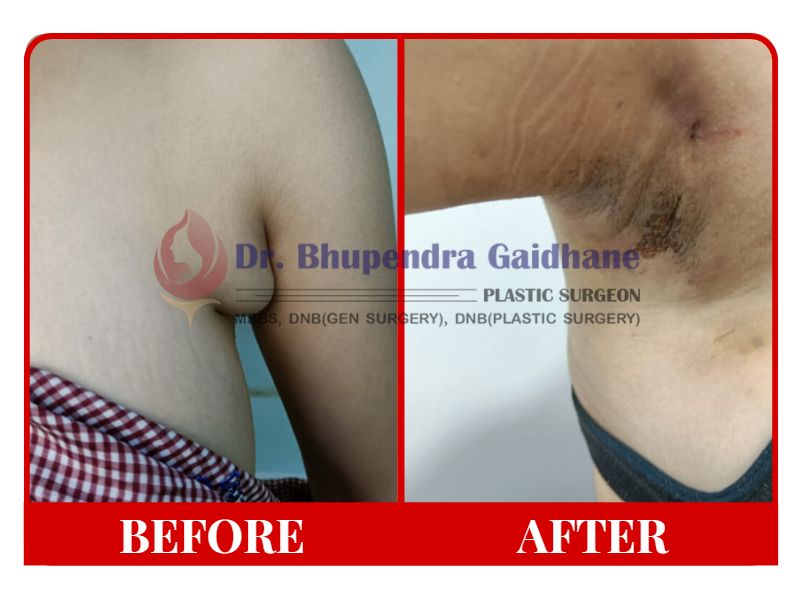
Before and After Expectations
The goal of surgery is to improve contour, reduce fullness, and create a smoother transition between the underarm and surrounding tissues.
Patients often notice:
- Reduced underarm bulging
- Improved clothing fit
- Better contour in sleeveless garments
- Reduced discomfort from rubbing or chafing
- Increased confidence in clothing choices
It is important to understand that every patient has unique anatomy and healing characteristics.
Final results depend on factors such as:
- Tissue composition
- Skin quality
- Amount of tissue removed
- Individual healing response
The objective is improvement rather than perfection, with treatment tailored to each patient’s anatomy and goals.
Axillary Breast Tissue During Pregnancy and Breastfeeding
Many women first notice accessory breast tissue during pregnancy.
Because this tissue responds to hormones in the same way as normal breast tissue, it may enlarge significantly during pregnancy and breastfeeding.
Common changes include:
- Increased fullness
- Tenderness
- Swelling
- Milk production within the accessory tissue
These changes can sometimes cause anxiety, particularly when the enlargement appears suddenly.
In most situations, surgery is postponed until after pregnancy and breastfeeding have been completed.
Following breastfeeding, the tissue may reduce in size but often does not return completely to its original appearance.
Patients considering future pregnancies should discuss timing during consultation so that treatment planning can be individualized appropriately.
Cost of Axillary Breast Tissue Removal Surgery in Nagpur
One of the most common questions patients ask is how much axillary breast tissue removal surgery costs.
There is no single fixed price because treatment requirements vary significantly from one patient to another.
Several factors influence the overall cost:
- Whether treatment is required on one side or both sides
- Size of the tissue
- Fatty versus glandular composition
- Need for liposuction, excision, or both
- Type of anaesthesia used
- Facility and operating room requirements
- Histopathological examination of removed tissue
For this reason, a meaningful cost estimate can only be provided after clinical evaluation and treatment planning.
During consultation, the diagnosis, treatment options, expected recovery, and associated costs are discussed in detail so that patients can make an informed decision.
Dr. Bhupendra Gaidhane’s Approach to Axillary Breast Tissue Removal
Successful treatment begins with an accurate diagnosis.
Not every underarm fullness represents accessory breast tissue, which is why careful clinical evaluation is the first step before recommending treatment.
The goals of surgery include:
- Confirming the diagnosis
- Selecting the most appropriate technique
- Achieving smooth, natural contours
- Minimizing visible scarring
- Providing realistic expectations regarding recovery
Treatment is individualized because no two patients present with exactly the same anatomy or tissue composition.
Whether treatment involves liposuction, excision, or a combination approach, the objective is to address the patient’s concerns while preserving a natural appearance.
Related Plastic Surgery Procedures in Nagpur
Patients researching axillary breast tissue removal may also be interested in:
• Liposuction in Nagpur – Learn about Lipovase 4th Generation VASER-assisted body contouring and fat reduction procedures.
• Lipoma Removal Surgery – Treatment options for benign fatty lumps that can sometimes be confused with axillary breast tissue.
• Gynecomastia Surgery – Male breast reduction surgery for enlarged male chest tissue.
• Breast Implant Surgery – Breast enhancement procedures designed to improve breast volume and shape.
• Breast Lift Surgery – Treatment for breast sagging that may occur after pregnancy, breastfeeding, ageing, or significant weight loss.
Frequently Asked Questions About Axillary Breast Tissue Removal
What is axillary breast tissue?
Axillary breast tissue, also known as accessory breast tissue, is breast tissue that develops outside the normal breast area, most commonly in the underarm (axilla). It is a developmental condition that occurs before birth and may become more noticeable during puberty, pregnancy, or hormonal changes.
Is axillary breast tissue normal?
Yes. Although not everyone develops accessory breast tissue, it is a recognised developmental variation. Studies suggest it occurs in approximately 2% to 6% of women and occasionally in men.
Is axillary breast tissue the same as underarm fat?
No. Ordinary underarm fat contains only fat cells, whereas axillary breast tissue contains breast tissue that can respond to hormonal changes.
This is why accessory breast tissue may enlarge during pregnancy, breastfeeding, or before menstrual periods, while ordinary fat does not.
How can I tell if I have axillary breast tissue or a lipoma?
A lipoma is usually a soft, localized lump composed of fat cells. Axillary breast tissue often presents as a broader area of fullness and may change in size with hormonal fluctuations.
A clinical examination and, when necessary, ultrasound imaging help establish the correct diagnosis.
Does axillary breast tissue get bigger during pregnancy?
Yes. Because accessory breast tissue behaves similarly to normal breast tissue, it often enlarges during pregnancy and breastfeeding.
Some women also experience tenderness, swelling, or milk production within the accessory tissue.
Can axillary breast tissue produce milk?
Yes. If glandular breast tissue is present, the accessory tissue may produce milk during breastfeeding.
Although uncommon, this is a recognised feature of true accessory breast tissue.
Can exercise remove axillary breast tissue?
Exercise may reduce overall body fat and improve fitness, but it does not remove glandular breast tissue.
Patients with true accessory breast tissue generally require surgery if they wish to remove it permanently.
Can weight loss eliminate axillary breast tissue?
Weight loss may reduce the fatty component of underarm fullness, but glandular breast tissue usually remains.
This is why many patients notice little improvement despite successful weight loss.
Is surgery the only permanent treatment?
Currently, surgery is the only reliable method for permanently removing accessory breast tissue.
Depending on the tissue composition, treatment may involve liposuction, surgical excision, or a combination of both.
Is axillary breast tissue removal painful?
The procedure is performed under appropriate anaesthesia, so patients do not feel pain during surgery.
After surgery, mild soreness, tightness, and swelling are expected but are usually manageable with prescribed medications.
How long does axillary breast tissue removal surgery take?
The duration depends on the amount of tissue being treated and the surgical technique used.
Most procedures are completed within one to two hours.
Is axillary breast tissue removal a day-care procedure?
In most cases, yes.
Patients are usually discharged on the same day once they are comfortable and medically stable.
When can I return to work after surgery?
Many patients return to desk-based work within a few days to one week.
More physically demanding activities may require additional recovery time.
When can I exercise after axillary breast surgery?
Light activities can usually be resumed early in recovery.
More strenuous exercise, weight training, and upper-body workouts are generally postponed for several weeks depending on healing progress.
Will the tissue come back after surgery?
Recurrence is uncommon when the glandular tissue has been adequately removed.
However, significant weight gain may enlarge any remaining fatty tissue, and future hormonal changes can influence surrounding tissues.
Is axillary breast tissue cancerous?
Most cases are completely benign.
However, because accessory breast tissue behaves like normal breast tissue, it can rarely develop benign or malignant breast conditions.
Any new lump, rapid enlargement, or unusual change should be evaluated promptly.
Can axillary breast tissue become breast cancer?
Although rare, breast cancer can develop within accessory breast tissue.
This is one reason why persistent lumps or new changes in the area should not be ignored.
Can men develop axillary breast tissue?
Yes.
Although it is more commonly diagnosed in women, men can also develop accessory breast tissue in the underarm region.
Is axillary breast tissue removal covered by insurance?
Insurance coverage varies depending on the policy, symptoms, medical necessity, and insurer requirements.
Patients should check directly with their insurance provider for specific coverage details.
What doctor should I consult for axillary breast tissue?
A board-certified plastic surgeon is often consulted when surgical treatment is being considered.
Depending on the situation, evaluation may also involve breast specialists or general surgeons.
What is the best treatment for axillary breast tissue?
There is no single treatment that is best for every patient.
The ideal approach depends on:
- Tissue composition
- Size of the swelling
- Presence of glandular tissue
- Skin quality
- Cosmetic goals
Treatment may involve liposuction, surgical excision, or a combination of both techniques.
Schedule a Consultation for Axillary Breast Tissue Removal in Nagpur
If you have persistent fullness, swelling, or a lump in the underarm region and would like a professional evaluation, a consultation can help determine whether the cause is accessory breast tissue, a lipoma, a fatty deposit, or another condition.
During your consultation, we will:
- Assess the nature of the tissue
- Discuss whether imaging is required
- Explain treatment options
- Review expected recovery and scarring
- Answer your questions in detail
Dr. Bhupendra Gaidhane
Plastic & Cosmetic Surgeon
Prime Polyclinic, Cabin No. 3, First Floor
Diamond One Building, Dhantoli, Nagpur
📞 9960961451