
Abdominoplasty (Tummy Tuck) in Nagpur
When your abdomen doesn’t return to its earlier shape after pregnancy or weight loss
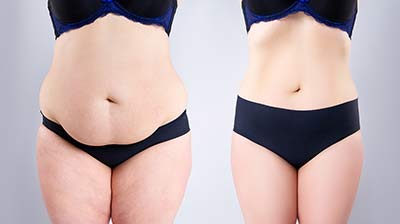
You may have lost the weight after pregnancy. You may have returned to the gym, started exercising regularly and worked hard to regain your fitness. Yet, when you look at your abdomen, something still feels different.
There may be a pouch in the lower abdomen that refuses to go away. The skin may hang over your waistband. Your stomach may look prominent even when you are not carrying much excess weight. Sometimes, the skin feels loose and empty; at other times, the entire abdominal area seems to bulge forward.
For some women, finding clothes that fit comfortably becomes difficult. Others feel conscious about their abdomen in fitted clothes or while swimming. Some are frustrated because their fitness has improved, but the shape of their abdomen has not changed in the way they hoped.
These concerns are not always caused by excess fat. Pregnancy can stretch the abdominal skin and the connective tissue between the rectus muscles. Significant weight loss can leave behind skin that no longer retracts sufficiently. In some patients, these changes occur together.
Exercise can improve strength and fitness, but it cannot reliably remove substantial loose skin or correct every case of abdominal muscle separation.
Abdominoplasty, commonly called a tummy tuck, is a surgical procedure that removes selected excess abdominal skin and may include repair of separated abdominal muscles. The aim is to improve abdominal contour according to your anatomy and needs.
However, a tummy tuck is not a minor cosmetic procedure. The improvement can be meaningful, but the operation involves permanent scars, a demanding recovery and risks that deserve careful consideration. Understanding both the potential benefits and the recovery involved is essential before deciding to proceed.
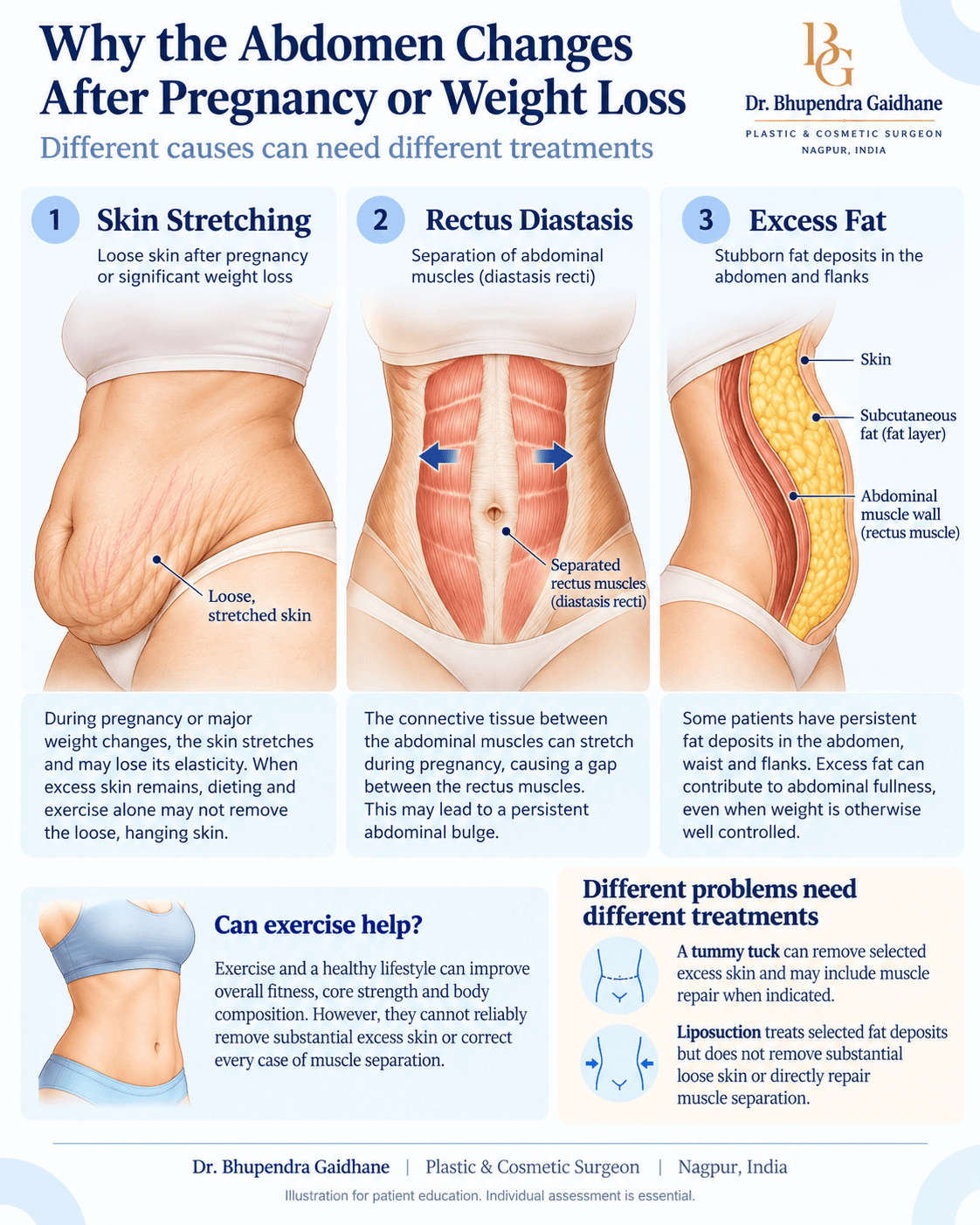
Why the Abdomen Changes After Pregnancy or Weight Loss
Loose skin, abdominal muscle separation and excess fat are different problems. Understanding which changes are present helps determine whether a tummy tuck, liposuction or a combination may be appropriate.
Quick Summary: Is a Tummy Tuck Right for You?
- Loose skin: Removes selected excess abdominal skin that may not retract after pregnancy or weight loss.
- Muscle separation: May include repair of rectus diastasis when indicated.
- Waistline definition: Can improve abdominal contour, with selective liposuction where appropriate.
- BMI and suitability: Weight stability, medical history and individual surgical risks matter.
- Recovery: Usually takes several weeks and requires planning, patience and support at home.
- Scars: Permanent scars are unavoidable, and the umbilical scar may remain noticeable.
- Results: Reasonable improvement is often evident by three months and continues to evolve over the following months.
Why Does the Abdomen Remain Prominent After Pregnancy?
The persistent lower abdominal pouch
Some patients have a lower abdominal bulge that remains even after weight loss. The cause may include excess skin, underlying fat, abdominal wall changes or a combination of these factors. Removing fat alone will not correct every type of abdominal prominence.
Loose, hanging skin
Skin stretched during pregnancy or significant weight changes may not return to its earlier elasticity. When excess skin hangs over the lower abdomen, further dieting or exercise may not resolve the fold. Abdominoplasty removes selected excess skin and redrapes the remaining skin.
Separation of the abdominal muscles
Pregnancy can stretch the connective tissue between the rectus abdominis muscles, resulting in rectus diastasis. Exercise and physiotherapy can improve core strength and function, but significant muscle separation does not always resolve sufficiently with these measures. In selected patients, the separated muscles can be brought closer together during a tummy tuck.
Changes in the mons pubis
Some patients notice fullness or descent of the mons pubis, the soft tissue over the pubic bone. This area should be considered during surgical planning. Additional contouring or lifting may be considered when appropriate.
Previous abdominal surgery and hernias
Previous abdominal operations can leave scars and may be associated with incisional hernias. A suspected hernia requires appropriate clinical assessment and, when indicated, further investigation. Its management must be incorporated into surgical planning.
What Can a Tummy Tuck Correct?
- Excess skin hanging over the lower abdomen.
- Selected abdominal skin folds and stretch marks within the skin being removed.
- Rectus muscle separation, when repair is indicated.
- Abdominal contour changes associated with skin laxity.
- Selected lower abdominal and mons pubis contour concerns when specifically included in the treatment plan.
A tummy tuck does not remove every stretch mark, guarantee a completely flat abdomen or replace weight management.
Is Your BMI Suitable for a Tummy Tuck?
BMI is one component of preoperative assessment. It helps inform risk, but it cannot determine suitability on its own.
Patients with a higher BMI may have an increased risk of wound-healing problems, infection, seroma and venous thromboembolism. Depending on the individual risk profile, weight optimisation before surgery may be advisable.
Patients generally benefit from reaching a sustainable, reasonably stable weight before abdominoplasty. A relatively slim person can also have significant excess skin or rectus diastasis and may benefit from assessment.
Suitability is considered in the context of BMI, weight stability, medical history, smoking status, previous operations, abdominal anatomy and the extent of surgery being considered. There is no single BMI threshold that guarantees a safe operation for every patient.
Can a Tummy Tuck Improve Waistline Definition?
Abdominoplasty can improve the transition between the abdomen and waist, particularly when excess skin and abdominal wall laxity contribute to a broad or protruding abdominal profile.
- Skin removal: Reduces the lower abdominal overhang.
- Muscle repair, when indicated: May reduce central abdominal protrusion caused by rectus diastasis.
- Selective liposuction: May enhance waistline definition in appropriately selected patients.
The degree of waistline synching varies according to skeletal anatomy, fat distribution, muscle separation, skin quality and the procedure performed. A particular waist measurement or silhouette cannot be guaranteed.
What Are the Different Types of Tummy Tuck?
Mini abdominoplasty
A mini tummy tuck may be appropriate when excess skin is limited mainly to the lower abdomen below the navel.
Standard or full abdominoplasty
A full tummy tuck is generally considered when excess skin extends across a larger part of the abdomen. It commonly involves lower abdominal skin removal, repositioning the navel and muscle repair when indicated.
Extended tummy tuck
An extended tummy tuck may be considered when excess skin extends towards the flanks.
Circumferential tummy tuck
For selected patients with excess skin extending around much of the lower trunk, often following substantial weight loss, a circumferential procedure may be appropriate.
These procedures differ in their extent, incision length and recovery requirements. The most extensive procedure is not necessarily the best one. The choice depends on your anatomy and goals.
Tummy Tuck vs 360° Liposuction
360° liposuction
360° liposuction targets selected fat deposits around the abdomen, waist, flanks and back. It may be suitable when excess fat is the main concern and the skin has sufficient elasticity.
Liposuction does not remove substantial hanging skin and does not directly repair rectus diastasis.
Abdominoplasty
A tummy tuck removes selected excess skin. A full abdominoplasty may also involve repositioning the navel and repairing rectus diastasis when indicated.
Lipoabdominoplasty
Lipoabdominoplasty combines abdominoplasty with selected liposuction. The combination may improve waist and abdominal contour in suitable patients, but it is not automatically superior to either procedure alone. The extent of liposuction must be planned carefully, considering skin blood supply and wound-healing potential.
What Happens During Abdominoplasty?
Abdominoplasty is generally performed under general anaesthesia in an appropriate surgical facility. The surgical plan may involve:
- Marking the areas of excess skin and the planned incision.
- Removing the planned amount of redundant abdominal skin.
- Repairing separated abdominal muscles if indicated.
- Repositioning the navel when required.
- Adding selected liposuction when appropriate.
- Closing the incisions and applying dressings. Drains may be used depending on the procedure and clinical assessment.
The duration of surgery, hospital stay and postoperative arrangements depend on the extent of correction, associated procedures and individual clinical circumstances.
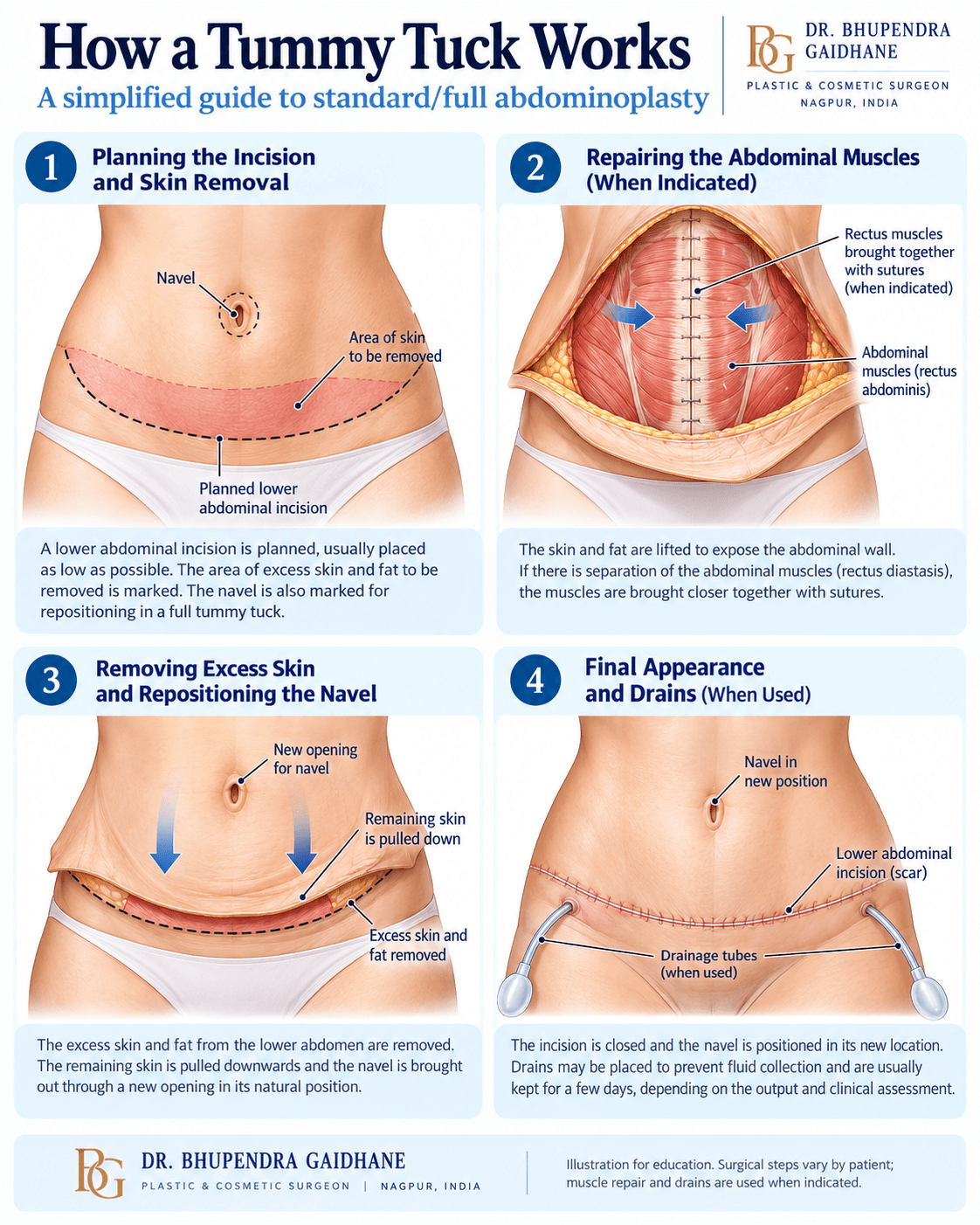
How a Tummy Tuck Works
This illustration shows the main stages of a standard or full abdominoplasty. Muscle repair and drains are used when indicated.
Recovery After a Tummy Tuck: What You Should Know Before Surgery
A tummy tuck is not a procedure after which you should expect to return to normal activities within a few days. You may need assistance with ordinary tasks, time away from work and patience while your body heals.
The day of surgery and the first few days
Mobilisation begins on the day of surgery when your clinical condition permits. Initially, you may need to walk with your trunk bent forward rather than standing completely upright.
Drains are generally retained for approximately 2–4 days in my postoperative protocol, depending on the amount of fluid collected and clinical assessment. The timing of removal is not determined by the calendar alone.
The first week
You should be prepared for limited mobility and the need for help with activities at home. Walking should begin early and progress gradually according to your condition and postoperative instructions.
A pressure garment is generally introduced after about one week, once the wound is healthy and the surgical team considers it appropriate.
Gradually returning to an upright posture
During the first week, you may need to maintain a flexed posture while walking. The transition towards standing fully upright should be gradual, depending on comfort, tissue tension and healing.
Returning to work and normal activities
Recovery commonly takes several weeks. The time away from work varies with the extent of surgery, the type of work you do and your healing. Heavy lifting, strenuous exercise and abdominal training must wait until your surgeon considers them safe.
Support at home
Arrange help with transport, household work, childcare and other daily responsibilities during the initial recovery period. If you live alone or have limited support, discuss this before scheduling surgery.
When Will You See the Final Results of a Tummy Tuck?
The result you see in the first few weeks is not your final result.
Swelling is expected after surgery. The abdomen may feel tight, look uneven or appear more swollen than anticipated. The tissues need time to heal, swelling needs to settle, and the abdominal contour gradually becomes clearer.
The first few weeks
Swelling, tightness and changes in sensation are common during early recovery. It is too early to judge the final contour at this stage.
Around three months
By approximately three months, a reasonable improvement in abdominal contour is often evident, although residual swelling may remain.
Three months to one year
The abdomen continues to settle as swelling reduces, tissues soften and scars mature. Improvement may continue for up to a year after surgery, and scar maturation can take longer.
Maintaining your results
- Maintain a reasonably stable weight. Significant weight gain or loss can alter the abdominal contour.
- Plan future pregnancies carefully. Pregnancy can stretch the skin and abdominal wall again, potentially reversing some of the improvement.
- Follow your postoperative instructions. Appropriate activity, wound care and follow-up help support recovery.
A tummy tuck can provide a meaningful and lasting improvement, but the outcome depends partly on what happens after surgery.
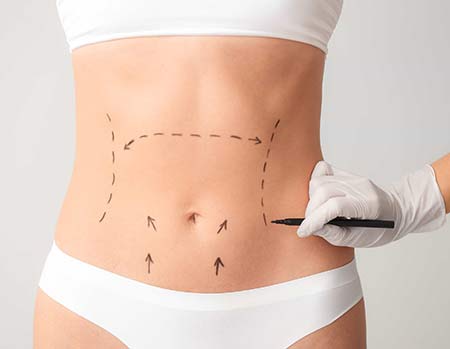
What Will the Tummy Tuck Scar Look Like?
A tummy tuck cannot be performed without scars. The lower abdominal scar is generally planned as low as practical, with its length depending on the amount and distribution of excess skin. A full tummy tuck also generally leaves a scar around the repositioned navel.
The umbilical scar can be noticeable. Scars often become less conspicuous over time, but they remain permanent. Some patients develop widened, raised or thickened scars.
What Are the Risks of Abdominoplasty?
Potential complications include bleeding, infection, seroma, delayed wound healing, wound separation, skin or fat necrosis, persistent swelling, numbness, contour irregularities, unfavourable scarring, blood clots and complications associated with anaesthesia or additional procedures.
Risk depends on your health, BMI, smoking status, extent of skin removal, associated liposuction, previous surgery and other factors. Appropriate assessment and postoperative monitoring help manage these risks but cannot eliminate them.
What Results Can You Expect?
Abdominoplasty can improve the abdominal contour by removing excess skin and, when indicated, repairing abdominal muscle separation. Selected liposuction may further improve contour.
However, surgery cannot guarantee a completely flat abdomen, a particular waist measurement, invisible scars or a specific body shape.
Maintaining a reasonably stable weight helps preserve the improvement. Significant weight changes or a future pregnancy can alter the result.
What Is the Cost of Tummy Tuck Surgery in Nagpur?
The cost of abdominoplasty depends on the extent of skin removal, whether muscle repair is required, whether liposuction is combined with surgery, the complexity of the case, anaesthesia, hospital stay and postoperative care.
An individual estimate should follow clinical assessment and discussion of the proposed procedure.
Frequently Asked Questions About Tummy Tuck Surgery
Can exercise remove a mommy pouch?
Exercise can improve core strength and body composition, but it cannot reliably remove substantial redundant skin or correct every case of rectus diastasis.
Is a tummy tuck a weight-loss procedure?
No. Abdominoplasty is primarily a body-contouring operation and is generally best considered when weight is reasonably stable.
Can a tummy tuck tighten abdominal muscles?
It may include repair of rectus diastasis when indicated. The presence and extent of muscle separation should be assessed clinically.
Does a tummy tuck remove stretch marks?
Stretch marks located on the skin removed during surgery may be removed with that tissue. Stretch marks outside the excision area remain.
Can a tummy tuck improve waistline definition?
It may improve waistline definition through skin removal and, when appropriate, muscle repair and selected liposuction.
Is lipoabdominoplasty better than a tummy tuck alone?
Not for everyone. Combined surgery may be useful when both excess skin and selected fat deposits need correction.
How long will I need to take off work?
Recovery varies with the procedure and the nature of your work. Many patients require several weeks, and physically demanding jobs may require longer.
Are tummy tuck scars permanent?
Yes. The lower abdominal scar and, in a full tummy tuck, the scar around the repositioned navel are permanent.
When will I see the final result?
Reasonable improvement is often evident by around three months, but swelling and tissue settling continue. The contour may continue to improve for up to one year.
Can pregnancy reverse the results?
Pregnancy can stretch the abdominal skin and wall again, potentially reducing some of the improvement. Discuss the timing of surgery if you are planning another pregnancy.
Is tummy tuck surgery safe?
All major surgery carries risks. Appropriate assessment, surgical planning, anaesthesia care and postoperative monitoring help manage those risks but cannot eliminate them.
Considering a Tummy Tuck in Nagpur?
If loose abdominal skin, a persistent bulge or changes after pregnancy or weight loss are affecting you, the first step is to understand the cause and available options.
Dr. Bhupendra Gaidhane, Plastic & Cosmetic Surgeon, can assess your abdominal anatomy and explain the potential benefits, limitations, scars, recovery and risks.
Consultation: Prime Polyclinic, Dhantoli, Nagpur.
Surgical facility: Nirvi 2 Surgical & Maternity Hospital, Besa, Nagpur.