
He Trained for Years.
His Chest Still Didn’t Change.
A 23-year-old medical student’s journey through bilateral Grade 2B gynecomastia.
Age
Weight
Height
Bilateral gynecomastia
+ gland excision
Follow-up
He had already tried to solve the problem himself.
At around 18 years of age, he began noticing persistent enlargement of his chest.
Over the following years, he tried extensive gym training, weight reduction and muscle building. His overall physique became fitter and more muscular, but the chest fullness remained.
At 23, he eventually decided to seek a surgical opinion. He found our practice through an online search and came for a consultation.
From the first concern to the 2-month follow-up
18 years
First noticed persistent chest enlargement.
18–23 years
Gym training, weight reduction and muscle building.
Age 23
Online search followed by consultation.
Consultation
Clinical assessment and discussion with the patient and his father.
Surgery
VASER / Lipovase-assisted contouring with gland excision.
Day 3
Early concerns about shape and apparent asymmetry were discussed.
2 months
Progressive settling with a very satisfactory early result.
“Why is my chest still prominent despite all the training?”
The consultation changed the question from how to train the chest further to understanding what was actually contributing to the persistent enlargement.
Understanding what was actually causing the fullness
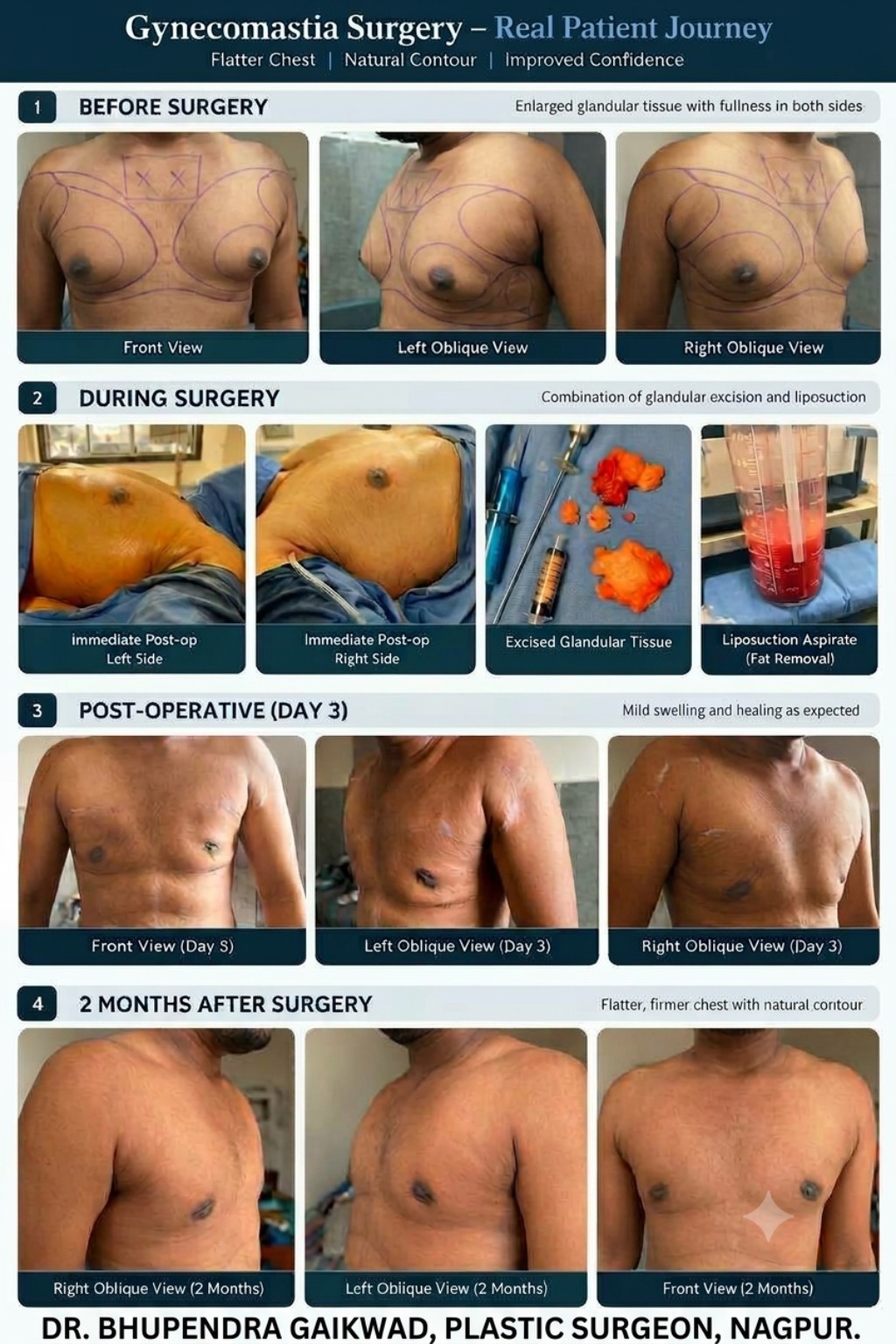
The preoperative appearance and markings are shown in the Case of the Month overview image above.
Clinical assessment showed bilateral Grade 2B gynecomastia.
The treatment plan considered the glandular component, surrounding fatty tissue and overall chest contour.
Treatment planning was based on the anatomy, not just the appearance.
The preoperative front and oblique markings are consolidated into the Case of the Month overview image above.
The markings were planned to address the central chest and surrounding contour while maintaining a natural transition across the chest and lateral regions.
Two tissue components. Two treatment approaches.
FATTY COMPONENT
VASER / Lipovase
Contouring of the surrounding fatty tissue.
GLANDULAR COMPONENT
Gland excision
Direct treatment of the persistent glandular tissue.
A flatter, proportionate and naturally contoured chest.
VASER / Lipovase + gland excision
General anaesthesia
Approximately 1 litre
Used on one side
No complications
Contouring the chest and addressing the glandular component
The intraoperative photograph, excised glandular tissue and liposuction aspirate are presented together in the Case of the Month overview image above.
Day 3: He was worried about the shape.
During the early postoperative period, the patient had concerns about the chest shape and some apparent unevenness.
Swelling, tissue firmness and differences in healing between the two sides can temporarily affect the appearance of the chest.
The patient was counselled and followed regularly as the tissues settled.
The early postoperative appearance is included in the Case of the Month overview image above.
Early postoperative photographs should be interpreted in the context of ongoing healing rather than as the final result.
The chest continued to settle.
At two months, the chest showed substantial improvement in contour with only minimal residual asymmetry.
Further tissue settling and maturation can continue beyond this stage.
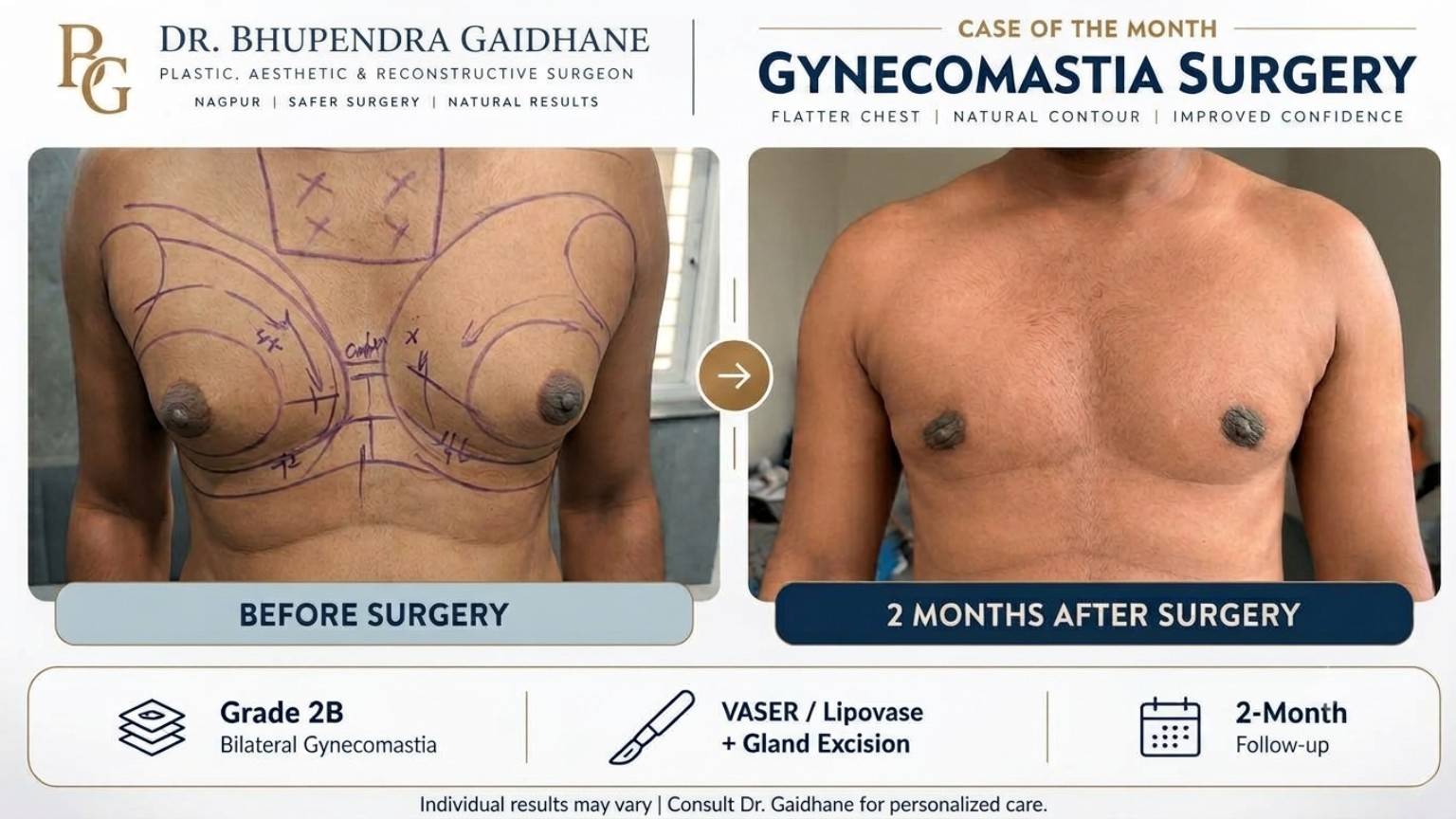
Individual results vary, and further tissue settling and maturation can continue beyond this stage.
The final before-and-after creative shows the preoperative appearance and the 2-month follow-up.
Individual results vary.
“Thank you so much, sir. I am very happy after seeing the results.”
Patient feedback at the 2-month follow-up.
What this case teaches us
A fit physique does not exclude gynecomastia.
Persistent glandular tissue may remain despite exercise, weight loss and changes in body composition.
The underlying tissue matters.
Assessment should distinguish the glandular component from surrounding fatty tissue.
Treatment is individualised.
The surgical approach depends on the patient’s anatomy, tissue composition and desired contour.
Early asymmetry can be temporary.
Postoperative swelling and differences in healing can temporarily affect the appearance of each side.
Healing takes time.
The appearance at Day 3 and at two months can be very different.
Can gynecomastia remain after losing weight?
Weight loss can reduce the fatty component of the chest, but persistent glandular tissue may remain.
Can exercise remove gynecomastia?
Exercise can improve overall chest muscle development and body composition, but established glandular tissue does not necessarily disappear with exercise.
Why were liposuction and gland excision combined?
The assessment showed both a fatty component and a glandular component. Each requires a different treatment approach.
Why can the chest look uneven after surgery?
Swelling, tissue firmness and differences in healing can temporarily make one side appear different from the other.
Is the two-month result final?
Two months provides an important indication of the developing result, but tissue settling and scar maturation can continue beyond this stage.
Learn more about gynecomastia
Understand the problem first.
Then discuss the options.