
A practical guide to Grade 1, 2, 3 and 4 gynecomastia — what each grade looks like, what is happening beneath the skin, and how the grade can influence treatment planning.
What are the 4 grades of gynecomastia?
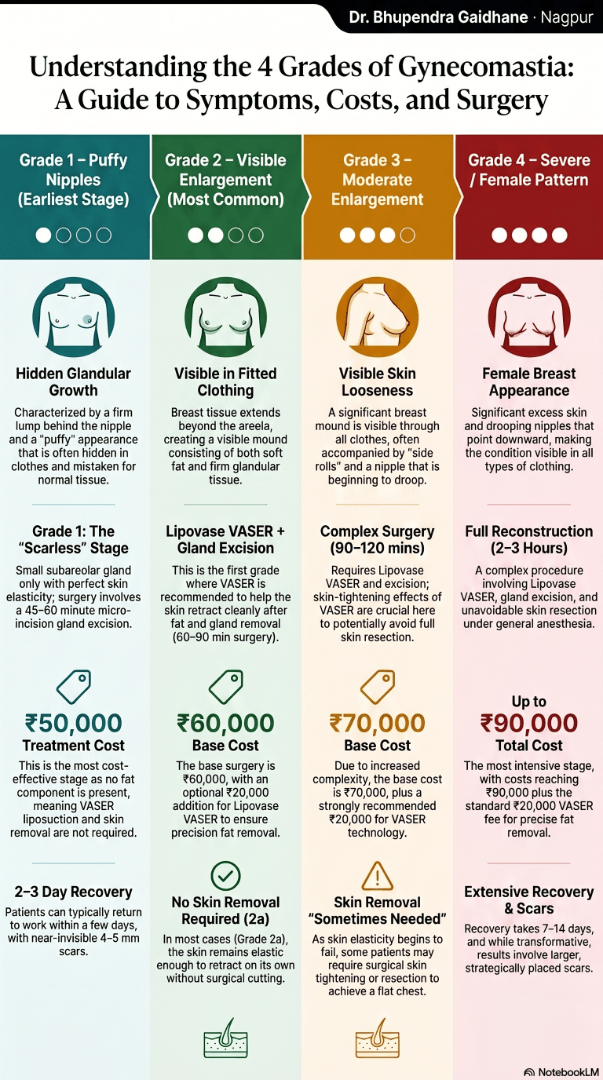
Gynecomastia is commonly described in four grades, from Grade 1 to Grade 4. The grade describes the extent of chest enlargement, the amount and distribution of glandular and fatty tissue, skin laxity and changes in nipple position.
Grade 1 is usually limited to mild enlargement around the nipple. Grade 2 produces more visible chest fullness. Grade 3 involves more significant enlargement and may include skin laxity. Grade 4 represents marked enlargement with significant skin excess in some patients.
Important: the grade does not determine the operation by itself. The final plan depends on the actual glandular tissue, fat distribution, skin quality, nipple position and amount of skin excess present in that individual chest.
Which grade looks closest to your chest?
Use these descriptions as a starting point. They are not a substitute for clinical examination.
02Grade 2Moderate visible chest fullnessMay contain glandular tissue and fat · 2A and 2B patternsExplore Grade 2 →
03Grade 3Significant enlargementSkin laxity may become an important part of treatment planningExplore Grade 3 →
04Grade 4Marked enlargement / excess skinMore extensive tissue and skin management may be requiredExplore Grade 4 →
How to use this guide
If you already know your grade, jump directly to that section. Each grade explains what you may see, what is happening beneath the skin, treatment components that may be considered, and scar/recovery considerations.
01
Mild Enlargement / Puffy Nipples
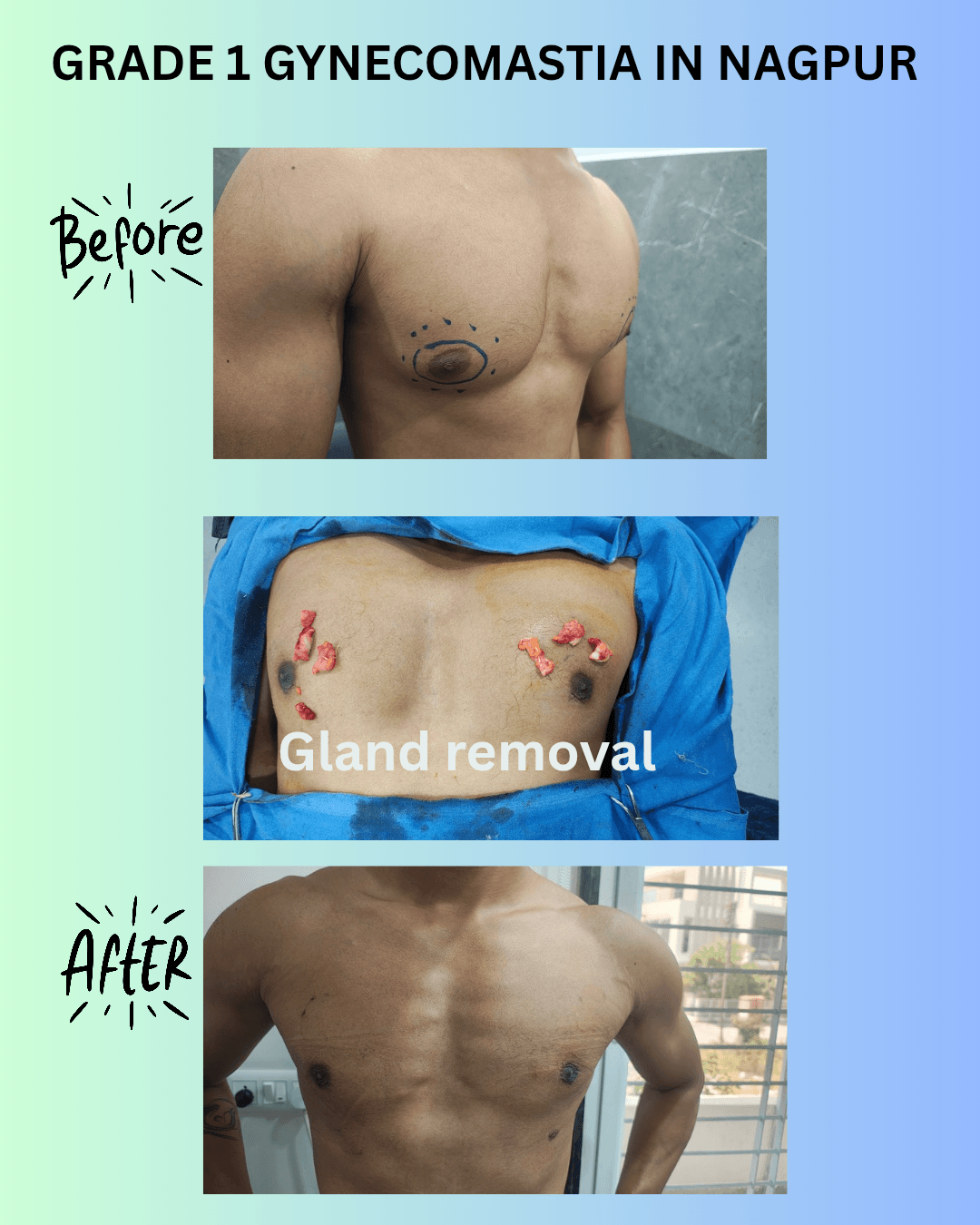
What does Grade 1 look like?
Grade 1 usually presents as mild enlargement concentrated around the nipple-areola region. The chest may otherwise appear relatively flat, with little or no excess skin.
- Puffy or protruding nipple area
- Small, firm or rubbery tissue beneath the nipple may be present
- Chest otherwise appears relatively flat
- Little or no visible skin excess
- One side may be slightly larger than the other
What is happening beneath the skin?
The enlargement is often predominantly glandular, although the exact proportion of glandular tissue and fat varies between patients. Examination helps determine what is actually contributing to the fullness.
How is Grade 1 usually treated?
When persistent glandular tissue is the main cause, gland excision may be considered. If a meaningful fat component is present, liposuction may also form part of treatment. The exact combination is decided after examination.
02
Moderate Chest Enlargement
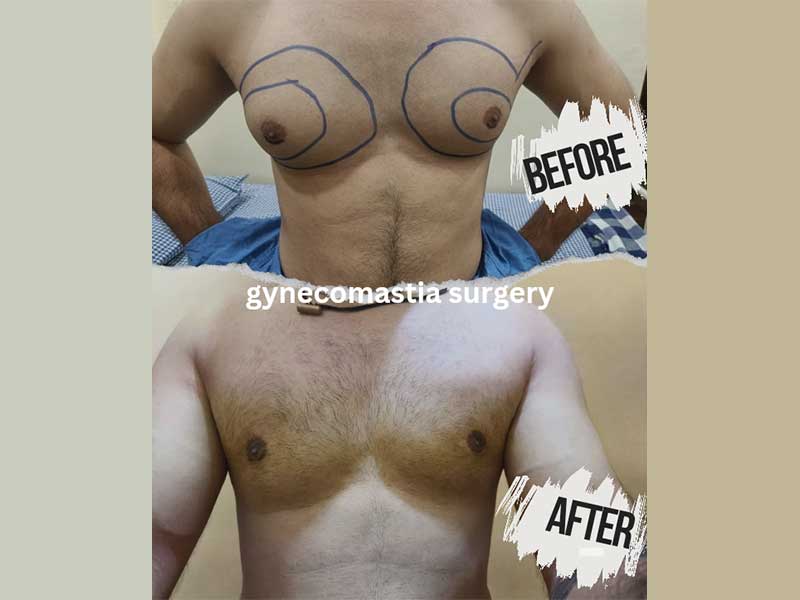
What does Grade 2 look like?
Grade 2 produces more visible chest enlargement than Grade 1. The fullness extends beyond the immediate nipple area and may be noticeable through fitted clothing as well as when shirtless.
2AModerate enlargement
Skin remains relatively tight, with little or no excess skin.
2BModerate enlargement + mild laxity
Some early skin laxity may be present and needs assessment.
What is usually present?
Grade 2 may contain both a firm glandular component and a softer fatty component. The relative contribution varies between patients.
- Visible chest fullness
- Tissue extending beyond the areola
- Glandular tissue may be felt beneath the nipple
- Fat may contribute to overall chest volume
- Skin is usually reasonably elastic, especially in Grade 2A
How is Grade 2 usually treated?
If both glandular tissue and fat contribute to chest enlargement, treatment may combine gland excision with liposuction. VASER-assisted liposuction (Lipovase) may be considered when liposuction is appropriate as part of the surgical plan. It is not required for every Grade 2 patient. Read more about VASER vs traditional liposuction.
03
Significant Enlargement with Skin Laxity

What does Grade 3 look like?
Grade 3 represents more significant chest enlargement. Tissue extends beyond the nipple area and may involve the lower and lateral chest. Skin laxity becomes an important part of assessment.
- Prominent chest enlargement
- More tissue across the lower or lateral chest
- Skin may feel less tight or elastic
- Nipple-areola position may begin to change
- Skin excess may influence the surgical approach
The key question in Grade 3: what will the skin do?
After glandular and fatty tissue are removed, the remaining skin needs to adapt to the reduced volume. Patients with better skin elasticity may not require skin excision, while patients with significant skin excess may need an additional skin-removal procedure.
How is Grade 3 approached?
Treatment may involve gland excision and liposuction when both components are present. Skin quality and excess then become important in deciding whether skin excision is necessary. VASER-assisted liposuction may be considered when liposuction is appropriate, but the need for skin management cannot be decided from the grade alone. See the guide to VASER vs traditional liposuction.
04
Marked Enlargement with Excess Skin
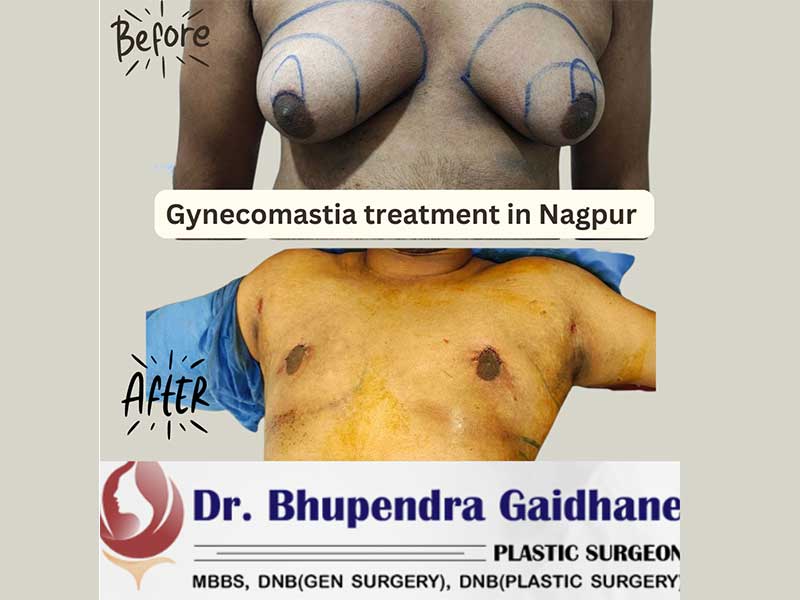
What does Grade 4 look like?
Grade 4 represents marked chest enlargement with significant skin excess or sagging in many patients. The nipple-areola complex may sit lower on the chest, and both glandular and fatty tissue may contribute to the volume.
- Marked chest enlargement
- Significant skin excess may be present
- Nipple-areola complex may be positioned lower
- Fat and glandular tissue may both contribute
- Skin management may become a major part of surgery
Why is Grade 4 different?
Removing underlying tissue does not automatically remove excess skin. When the skin has significant laxity or excess, the plan may need to include skin excision and, where appropriate, management of nipple position. The scar pattern depends on the amount and distribution of excess skin.
What may be involved in Grade 4 surgery?
Depending on the anatomy, surgery may include gland excision, liposuction, skin excision and management of nipple-areola position. The exact combination is individualized according to tissue, skin excess and chest shape.
Grade 1 vs 2 vs 3 vs 4
The grade describes the presentation. It does not by itself prescribe the operation.
| Feature | Grade 1 | Grade 2 | Grade 3 | Grade 4 |
|---|---|---|---|---|
| Chest enlargement | Mild | Moderate | Significant | Marked |
| Glandular tissue | Often present | Often present | Often present | May be substantial |
| Fat component | Variable | Common | Variable / common | May be significant |
| Skin excess | Little or none | Little / variable | May be present | Often significant |
| Skin excision | Usually not required | Usually not required when excess is limited | Sometimes | May be required |
| Possible treatment | Gland ± contouring | Gland ± liposuction | Gland + fat ± skin | Gland + fat + skin ± nipple management |
| Main planning issue | Gland | Gland + fat | Skin behaviour | Skin excess + contour |
Your grade is not your operation
The most useful way to think about gynecomastia surgery is not simply “What grade am I?” but “What tissues are creating my chest shape?”
01
Gland
Firm glandular tissue may require surgical excision when it is a significant part of the enlargement.
02
Fat
Fat may contribute to chest volume and contour and can be considered for liposuction when appropriate.
03
Skin
Skin quality and excess become increasingly important as the amount of enlargement increases.
04
Nipple position
Changes in nipple-areola position can influence the plan, particularly when significant skin excess is present.
Would you like a personalised assessment?
Book an appointment with Dr. Bhupendra Gaidhane online. Booking usually takes about 2 minutes.
Afternoon and evening slots may be available at both locations. Choose your preferred clinic and an available time when booking.
How much does gynecomastia surgery cost?
The grade can influence the extent of surgery, but it does not determine final cost by itself. Glandular tissue, fat, skin excess and the techniques required are also considered.
The 4 grades at a glance
Questions patients ask about gynecomastia grades
How do I know what grade of gynecomastia I have?
Photos and descriptions can give you a rough idea, but accurate grading requires clinical assessment. The examination considers glandular tissue, fat distribution, skin laxity and nipple-areola position.
What is Grade 1 gynecomastia?
Grade 1 usually refers to mild enlargement concentrated around the nipple-areola region, with little or no excess skin.
What is Grade 2 gynecomastia?
Grade 2 involves more visible chest enlargement. It may contain both glandular tissue and fat, and is commonly described as Grade 2A or 2B depending on skin laxity.
What is the difference between Grade 2A and Grade 2B?
Grade 2A generally describes moderate enlargement with relatively tight skin, while Grade 2B includes some early or mild skin laxity. Individual anatomy remains more important than the label.
What is Grade 3 gynecomastia?
Grade 3 represents more significant chest enlargement, often with some degree of skin laxity. Whether skin excision is needed depends on the amount of excess skin and its quality.
What is Grade 4 gynecomastia?
Grade 4 represents marked enlargement with significant skin excess or sagging in many patients. Surgery may therefore involve more than gland excision and liposuction, depending on anatomy.
Does the grade determine the surgery?
No. The grade is a useful description, but the operation is planned according to glandular tissue, fat distribution, skin quality, skin excess, nipple position and overall chest anatomy.
Can exercise remove gynecomastia?
Exercise and weight loss can reduce the fat component of the chest, but they do not directly remove established glandular tissue. Many patients have a combination of fat and gland.
Can gynecomastia go away on its own?
Gynecomastia during puberty can improve spontaneously in some adolescents. Persistent or longstanding enlargement should be assessed clinically rather than assuming that it will resolve with exercise or weight loss. Parents and teenagers can also read the guide to teenage gynecomastia.
Will Grade 3 or Grade 4 always require skin removal?
No. The need for skin excision depends on skin excess, skin quality, nipple position and the amount of tissue being removed.
How much does gynecomastia surgery cost in Nagpur?
Cost depends on grade, glandular and fatty tissue, skin excess and techniques required. See the Gynecomastia Surgery Cost in Nagpur guide for the current 2026 pricing information.
Not sure which grade you have?
A consultation can help assess the glandular tissue, fat distribution, skin quality and treatment options appropriate for your chest.
Choose from available afternoon and evening appointments at either clinic location.
Cabin No. 3, 1st Floor, Diamond One Building, Dhantoli, Nagpur
Consultation clinic
Besa, Nagpur
Surgical unit