Quick Answer

Breast augmentation, also called breast implant surgery, is a cosmetic procedure used to increase breast volume, improve breast shape and projection, restore lost fullness, or improve breast symmetry using carefully selected breast implants.

The important part is “carefully selected.”

Breast augmentation is not simply about choosing 300 cc, 350 cc, or the largest implant possible. Implant size, profile, width, placement and surgical technique are selected after considering your chest dimensions, existing breast tissue, skin quality, body proportions and the result you want to achieve.

The aim is not simply to make the breasts bigger, but to create an enhancement that looks balanced, proportionate and appropriate for your body.

Key Takeaways

  • Breast augmentation can increase breast volume, improve shape and enhance body proportions.
  • There is no single implant size or type that is right for every woman.
  • Implant selection depends on chest width, breast dimensions, existing tissue, skin quality, implant profile and your aesthetic goals.
  • The same implant volume can look very different on two different women.
  • Breast augmentation can also restore volume following pregnancy, breastfeeding or significant weight loss.
  • Recovery occurs gradually, with the breasts continuing to settle and soften over time.
  • Good long-term results begin with appropriate patient selection, careful planning, safe surgery and realistic expectations.

At our practice in Nagpur, breast augmentation is approached as a carefully guided medical decision, not a cosmetic impulse — with emphasis on natural proportions, long-term comfort, and safety.

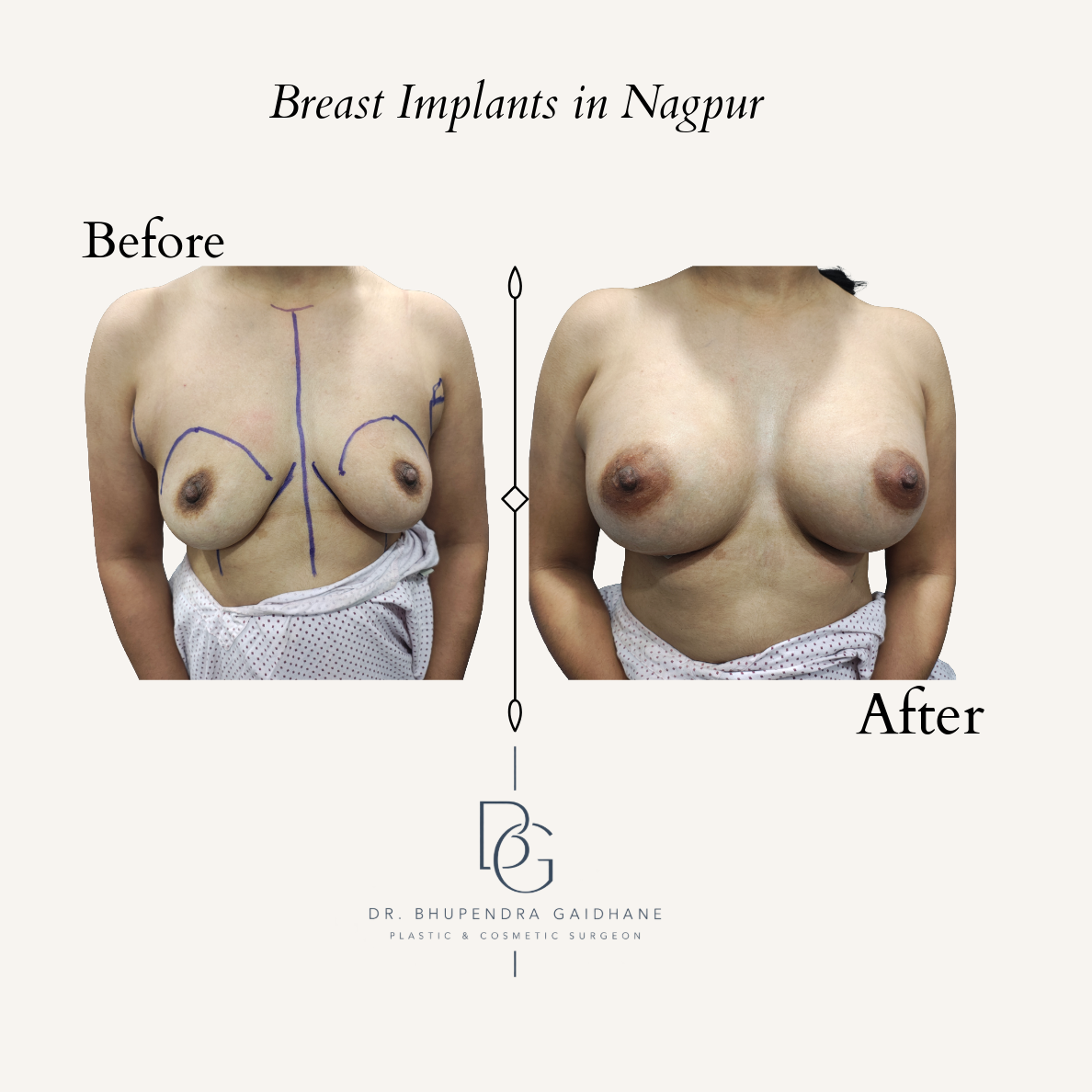
“Before and after breast augmentation with 315cc motiva implants in Nagpur.”
Natural-looking breast augmentation with 315 cc implants placed in the subfascial plane.

Breast Implant Surgery in Nagpur

For many women, deciding to have breast implant surgery isn’t simply about wanting larger breasts.

You may feel that your breasts have always been smaller than you’d like. You may have lost volume after pregnancy or weight loss. You may feel that your breasts are uneven, or simply want your body proportions to feel more balanced.

And before making a decision, you probably have questions:

“What size would suit me?”
“Will the result look natural?”
“Which implant is right for my body?”
“Will I look too big?”
“What will I look like after surgery?”

These are all important questions.

At our practice in Nagpur, breast augmentation begins with understanding you—not an implant catalogue.

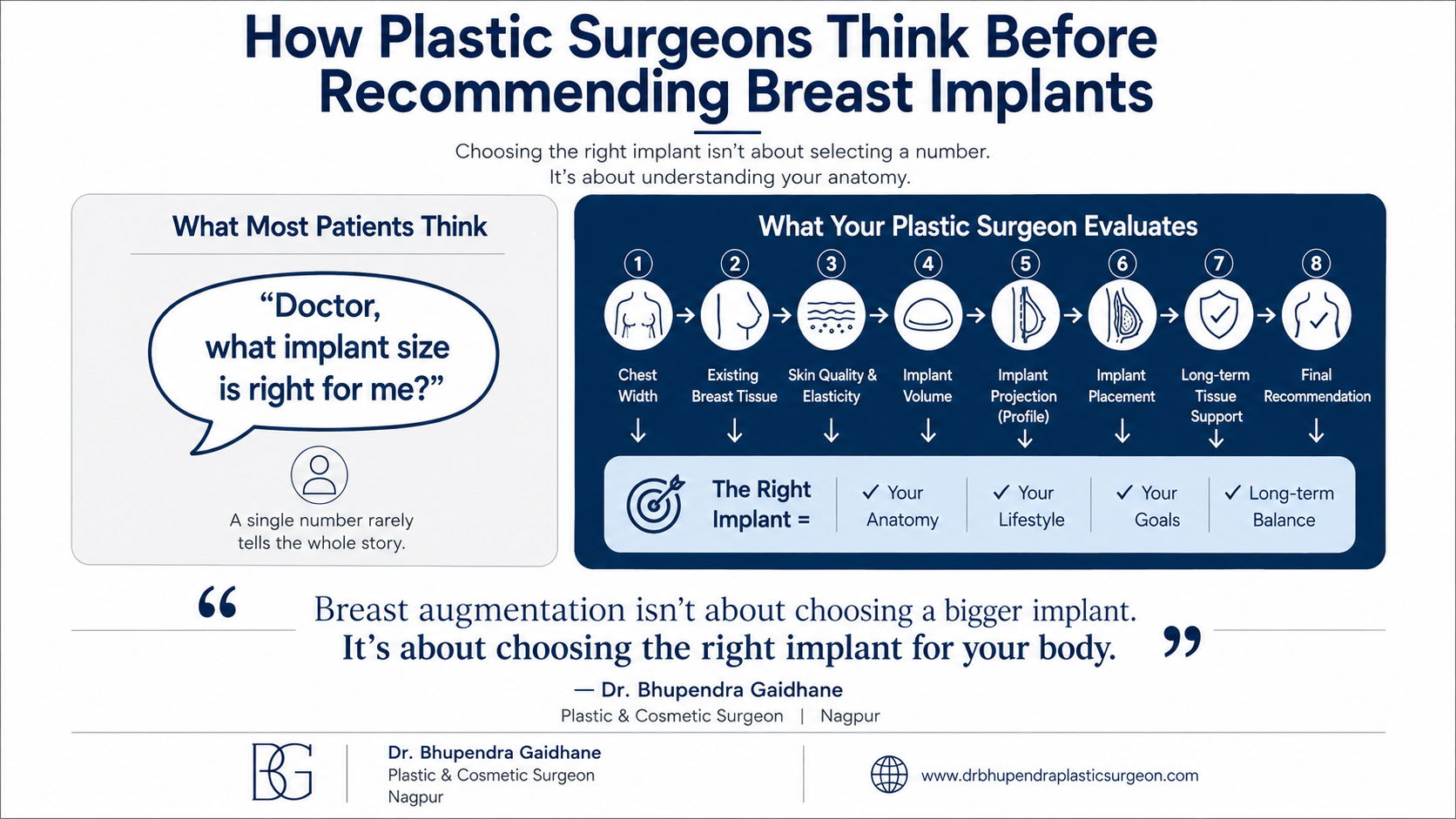
Your chest dimensions, breast measurements, existing breast tissue, skin quality, body proportions, lifestyle and aesthetic goals are assessed before an implant is recommended.

The objective is not to choose the biggest implant you can accommodate. It is to choose an implant that helps create the result you want while remaining proportionate to your body and appropriate for your tissues.

How We Choose the Right Breast Implant for You

One of the first questions women ask during a consultation is:

“Doctor, should I choose 250 cc, 300 cc or 350 cc?”

It’s a natural question—but cc alone cannot tell us what your breasts will look like after surgery.

Two women can receive the same 325 cc implant and have completely different results because their chest width, breast tissue, skin quality, proportions and implant profile may be different.

So instead of starting with an implant number, we start with your body and your desired result.

This is the basis of the Dr. Bhupendra Implant Planning Protocol—a structured approach to assessing your anatomy, understanding your expectations and selecting an implant that is appropriate for you.

"Before and after results of breast implant surgery performed by Dr. Bhupendra Gaidhane in Nagpur, showing significant enhancement in breast shape and volume."
“Breast Implant Surgery Before and After Results – Achieved by Dr. Bhupendra Gaidhane, leading cosmetic and plastic surgeon in Nagpur.”

The Protocol

Step 1 — Understanding What You Want

Every breast augmentation begins with listening.

Some women want a subtle increase in volume and a natural-looking result. Others want more upper-pole fullness, increased cleavage or a fuller silhouette. Some women are primarily concerned about loss of volume after pregnancy or weight loss, while others are concerned about asymmetry.

There is no “correct” aesthetic goal.

The first step is understanding what you would like to see when you look in the mirror—and then determining what can realistically and safely be achieved.


Step 2 — Measuring Your Anatomy

Once we understand your goals, we assess your anatomy.

This includes:

  • Breast base width
  • Chest wall dimensions
  • Existing breast volume
  • Skin quality and elasticity
  • Nipple position
  • Breast symmetry
  • Soft-tissue coverage

These measurements help establish which implant dimensions are appropriate for your body.


Step 3 — Choosing Implant Volume

Breast implant volume is measured in cubic centimetres (cc).

But cc is only one dimension of an implant.

A 295 cc implant, 325 cc implant and 350 cc implant will obviously contain different volumes—but the final appearance also depends on how that volume is distributed across the implant and how it interacts with your anatomy.

So rather than asking:

“How many cc can I put?”

we ask:

“What volume will create the proportion and appearance we are trying to achieve?”


Step 4 — Choosing Implant Profile and Projection

This is where breast implant selection becomes more technical.

Profile, or projection, describes how far the implant projects forward from the chest wall.

Two implants can have the same volume but different widths and projections.

For example, two 325 cc implants may create different breast shapes if one has a wider base and lower projection while another has a narrower base and greater projection.

This is why implant selection isn’t simply a question of “How many cc?”

We consider:

Volume + Width + Projection + Your Anatomy

to determine which implant is appropriate.


Step 5 — Discussing the Options With You

Once your measurements and goals are understood, we discuss the available options with you.

We explain how differences in:

  • implant size
  • profile
  • implant brand
  • placement
  • incision
  • expected projection

may influence the final result.

The decision should be shared, not rushed.

Our role is to give you an honest recommendation, explain the advantages and limitations, and help you make an informed choice.


Step 6 — Creating Your Individual Surgical Plan

Only after your anatomy, goals and implant options have been assessed do we finalise the surgical plan.

This includes deciding:

  • Implant volume
  • Implant width
  • Implant profile
  • Implant brand
  • Implant placement
  • Surgical incision

Every element needs to work together.

A good implant in the wrong size, profile or position may not produce the result you are expecting.


Step 7 — Thinking Beyond the Operation

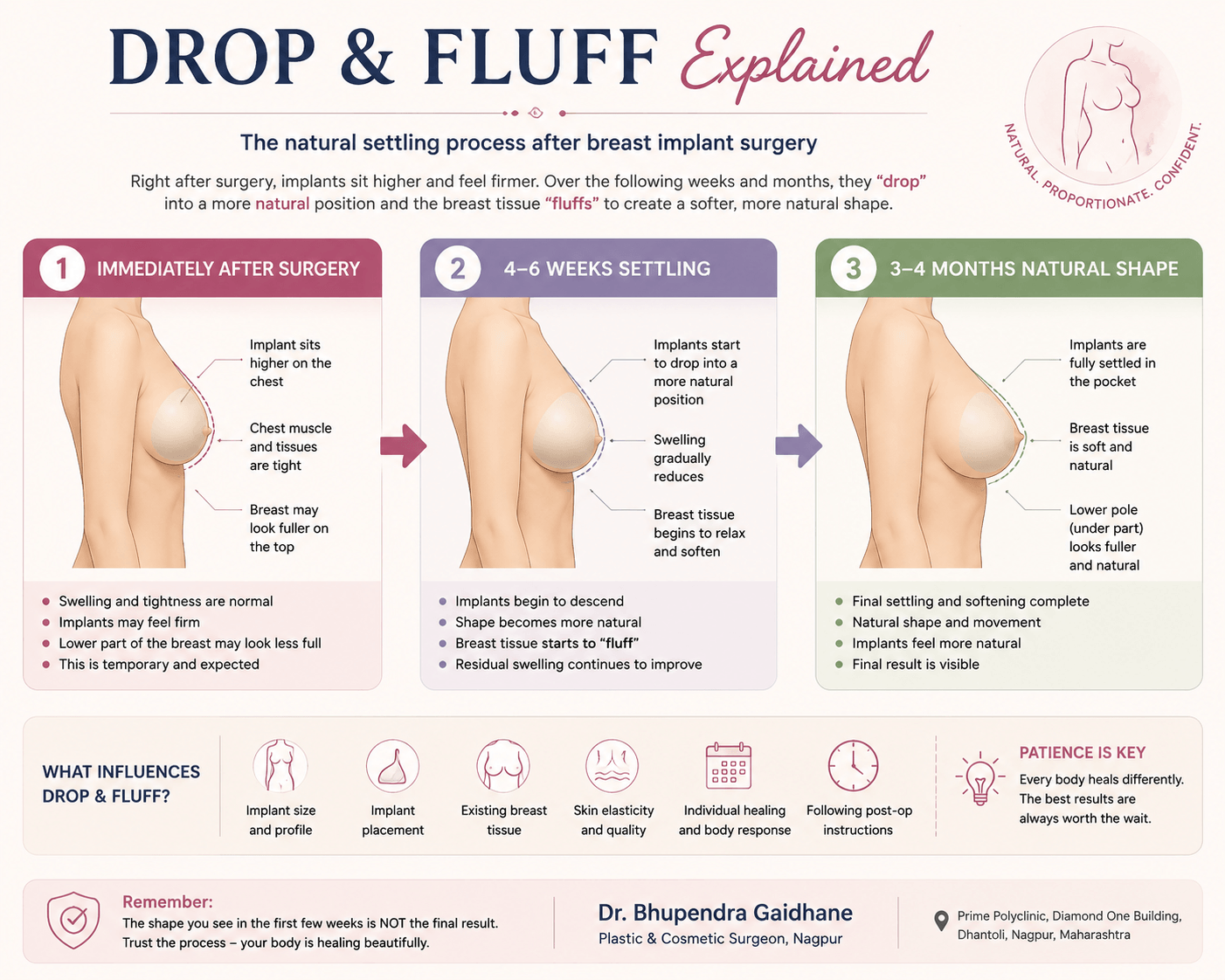
Breast augmentation shouldn’t be judged by how the breasts look immediately after surgery.

Swelling settles. The tissues relax. The implants settle into position. Scars mature. The breasts gradually take on their longer-term appearance.

For this reason, we plan not only for the immediate postoperative result, but also for how the breasts should look, feel and remain proportionate over time.

The goal is simple:

A result that looks like it belongs to your body—not like an implant has been placed on it.


Want to See What This Planning Looks Like in Real Patients?

Every patient has different anatomy, goals and implant requirements.

Explore selected breast implant before-and-after results to see how different implant sizes and profiles can create different outcomes depending on the patient’s body.

→ View Breast Implant Before & After Results

Before and after breast augmentation surgery in Nagpur by Dr. Bhupendra Gaidhane. Enhanced breast shape and volume through advanced surgical techniques
Before and after transformation of breast augmentation surgery in Nagpur by Dr. Bhupendra Gaidhane. Specializing in breast implants, augmentation, and cosmetic enhancements.


Breast Implant Size Guide: Understanding CC, Width & Projection

One of the first things women often ask during a breast augmentation consultation is:

“Doctor, what size implant should I get?”

You may already have a number in mind—250 cc, 300 cc, 325 cc or 350 cc. That’s completely understandable.

But an implant is not like choosing a clothing size.

The number of cc tells us how much volume the implant contains. It does not tell us exactly how your breasts will look after surgery.

The final appearance depends on how that volume fits your chest and interacts with your existing breast tissue, skin and overall body proportions.


What Does “CC” Mean in Breast Implants?

Breast implant volume is measured in cubic centimetres (cc).

For example:

  • 250 cc = 250 cubic centimetres of implant volume
  • 300 cc = 300 cubic centimetres
  • 325 cc = 325 cubic centimetres
  • 350 cc = 350 cubic centimetres

A higher cc generally means more implant volume, but more volume does not automatically mean a better result.

The right implant is the one that fits your anatomy and produces the appearance you are trying to achieve.


Does a Larger Implant Always Mean Larger-Looking Breasts?

Not necessarily.

The appearance of an implant depends on several dimensions:

Volume + Base Width + Projection + Your Existing Breast Tissue

For example, two women may both receive a 325 cc implant, yet their results can look noticeably different.

One may have a wider chest and more natural breast tissue, while another may have a narrower chest and thinner soft-tissue coverage.

The same implant is therefore interacting with two completely different bodies.

This is why choosing an implant by copying another patient’s size is usually not a good strategy.


Implant Profile: Why Projection Matters

Implant profile refers to how much the implant projects forward from the chest wall.

This is an important distinction because two implants can contain the same volume but have different dimensions.

A wider implant may distribute its volume over a broader base and create a different contour.

A higher-profile implant may have a narrower base and project further forward.

So when we discuss an implant, we are not looking at cc alone.

We consider:

How wide is it?
How much does it project?
Does its base fit your breast?
How will your existing tissue cover it?

These details can have a major influence on the final shape.


Can You Choose Your Breast Implant Based on Cup Size?

This is another very common question.

Unfortunately, there is no reliable one-to-one conversion between implant volume and bra cup size.

Bra sizing varies between manufacturers and styles, and the final breast size also depends on your original breast volume, chest dimensions, implant profile and soft-tissue characteristics.

So rather than promising:

“325 cc will give you a C cup.”

we prefer to discuss the appearance and proportions you want to achieve.

Your implant is then selected to work towards that goal within the limits of your anatomy.


Bigger Isn’t Always Better

It is natural to think that if a little more volume looks good, even more volume must look better.

But breast tissues have limits.

An implant that is too large or too wide for your anatomy may place unnecessary stress on the breast tissues and can contribute to problems such as excessive stretching, visible implant edges, rippling or earlier tissue descent.

The objective is therefore not:

“How large an implant can I fit?”

It is:

“What implant gives this patient the best balance between her desired appearance, anatomy and long-term tissue support?”

That distinction is at the heart of good implant selection.


Choosing the Right Implant for Your Body

There is no universally “best” breast implant.

The appropriate choice depends on your anatomy, your goals and the result you want to achieve.

During consultation, we consider:

  • Breast base width
  • Chest dimensions
  • Existing breast volume
  • Skin quality and elasticity
  • Soft-tissue thickness
  • Desired fullness and projection
  • Implant profile
  • Implant placement
  • Lifestyle and activity level
  • Long-term tissue support

Only after considering these factors can an implant be meaningfully recommended.


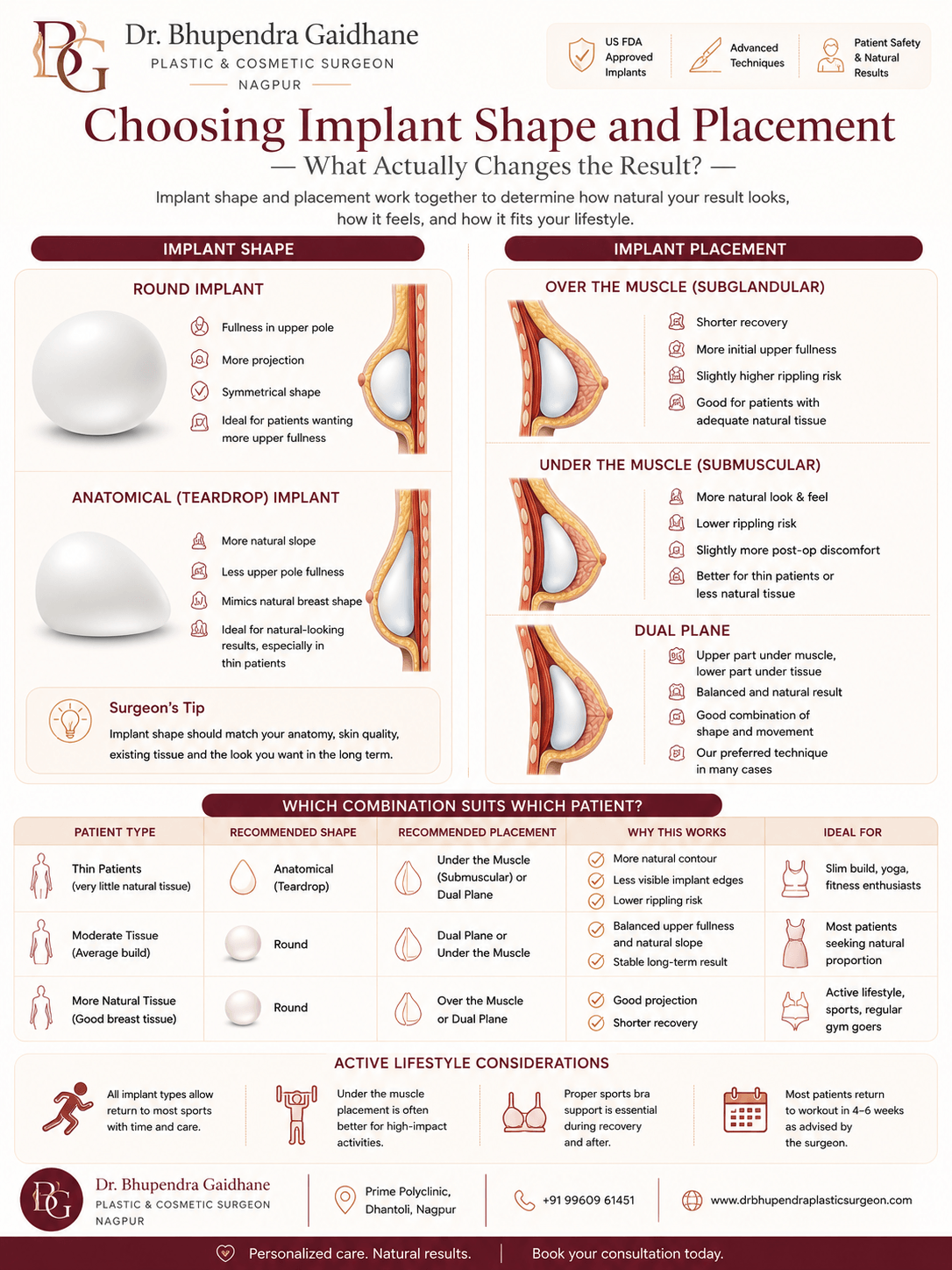
Round or Anatomical (Teardrop) Implants?

Modern breast implants are available in different shapes, including round and anatomical (teardrop) designs.

Round Implants

Round implants are commonly used for cosmetic breast augmentation.

When appropriately selected, they can provide attractive upper-pole fullness and projection while still producing a soft and natural-looking result.

For many women seeking cosmetic breast augmentation, a well-selected round implant is an excellent option.

Anatomical Implants

Anatomical or teardrop implants are designed with a more tapered upper portion and greater fullness towards the lower part of the implant.

They may be useful in selected situations, including certain reconstructive or specific anatomical cases.

The decision between round and anatomical implants should therefore be based on your anatomy and desired result, rather than assuming that one shape is automatically more natural.


Does the Implant Brand Matter?

Patients often ask:

“Which breast implant brand is the best?”

There isn’t one brand that is ideal for every patient.

At our practice, implant selection may include established brands such as Motiva® and GC Aesthetics®, depending on availability, implant dimensions, patient requirements and the planned surgical result.

The brand is only one part of the decision.

A premium implant cannot compensate for an inappropriate size, unsuitable dimensions or poor surgical planning.

The right implant is the one that fits the patient’s anatomy and treatment plan.


The Dr. Bhupendra Philosophy

Beautiful breast augmentation is not about choosing the largest implant.

It is about choosing the right implant for the right patient.

Every woman has different anatomy, different proportions and a different idea of what beautiful means to her.

My role is not simply to place an implant. It is to understand what you want, determine what is realistically achievable, and recommend an implant that works with your anatomy rather than against it.

The best breast augmentation should enhance your body without overpowering it.

The goal is not for people to notice that you have implants.

The goal is for them to notice that you look beautifully balanced.

Where Is the Breast Implant Placed?

One of the first questions many women have before breast augmentation is:

“Where exactly will my implant be placed?”

There isn’t one placement that is best for every woman. The ideal position depends on your existing breast tissue, skin quality, chest anatomy, implant size and profile, lifestyle, and the result you want to achieve.

The three commonly discussed approaches are subfascial, dual-plane, and subglandular placement. Each has its own indications, advantages and limitations.


Subfascial Implant Placement

In subfascial breast augmentation, the implant is positioned beneath the fascia covering the pectoral muscle while the muscle itself is preserved.

At our practice, this is commonly considered for appropriately selected patients, particularly when there is adequate breast tissue and soft-tissue coverage.

Potential advantages include:

  • Preservation of the pectoral muscle
  • Natural movement of the breast
  • Good soft-tissue support
  • Less muscle-related discomfort than techniques involving significant muscle dissection
  • Faster recovery for many appropriately selected patients

However, subfascial placement is not automatically the right choice for everyone. The thickness of your existing tissues and the implant being considered are important factors in deciding whether it is appropriate.


Dual-Plane Implant Placement

In a dual-plane technique, the upper portion of the implant receives coverage from the pectoral muscle, while the lower portion is positioned beneath the breast tissue.

This can be useful in selected patients who have limited upper-pole soft-tissue coverage, while still allowing the lower portion of the implant to shape the breast.

The exact technique and extent of muscle release are individualized according to the patient’s anatomy and surgical goals.


Subglandular Implant Placement

With subglandular placement, the implant sits behind the breast tissue but in front of the pectoral muscle.

This can be appropriate for selected women who have sufficient natural breast tissue and soft-tissue coverage.

However, placing an implant directly beneath relatively thin breast tissue may make implant edges or rippling more noticeable in some patients. Therefore, tissue thickness and implant dimensions are important considerations before choosing this plane.


Which Implant Placement Is Right for You?

This is not a decision that should be made simply by choosing “over the muscle” or “under the muscle.”

During consultation, we consider:

  • Existing breast tissue
  • Soft-tissue thickness
  • Skin quality and elasticity
  • Chest-wall anatomy
  • Breast measurements
  • Implant size and profile
  • Desired breast shape
  • Lifestyle and physical activity
  • Long-term tissue support

The implant plane is then selected as part of the overall surgical plan.

The implant, its dimensions, and its placement need to work together.

A beautifully selected implant placed in an unsuitable plane may not produce the result you are expecting. Conversely, when implant size, profile, placement and your anatomy are carefully matched, the result can look much more natural and proportionate.


My Approach to Implant Placement

I don’t believe in using one implant plane for every patient.

The right plane is the one that best suits your anatomy and the implant being selected.

For appropriately selected patients, subfascial augmentation can provide an excellent balance between implant coverage, natural movement and preservation of the pectoral muscle. For patients with different anatomical requirements, a dual-plane or subglandular approach may be more appropriate.

The decision is made after clinical assessment—not from a photograph or a preference for a particular technique.

Good breast augmentation isn’t about following a single technique. It’s about choosing the technique that makes sense for the individual patient.

Your Safety Comes First

Choosing breast implants is not only an aesthetic decision—it is also a surgical decision. A beautiful result should never come at the expense of your safety.

Breast augmentation is performed as a surgical procedure in an appropriately equipped hospital setting, with careful preoperative assessment, safe anaesthesia, sterile operating-room protocols and postoperative monitoring.

Before recommending surgery, we consider not only the result you want, but also whether breast augmentation is appropriate for you, which implant is suitable, and what can realistically and safely be achieved.

Why Hospital-Based Surgery Matters

A properly equipped surgical facility provides access to:

  • Dedicated operating-room facilities
  • Strict infection-control and sterile protocols
  • Qualified anaesthesia support
  • Continuous monitoring during surgery
  • Appropriate postoperative observation
  • Emergency and resuscitation facilities when required

These are not extras. They are fundamental components of safe surgical care.

Safety Begins Before Surgery

Good outcomes start well before the operation.

Your consultation includes discussion of your medical history, expectations, breast anatomy, implant options, surgical technique, recovery and potential complications.

You should have enough information to make a decision without feeling rushed or pressured.

Safety Continues After Surgery

Your care doesn’t end when the operation is over.

Postoperative follow-up allows us to monitor healing, implant position, swelling, scars and your overall recovery. You’ll also receive guidance regarding wound care, activity, exercise and when you can gradually return to your normal routine.

My approach is simple: no cosmetic result is worth compromising patient safety.

The aim is to achieve the best possible aesthetic outcome within the boundaries of sound surgical judgment and long-term patient safety.


Privacy Matters

Breast augmentation is a deeply personal decision, and many women may feel nervous discussing intimate concerns or sharing clinical photographs.

Your consultation and treatment are handled with privacy, dignity and confidentiality.

We ensure that:

  • Consultations are conducted in a private environment.
  • Medical records and clinical photographs are handled confidentially.
  • Photography is performed only after appropriate consent.
  • Clinical examinations are performed respectfully and only when required.
  • You have the opportunity to discuss concerns openly and ask questions before making a decision.

You should feel comfortable with both the surgeon and the decision before proceeding with surgery.


My Commitment to Every Patient

I believe that good cosmetic surgery begins with honest communication.

Sometimes the safest recommendation may be a smaller implant, a different implant plane, an additional procedure such as a breast lift, or even postponing surgery.

The objective is not simply to perform surgery.

It is to determine whether surgery is appropriate, what approach is most suitable, and how to achieve the best possible long-term result for you.

Beautiful results begin with safe decisions.

My Commitment to Every Patient

One question guides every recommendation I make:

“What is the safest and most predictable way to achieve the best possible long-term result?”

That question is more important than choosing a particular implant size, brand, or surgical technique.

Sometimes the answer is a larger implant. Sometimes it is a more conservative implant. In some patients, a different implant placement or an additional procedure such as a breast lift may provide a better result. And occasionally, the safest recommendation is to postpone surgery.

My responsibility is to explain these options honestly, including their benefits, limitations and potential risks, so that you can make a decision you are comfortable with.

My goal is not simply to perform breast augmentation.

It is to help you achieve a result that is:

Safe → Proportionate → Natural-looking → Predictable → Designed with the long term in mind

Beautiful breast augmentation begins with good judgment—not simply good technique.

That is the principle behind the Dr. Bhupendra Implant Planning Protocol and the way I approach every patient.

Breast Augmentation in Nagpur

Frequently Asked Questions About Breast Implant Surgery

Will I be able to breastfeed after breast implant surgery?

Many women are able to breastfeed after breast augmentation, but breastfeeding ability cannot be guaranteed.

Breastfeeding depends on several factors, including your pre-existing breast anatomy, milk-gland and duct function, pregnancy-related changes and the surgical technique used.

During consultation, future pregnancy and breastfeeding plans can be discussed when deciding the incision and implant placement.

If having children and breastfeeding in the future is important to you, tell your surgeon before surgery so this can be considered during planning.


Will I have visible scars after breast augmentation?

Breast augmentation requires an incision, so a scar is unavoidable. The goal is to place and close the incision carefully so that the scar is as discreet as reasonably possible.

An inframammary fold (IMF) incision is commonly used because the resulting scar is positioned within the natural crease beneath the breast.

How a scar eventually looks varies from person to person and depends on factors such as genetics, skin characteristics, wound healing and postoperative scar care.

The scar generally matures and becomes less noticeable with time, but no surgeon can guarantee an invisible scar.


Are breast implants safe?

Breast implants are medical devices with established benefits, but they are not risk-free.

Potential complications include capsular contracture, implant rupture, changes in breast or nipple sensation, asymmetry, infection, pain, rippling, implant malposition and the possibility of additional surgery. There is also a rare risk of breast implant-associated anaplastic large cell lymphoma (BIA-ALCL), particularly associated with certain textured implants.

The important question is not simply whether implants are “safe,” but whether breast augmentation is appropriate for you and whether the expected benefits outweigh the potential risks.

These risks are discussed during consultation before you make a decision.


How long do breast implants last?

Breast implants are not considered lifetime devices.

There is no fixed date at which every implant needs to be replaced. Some implants may remain problem-free for many years, while others may require removal or replacement earlier because of complications or changes in the breast.

The longer implants remain in place, the greater the cumulative possibility of complications and additional surgery.

Regular clinical follow-up is therefore important, and patients should contact their surgeon if they notice a new change in breast shape, swelling, pain, firmness or other unusual symptoms.


Do silicone implants need regular checking?

Yes. Breast implants should be monitored over time.

Silicone gel implants can develop a silent rupture, meaning that there may be no obvious change in the appearance or feel of the breast. MRI is the most effective imaging method for detecting silent rupture, while ultrasound is also an accepted screening option for asymptomatic patients.

Your surgeon can advise you about appropriate follow-up and imaging based on your implant, symptoms and individual circumstances.


Will breast implants affect mammograms?

Breast implants do not mean that you should stop routine breast-cancer screening.

Tell the radiology team that you have breast implants when scheduling a mammogram. Additional or modified views may be used to obtain appropriate breast-tissue images.

Your usual breast-cancer screening should continue according to your age, risk factors and the recommendations of your healthcare provider.


What are the possible risks of breast implant surgery?

As with any operation, breast augmentation carries surgical and anaesthesia-related risks.

Potential implant-related complications include:

  • Infection
  • Bleeding or haematoma
  • Capsular contracture
  • Implant rupture
  • Implant malposition or displacement
  • Rippling or visible implant edges
  • Changes in nipple or breast sensation
  • Asymmetry
  • Persistent pain
  • Need for revision surgery or implant removal

The likelihood and significance of these complications vary between patients.

A detailed discussion of risks is an essential part of informed consent before surgery.


Can breast implants be removed if I change my mind?

Yes. Breast implants can be surgically removed, with or without replacement.

However, removing an implant does not necessarily return the breast to exactly how it looked before augmentation. Depending on implant size, duration of implantation, pregnancy, weight changes and natural tissue characteristics, the breasts may have stretching, sagging, volume loss or changes in shape after removal.

For this reason, the long-term implications of having implants should be considered before surgery—not only the immediate result.


Is there a non-surgical alternative to breast implants?

For women who want increased breast volume without implants, fat transfer breast augmentation may be an option in selected cases.

However, it is fundamentally different from implant augmentation. The amount of volume that can be transferred and retained depends on the patient’s available donor fat and individual biology.

During consultation, the appropriate option can be discussed based on your anatomy and desired outcome.


When can I return to exercise after breast augmentation?

Recovery varies between patients and depends on the procedure, implant placement, healing and the type of activity.

Light movement and routine daily activities are generally resumed progressively, while strenuous exercise, heavy lifting and activities involving significant chest-muscle use require a longer recovery period.

Your surgeon should give you a personalized timeline rather than relying on a fixed number of days.


How should I sleep after breast augmentation?

During the early recovery period, sleeping on your back with the upper body slightly elevated may help reduce swelling and discomfort.

Your surgeon will advise when it is appropriate to return to your usual sleeping position based on your healing and the type of surgery performed.


What happens if I develop a problem with my implant years later?

A change in the breast does not automatically mean that the implant has ruptured, but new swelling, persistent pain, a mass, significant asymmetry, firmness or other unexplained changes should be evaluated.

Some implant-related conditions can occur years after surgery, so unusual changes should not simply be ignored.

Early assessment allows the appropriate examination and imaging to be arranged when necessary.

Recovery After Breast Implant Surgery

Recovery after breast augmentation surgery is usually smooth when careful surgical technique, appropriate implant selection, and proper postoperative care work together.

Most women are able to return home the following day and gradually resume normal daily activities over the next few weeks. Mild swelling, tightness, and discomfort are expected during the early recovery period and improve steadily with time.

Recovery, however, is a gradual process rather than a single event. Your activity levels, sleeping position, exercise routine, and the way your implants settle all change over the weeks and months following surgery.

Because recovery is one of the most common concerns for women considering breast implants, we have created a detailed week-by-week Breast Implant Recovery Guide, explaining what you can realistically expect from the day of surgery through your final result.

( Breast Implant Surgery Recovery Timeline)

"Before and after breast augmentation surgery in Nagpur by Dr. Bhupendra Gaidhane. Enhanced breast shape and volume through advanced surgical techniques.
Before and after transformation of breast augmentation surgery in Nagpur by Dr. Bhupendra Gaidhane. Specializing in breast implants, augmentation, and cosmetic enhancements
 

Considering Breast Implant Surgery?

You may have questions about implant size, profile, placement, recovery, scars, or what your result could realistically look like. These are important decisions, and you don’t need to make them based on photographs or implant numbers alone.

A personal consultation allows us to look at your anatomy, your expectations and your long-term goals and discuss what is realistically achievable for you.

During your consultation, we can discuss:

  • Your desired breast shape and volume
  • Detailed breast and chest measurements
  • Suitable implant size and profile
  • Implant brand and available options
  • Implant placement and incision
  • Expected results and limitations
  • Recovery and return to normal activities
  • Potential risks and long-term considerations

There is no pressure to proceed with surgery. The purpose of the consultation is to give you clear information so that you can make a decision with confidence.

Ready to Explore Your Options?

Book a consultation with Dr. Bhupendra Gaidhane, Plastic & Cosmetic Surgeon in Nagpur.

💬 Have a Question? Chat Directly on WhatsApp

WhatsApp Dr. Bhupendra →

📞 +91 99609 61451
📍 Prime Polyclinic, Dhantoli, Nagpur


Explore Before Your Consultation

View Breast Implant Before & After Results →

Breast Implant Recovery Timeline →

Breast Implant Cost in Nagpur →

The right breast implant isn’t the biggest implant or the one someone else chose. It’s the one that is carefully selected for your anatomy, your goals and your long-term expectations.

Your consultation is the first step in finding out what is right for you.