
The question that comes before everything else
Choosing the right breast implant is not just about size. Understanding the different Types of Breast Implants in Nagpur is important because the implant type affects how natural the result feels, how the implant behaves over time, the kind of monitoring required years later, and even how revision surgery is approached if it is ever needed.
Most patients research this online before their first consultation and end up more confused than when they started. The information is scattered, often American in context, and rarely speaks to what is actually used and available in India.
This guide explains the major breast implant types used in modern breast augmentation surgery in Nagpur — including silicone gel implants, saline implants, and highly cohesive gummy bear implants — in practical, patient-friendly terms.
The goal is not to overwhelm you with technical detail but to give you enough clarity to have a meaningful conversation with your surgeon.
Many patients from Wardha, Amravati, Chandrapur, Bhandara, and nearby regions visit Nagpur for breast augmentation consultation and surgery because it offers access to specialised plastic surgery care without the need to travel to larger metropolitan cities. At our clinic in Dhantoli, Nagpur, consultations focus on detailed implant planning, body proportion assessment, implant sizing, and long-term aesthetic considerations so patients can make informed decisions with clarity and realistic expectations.
Quick Summary
• Silicone gel implants are the most commonly chosen implants in India
• Gummy bear implants offer greater shape stability and structure
• Saline implants allow immediate rupture detection but feel firmer
• Thin patients usually benefit more from silicone or cohesive gel implants
• Implant choice depends on anatomy, lifestyle, skin quality, and long-term goals
• Keller Funnel insertion helps reduce contamination and capsular contracture risk
What all breast implants have in common — and where they differ
Every breast implant, regardless of type, shares the same basic anatomy: a solid silicone outer shell surrounding a fill material.
The shell is largely the same across all implant categories.
What changes is what is inside — and that difference changes almost everything about:
• how the implant feels
• how natural it looks
• how it behaves if damaged
• how rupture is detected
• what kind of long-term monitoring is needed
Think of the outer shell as the constant.
The fill material is the variable.
And that fill material is what ultimately determines how the implant behaves inside the body over the next 10–20 years.
Saline implants
Saline implants are filled with sterile saltwater.
The shell is inserted empty through a smaller incision and filled during surgery once positioned correctly.
This allows shorter incision length compared to pre-filled implants.
In terms of feel, saline implants are firmer than silicone options.
In patients with moderate natural breast tissue, this may not be particularly noticeable.
In thinner patients with minimal existing tissue — which is common in many patients we see in Nagpur — the firmer feel and visible rippling may become more obvious.
The main advantage of saline implants is rupture detection.
If the shell breaks, the sterile saltwater is safely absorbed by the body and the breast visibly deflates. There is no silent rupture.
Because the rupture becomes immediately obvious, routine imaging is generally not required.
Saline implants are usually best suited for:
• patients with adequate natural tissue
• patients prioritising simpler rupture detection
• patients wanting smaller incisions
They are generally less ideal for very thin patients seeking the softest and most natural feel.
Silicone gel implants — the most widely used in India
Silicone gel implants are pre-filled with a soft cohesive silicone gel designed to closely mimic natural breast tissue.
They are the most commonly used breast implants worldwide and remain the preferred choice for most cosmetic breast augmentation patients at our clinic in Nagpur.
The biggest advantage is feel.
Well-placed silicone implants often feel extremely natural, particularly in thin patients where the implant sits closer to the skin surface.
The trade-off is rupture detection.
If the implant shell cracks, the silicone gel usually remains trapped inside the surrounding tissue capsule.
This is called a silent rupture because there may be no visible change in breast shape.
For this reason, periodic imaging — usually ultrasound every 2–3 years — is recommended.
Silicone implants are available in:
• round implants
• anatomical (teardrop) implants
Round implants remain the most commonly selected option for cosmetic augmentation.
Silicone implants are particularly suitable for:
• thin patients
• patients prioritising natural feel
• patients wanting softer movement and contour
• most primary breast augmentation cases
Gummy bear implants — structure, stability, and what the name actually means
Gummy bear implants are a newer generation of highly cohesive silicone implants.
The nickname comes from the gel behaviour.
Even if the implant is cut, the gel largely holds its shape rather than dispersing.
This highly cohesive structure creates:
• greater shape stability
• firmer upper pole support
• more consistent long-term projection
• lower rippling risk
Many gummy bear implants are anatomical (teardrop-shaped), creating a more natural lower fullness and softer upper slope.
In the event of rupture, the cohesive gel tends to remain contained within the implant shell and surrounding capsule.
One important consideration is implant rotation.
Because anatomical implants have a defined top and bottom, rotation can create visible asymmetry that may require revision surgery.
This makes surgical precision extremely important.
Gummy bear implants are often best suited for:
• patients wanting structured projection
• thin patients requiring better shape control
• patients wanting long-term contour stability
• revision augmentation cases
They are usually more expensive than standard silicone implants because of manufacturing complexity and surgical precision requirements.
Breast Implant Types Explained — Saline vs Silicone vs Gummy Bear
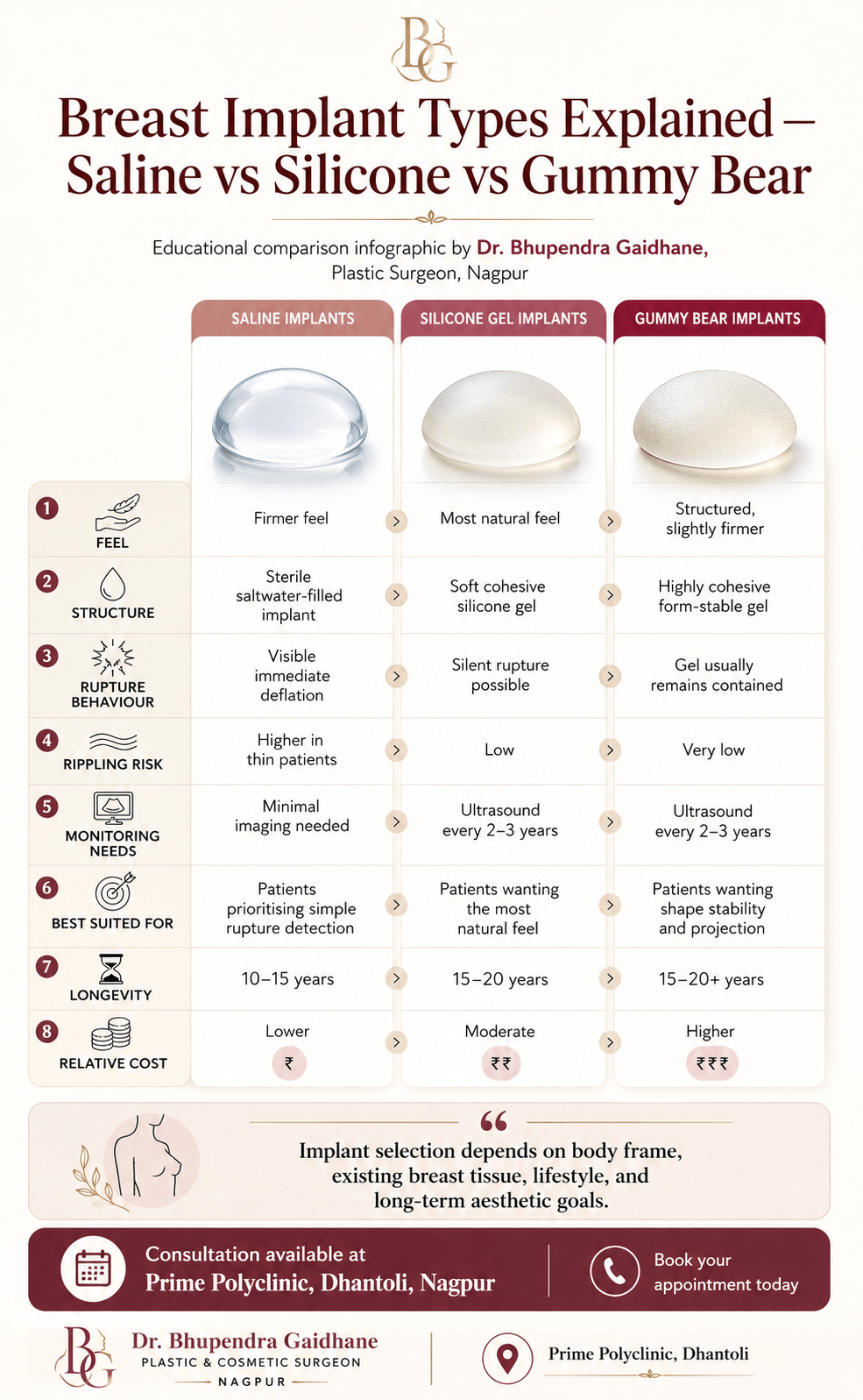
Side-by-side comparison
| Feature | Saline | Silicone Gel | Gummy Bear |
|---|---|---|---|
| Fill material | Sterile saltwater | Soft silicone gel | Highly cohesive silicone gel |
| Natural feel | Moderate | Most natural | Structured, slightly firmer |
| Shape options | Round | Round + anatomical | Round + anatomical |
| Rupture detection | Immediately visible | Silent rupture possible | Gel usually remains contained |
| Monitoring needed | Minimal | Ultrasound every 2–3 years | Ultrasound every 2–3 years |
| Suitable for thin patients | Less ideal | Yes | Yes |
| Rippling risk | Higher | Low | Very low |
| Rotation risk | None | Low | Exists in anatomical implants |
| Longevity | 10–15 years | 15–20 years | 15–20+ years |
| Relative cost | Lower | Moderate | Higher |
Choosing Implant Shape and Placement — What Actually Changes the Result?
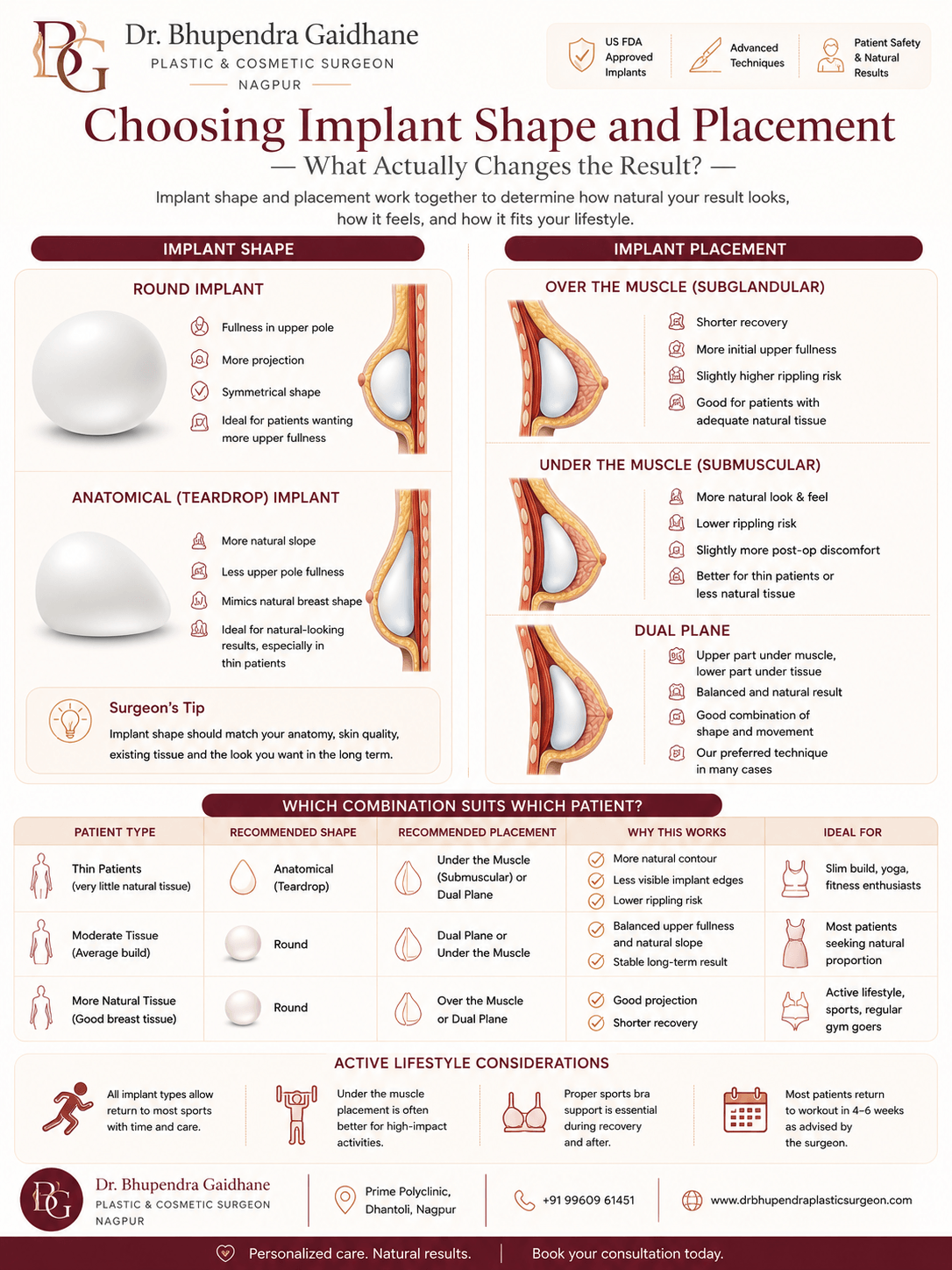
The Keller Funnel technique — why the “no-touch” approach matters
The technique used to insert a breast implant matters just as much as the implant itself.
At our clinic in Nagpur, breast implants are inserted using the Keller Funnel — a sterile, single-use device designed to allow “no-touch” implant placement.
Instead of the implant being handled directly and manually pushed through the incision, the implant is introduced into the breast pocket through the funnel in a controlled and sterile manner.
This offers several important advantages.
Reduced implant handling
The “no-touch” technique reduces direct contact between the implant and the skin surface during insertion. This helps minimise bacterial contamination, which is believed to play an important role in the development of capsular contracture — one of the most common long-term complications associated with breast implants.
Smaller incision length
Because the implant is delivered through the funnel in a compressed and controlled manner, implants can often be inserted through smaller incisions compared to traditional insertion techniques.
Smaller incisions may contribute to:
- less tissue trauma
- more refined scar placement
- improved cosmetic appearance of scars
Reduced stress on the implant shell
The Keller Funnel also reduces friction and mechanical stress during insertion, helping protect implant integrity during placement.
More comfortable early recovery
While recovery depends on multiple factors including implant placement and individual healing response, reduced tissue handling during surgery may contribute to:
- less swelling
- reduced discomfort
- smoother early recovery in some patients
At our clinic in Dhantoli, Nagpur, the Keller Funnel technique is routinely used for breast augmentation procedures as part of a precision-focused and sterility-conscious surgical approach.
Which implant type suits which patient — a practical guide
If you have very little natural breast tissue
Silicone gel or gummy bear implants placed beneath the chest muscle usually produce the most natural-looking result.
Saline implants in very thin patients are more likely to show visible edges and rippling.
If natural feel matters most to you
Standard silicone gel implants remain the closest option to natural breast tissue in both movement and softness.
This is why they remain the most commonly chosen implant type at our clinic.
If you want a more structured, sculpted result
Anatomical gummy bear implants create greater shape stability and a more defined lower pole contour.
These are useful in patients wanting stronger projection or long-term shape consistency.
If monitoring simplicity is important
Saline implants offer immediate visible rupture detection.
The trade-off is a slightly firmer feel and higher rippling risk.
If you are physically active
All implant types are compatible with sports and exercise.
Implant placement often matters more than implant type itself.
Dual plane or under-muscle placement may feel more comfortable long-term in some athletic patients.
Related reading
• Cost of breast implant surgery in Nagpur
• Recovery after breast augmentation surgery
• Breast augmentation in Nagpur
Implant brands used at our clinic — and why it matters
Not all breast implants are manufactured to the same standard.
At our clinic in Nagpur, we use Motiva implants and GC implants — both US FDA approved and backed by internationally recognised safety data and manufacturer warranty systems.
The advantage of certified implants is not just branding.
It includes:
• consistency in shell quality
• predictable gel cohesivity
• long-term safety data
• dimensional precision
• documented clinical performance
Patients should always feel comfortable asking:
• which implant brand is being used
• whether the implant is FDA approved
• what long-term monitoring is recommended
These questions matter.
Combining implants with fat grafting — when implants alone are not enough
Not every patient seeking breast augmentation wants a dramatically augmented appearance.
Some patients want:
- softer upper pole transition
- gentler cleavage contour
- less visible implant edges
- a more blended result in thin body types
In these situations, implants alone may not always create the most natural transition between the implant and the surrounding chest tissue.
This is where autologous fat grafting can become valuable.
A small amount of fat is harvested from areas such as:
- abdomen
- flanks
- thighs
…using VASER-assisted liposuction (Lipovase technology), purified carefully, and strategically placed around specific implant edges.
The goal is not additional volume.
The goal is refinement.
Fat grafting is especially useful in:
- very thin patients
- patients with visible upper implant edges
- revision breast augmentation
- patients seeking softer cleavage transitions
Not every patient requires this combination, but when selected appropriately, it can significantly improve how natural the final result appears and feels.
Learn more about VASER liposuction in Nagpur →
What happens during implant selection at consultation?
One of the biggest misconceptions about breast implants is that patients are expected to choose a cup size before consultation.
That is not how modern breast augmentation planning works.
At consultation, implant selection begins with measurements.
These include:
- chest width
- nipple position
- breast base diameter
- skin elasticity
- existing breast tissue thickness
- body proportions
Only after these measurements are taken does implant sizing begin.
Patients are also able to try physical sizer implants inside a bra during consultation to understand how different implant volumes look on their own body frame and clothing.
This process matters because:
- the same implant looks different on different body types
- cup size is not standardized
- oversizing creates long-term tissue stretching risks
- implant width must match chest dimensions
The goal is not simply to create larger breasts.
The goal is to create proportion, balance, and long-term aesthetic stability.
Common myths about breast implants
Breast implants must be replaced every 10 years
Not necessarily.
Modern implants are designed to remain stable for 15–20 years or longer. Replacement is only necessary if:
- rupture occurs
- capsular contracture develops
- the patient wishes to change size or implant type
“Silicone implants leak throughout the body”
Modern cohesive silicone implants behave very differently from older-generation liquid silicone implants.
Even in the event of rupture, the gel usually remains contained within the surrounding capsule.
“Breast implants prevent breastfeeding”
Most women with implants are able to breastfeed normally.
Implants are positioned either beneath the breast tissue or beneath the chest muscle without directly affecting milk production structures.
Future pregnancy and breastfeeding plans are discussed during consultation while planning incision placement.
“Gummy bear implants are permanent”
No implant is considered lifetime permanent.
Gummy bear implants are highly durable and shape-stable, but they still require long-term monitoring like all breast implants.
A note from Dr. Bhupendra Gaidhane
Patients often ask me:
“Which implant do you personally recommend?”
My answer is always the same:
There is no universally “best” implant.
There is only the implant that best suits the patient sitting in front of me.
The correct implant depends on:
- anatomy
- skin quality
- lifestyle
- activity level
- existing breast tissue
- long-term goals
- how natural or structured the patient wants the result to appear
What I believe strongly is this:
Implant selection should never be rushed.
Photographs online are taken:
- under controlled lighting
- on specific body types
- at flattering angles
What matters more is how the result looks and feels in normal daily life over the next 15 years.
That is why consultation at our clinic is structured carefully around planning, sizing, and long-term expectations — not simply choosing a volume number.
— Dr. Bhupendra Gaidhane
DNB Plastic Surgery
Prime Polyclinic, Dhantoli, Nagpur
Frequently asked questions
Which breast implant feels the most natural?
Silicone gel implants generally provide the softest and most natural feel, especially in thin patients with minimal natural breast tissue.
What is a silent rupture?
A silent rupture occurs when the shell of a silicone implant breaks but the gel remains contained inside the surrounding capsule without visible change in breast shape.
This is why periodic ultrasound monitoring is recommended.
Which implant is best for thin women?
Silicone gel or gummy bear implants placed beneath the chest muscle usually produce the most natural result in thin patients.
Can implants affect breastfeeding?
Most women with implants can breastfeed normally after surgery.
Future pregnancy and breastfeeding plans are discussed before surgery planning.
How long do breast implants last?
Modern implants commonly remain stable for 15–20 years or longer, although periodic monitoring is recommended.
Choosing your implant type in Nagpur — what to expect at consultation
You do not need to decide your implant type before your first consultation.
At our clinic in Dhantoli, Nagpur, consultation includes:
- body frame assessment
- implant sizing discussion
- tissue evaluation
- implant feel comparison
- shape and placement planning
- long-term expectation discussion
Physical sizer implants are also used during consultation so you can understand how different implant volumes look before surgery.
Medically reviewed and written by
Dr. Bhupendra Gaidhane
DNB Plastic Surgery
Prime Polyclinic, Dhantoli, Nagpur