
PATIENT RECOVERY GUIDE
Gynecomastia Surgery Recovery Timeline: What to Expect Week by Week
If you are planning gynecomastia surgery, it is natural to wonder how sore you will feel, when you can return to work, and when your chest will start looking settled. Recovery usually happens in stages—not all at once.
Many patients are able to walk on the day of surgery and return to light daily activities within a few days. Desk work may be possible within 3–7 days, depending on how you feel and the work you do. Swelling and firmness can take longer to settle, and the chest contour usually continues to change over the first three months.
These are general timeframes, not a personal clearance plan. Follow the instructions given by your treating surgeon, especially if your procedure or recovery is different from what is described here.
The short answer
Most people can start light activities within a few days, return to desk work in about 3–7 days, and build back towards exercise gradually. Driving may be possible after around 7–8 days, light cardio around two weeks, and gym training around six weeks—but only when healing is progressing well and your surgeon agrees. The final chest shape takes time to settle.
Recovery at a glance
Recovery is not a straight line. You may feel better one day and notice swelling or tightness the next. These milestones are a guide to what often happens—not a test you have to pass on an exact date.
Surgery day
Rest, follow discharge instructions and take short, gentle walks when advised.
Days 2–7
Dressings and garment instructions are reviewed. Swelling, bruising and tightness may be noticeable.
Week 2
Everyday movement often feels easier, though the chest may still feel firm or look uneven.
Weeks 3–6
Healing continues. Activity can be increased in stages according to your surgeon’s advice.
Around month 3
The chest contour is usually more settled, although small changes can continue beyond this point.
KEEP IT HANDY
Prefer a step-by-step guide?
Use the recovery handbook to revisit the main instructions at home. If anything in the guide differs from the advice given to you after surgery, follow your own surgeon’s instructions.
What happens immediately after surgery?
You may feel drowsy for a while after anaesthesia. The chest can feel tight beneath the dressings, and you may notice mild discomfort, bruising or swelling. The amount of discomfort varies from person to person; follow the pain-relief plan provided by your surgical team.
Before going home
Your team will check that you are recovering appropriately and can mobilise, drink fluids and pass urine as expected before discharge.
Your first night
- Rest and sleep on your back in a comfortable, slightly elevated position if advised.
- Keep prescribed medicines, water and essentials within easy reach.
- Avoid lifting, straining or raising your arms high if your surgeon has restricted these movements.
- Arrange help if you need it, and do not drive while affected by anaesthesia or pain medicines.
A common worry: “My chest feels tight and looks swollen—is something wrong?” Some tightness and swelling can be part of early healing, but a sudden change, rapidly increasing swelling or worsening severe pain should not be ignored. If you are unsure, contact your surgical team rather than trying to diagnose it yourself.
Gynecomastia surgery recovery: week by week
Your own timeline depends on the procedure performed, your general health and how your body heals. The milestones below are approximate.
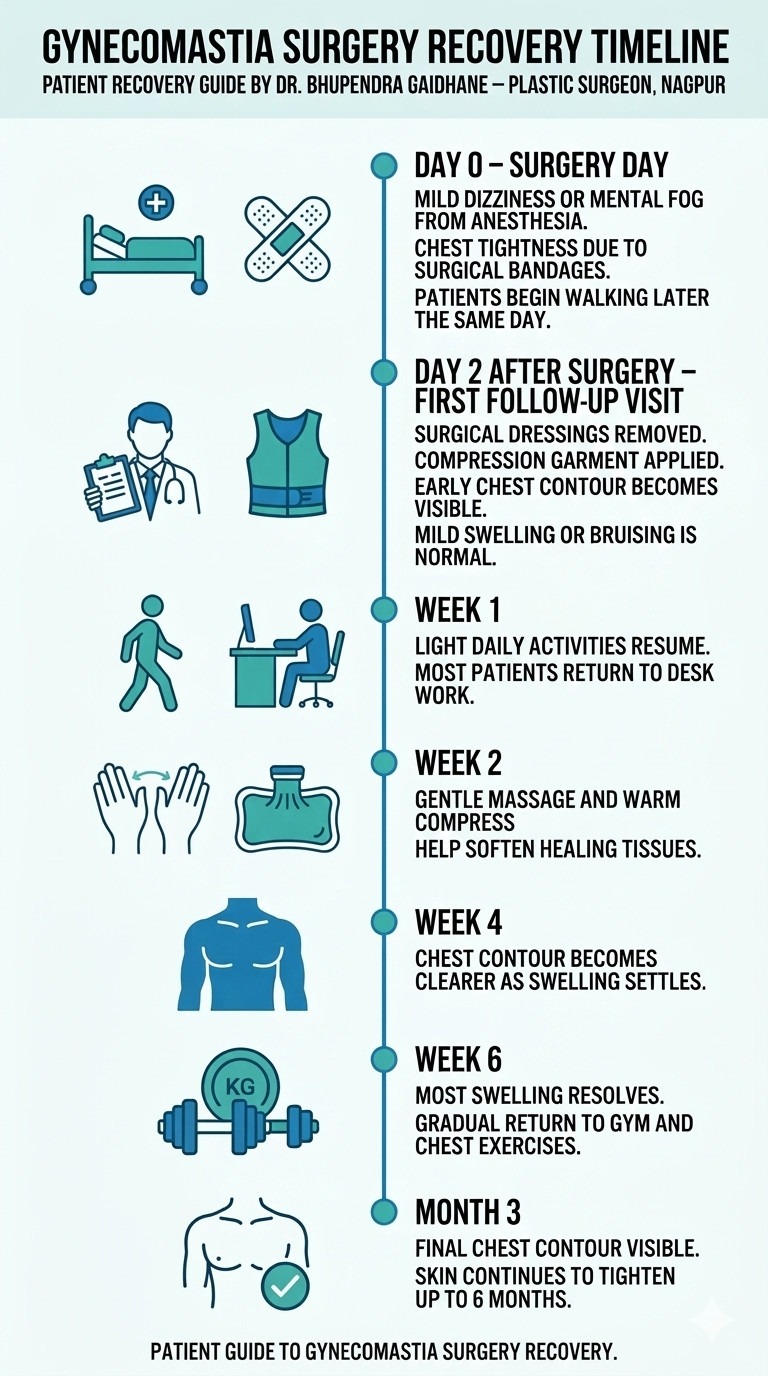
Surgery day
Rest as instructed, begin gentle walking when your team says it is appropriate, and keep the dressings in place as directed. Do not judge your final chest shape from its appearance on the first day.
First follow-up
Your dressing and compression garment plan will be reviewed. Early swelling can affect how the chest looks, so the first follow-up is mainly about checking healing and making sure you understand the care instructions.
Getting back into a routine
Many patients manage light daily activities and some desk work. Bruising, swelling, tightness or tiredness may still be present. Increase activity gradually rather than pushing through discomfort.
Feeling more mobile
Swelling may be starting to improve, but the chest can still feel firm, numb or uneven. Massage should only begin when your surgeon has advised that it is appropriate for your healing.
Gradually increasing activity
Healing continues beneath the skin even when you feel well. Follow your garment plan and increase exercise in stages, rather than returning immediately to your previous training intensity.
Assessing the developing result
The chest contour is often more settled by this stage. Some firmness, altered sensation or subtle changes can take longer to resolve. Your follow-up examination is the right place to discuss concerns about your result.
To understand what changes can look like over time, see our gynecomastia before-and-after results.
A DOCUMENTED CLINICAL CASE
See a real gynecomastia case
Recovery information helps you understand the healing process. Looking at a documented case can also help you understand the treatment journey. Every patient starts from a different place, and the procedure, healing process and result can vary.
How long should you wear the compression garment?
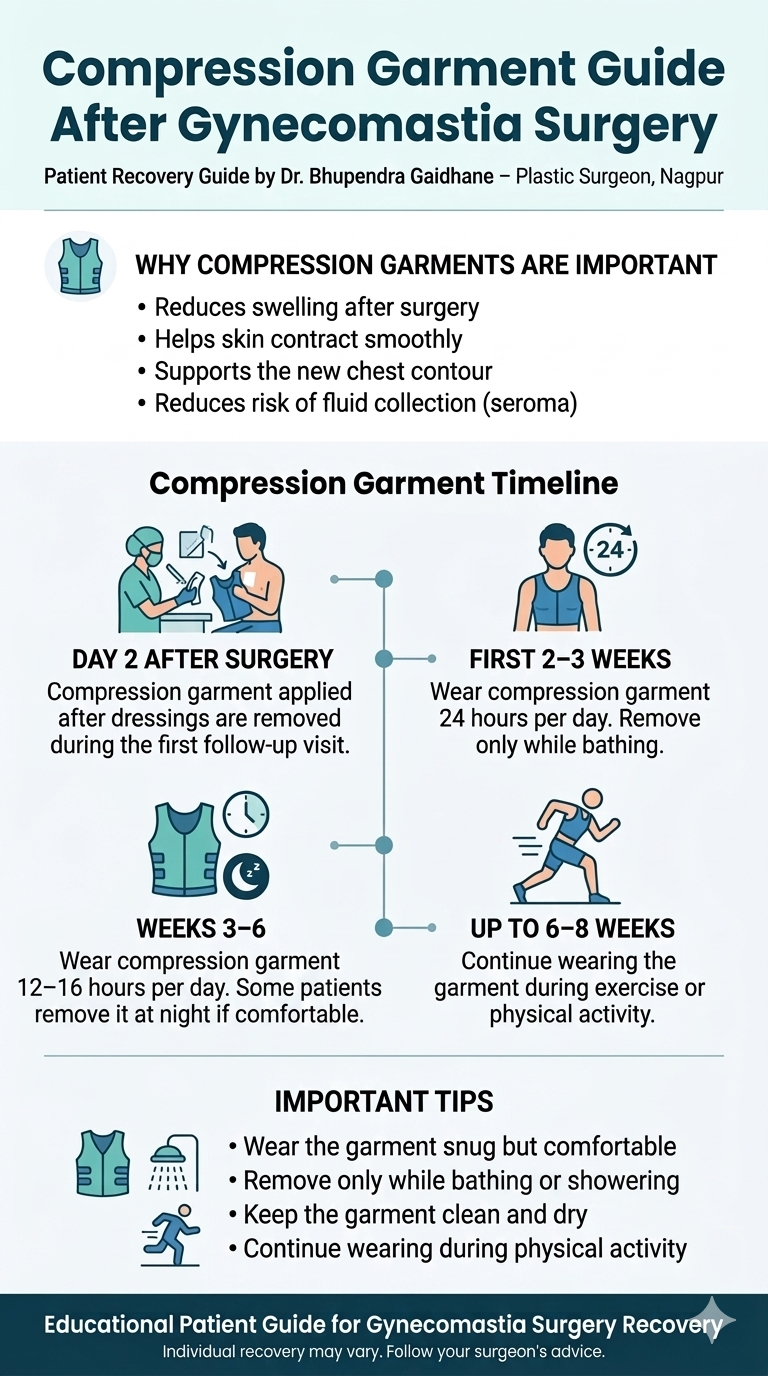
The garment supports the healing chest and may help manage swelling. It should feel supportive, not painfully tight. Your surgeon may adjust the schedule depending on your operation, skin, swelling and comfort.
Continuous wear
Wear it day and night, removing it for showering, according to your surgeon’s instructions.
Part-time wear
The usual plan is around 12–16 hours a day, if this is the schedule prescribed for you.
Review as needed
Some patients may be advised to use it during physical activity for longer. Do not extend or stop use solely based on a calendar.
If the garment causes significant pain, skin injury, breathing difficulty or a concerning change in swelling, remove pressure if necessary and seek advice promptly.
Massage, firmness and the “hard phase”
One concern patients often have is that the chest can feel hard, lumpy or slightly uneven after surgery. During healing, swelling and internal tissue changes can create areas of firmness. That does not automatically mean the final result will feel or look that way.
Firmness should gradually be assessed over time. If it is worsening, is associated with increasing pain or redness, or comes with sudden swelling, contact your surgeon rather than assuming it is normal healing.
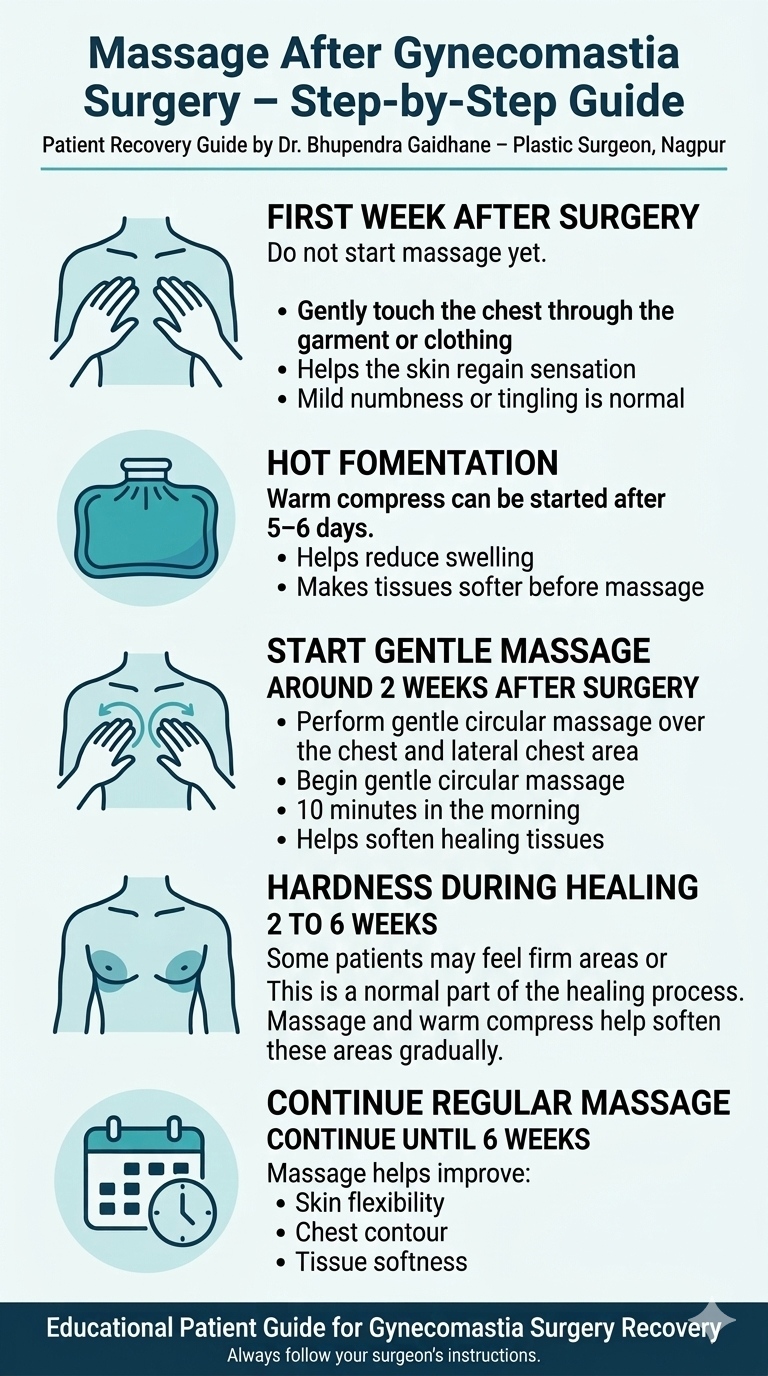
During the first week
Handle the chest gently and follow the dressing and garment instructions. Temporary numbness or tingling can occur as sensation changes during healing.
Warm compresses
They may be advised after about 5–6 days in your protocol, but only use heat when your surgeon confirms it is safe for your wounds and skin.
Gentle massage
In the usual plan described here, gentle circular massage may begin at around two weeks, with the timing and pressure guided by your surgeon. Do not massage forcefully or over an area that is unusually painful or swollen.
When can you return to work, driving and the gym?
It is understandable to want to get back to normal quickly—especially if you work, train regularly or have responsibilities at home. The safest return is gradual. Use these timeframes as a guide, not permission to resume an activity if you are still uncomfortable or taking medicines that affect alertness.
Short, gentle walks are generally encouraged. Increase duration as you feel able.
Depends on discomfort, fatigue, travel and whether your work involves lifting or physical effort.
Only when you can move comfortably, react safely, are not impaired by medication and your surgeon agrees.
Restart gently only after clearance; avoid activity that strains the chest or causes discomfort.
Return gradually after your surgeon clears you. Start below your previous intensity and increase step by step.
If your work is physically demanding, your recovery is slower than expected, or you had a more extensive procedure, you may need more time.
What is normal—and when should you seek help?
It can be difficult to know whether a change is part of healing or needs attention. You do not need to work that out alone.
Changes that can occur during healing
- Mild swelling or bruising
- Tightness in the chest
- Temporary numbness or tingling
- Areas that feel firm as tissues heal
These should generally improve over time. Tell your surgeon if you are unsure or the pattern concerns you.
Contact your surgical team promptly
- Rapid or increasing swelling, particularly if one side changes suddenly
- Severe or worsening pain
- Increasing redness, warmth, wound discharge or fever
- A wound opening or a sudden, concerning change in appearance
Seek urgent medical assessment for severe symptoms, breathing difficulty, fainting or any rapidly deteriorating condition.
Why follow-up with your surgeon matters
Gynecomastia surgery is not simply about removing tissue. The chest needs time to heal and settle, and your surgeon can assess swelling, firmness, symmetry, skin response and your return to activity during follow-up.
If something worries you, ask. A photograph or a message may help your team decide whether you need an examination, but it does not replace an in-person assessment when one is necessary.
For a broader overview of the procedure and decision-making, read our complete guide to gynecomastia surgery in Nagpur. You can also learn about VASER liposuction and see our patient results gallery.
Questions patients often have during recovery
When your chest is changing day by day, it is easy to wonder whether everything is going as it should. These are examples of the kinds of questions worth asking your surgeon. They are written in everyday language, not presented as quotations from particular patients.
“Doctor, it still looks puffy. Did the surgery work?”
It is too early to judge the final shape from the first few days or weeks. Swelling can hide the developing contour, and the chest continues to settle over time. A sudden increase in swelling—especially on one side—needs prompt assessment.
“One side feels harder, and the two sides don’t look the same. Is that expected?”
Healing is not always perfectly symmetrical, and temporary firmness can occur. But do not assume every lump or difference is normal. Tell your surgeon if it is new, getting worse, painful or changing quickly.
“I feel okay now. Can I get back to the gym—or train chest?”
Feeling better is encouraging, but deeper tissues may still be healing. Build activity back gradually and wait for your surgeon’s clearance before lifting heavy weights or restarting chest exercises.
“What if something doesn’t feel right and my next follow-up is still days away?”
You do not have to wait and worry. Contact your surgical team, explain what changed and when it began, and follow their advice. Severe pain, rapidly increasing swelling, fever or breathing difficulty needs urgent assessment.
“When will I stop thinking about every little change in my chest?”
It is understandable to watch the area closely after an operation that matters to you. Try to judge progress over time rather than checking every small change in the mirror. Keep your follow-up appointments and raise concerns that persist or worry you.
These are common examples of patient concerns, not verbatim statements from named or identifiable patients. If your question is different, ask it—there is no need to feel embarrassed about discussing your recovery.
Frequently asked questions about recovery
How long does recovery take after gynecomastia surgery?
Light activities may be possible within a few days. Many patients return to desk work in about 3–7 days, while exercise takes longer. Swelling and firmness can continue to change over several weeks, and the chest contour is often more settled around three months.
Will my chest look swollen or uneven at first?
It can. Swelling, bruising and differences between the two sides may be noticeable early in recovery. What matters is how the change develops and whether there are warning signs. Sudden or rapidly increasing asymmetry should be assessed promptly.
When can I shower?
Follow the instructions given by your surgical team. In many cases, showering is allowed after the first follow-up once dressings have been reviewed or removed, but this depends on your wounds and dressing plan.
How long should I wear the compression garment?
The schedule described on this page is continuous wear for the first three weeks, followed by around 12–16 hours a day through Week 6. Follow the plan prescribed for your own operation if it differs.
Is chest hardness after surgery normal?
Temporary firmness can occur during healing, but it should be interpreted in context. Do not assume a new, worsening, painful or rapidly changing lump is normal; contact your surgeon for advice.
When can I return to the gym?
Gradual gym training often resumes around six weeks, after your surgeon has cleared you. Chest exercises should be restarted carefully, with intensity increased step by step.
What if I am worried that my recovery is not going as expected?
Contact your surgical team and explain what has changed, when it started and whether you have pain, fever, redness or increasing swelling. If symptoms are severe or rapidly worsening, seek urgent medical assessment.
Medical reference
American Society of Plastic Surgeons (ASPS): Gynecomastia surgery recovery.
PERSONALISED GUIDANCE
Have a question about your recovery?
Recovery advice is most useful when it reflects your procedure and how you are healing. If you are considering gynecomastia surgery or want to discuss a concern, arrange a consultation.
Online booking usually takes about 2 minutes. Afternoon and evening appointments may be available depending on the booking schedule.
Prime Polyclinic, Cabin No. 3, 1st Floor, Diamond One Building, Dhantoli, Nagpur.
Nirvi 2 Surgical & Maternity Hospital, Besa, Nagpur.