
Why patients choose breast augmentation surgery in Nagpur
Patients considering breast implant surgery today are usually looking for more than simply an increase in size.
Many patients want:
- natural body proportion
- predictable recovery guidance
- discreet treatment experience
- long-term follow-up
- balanced body contour
- clear communication before surgery
At our clinic in Dhantoli, Nagpur, consultations focus not only on implant size selection, but also on:
- implant positioning
- body proportions
- scar placement
- recovery planning
- long-term expectations
Some patients also combine breast augmentation with:
- breast lift procedures
- liposuction body contouring
- post-pregnancy contour correction
Careful planning helps achieve results that fit naturally with the patient’s body structure and lifestyle.

Patients considering breast augmentation surgery often want results that look balanced, proportionate, and natural rather than excessively artificial or overdone. Before-and-after photographs help patients understand how implant size, body proportions, skin characteristics, and implant positioning influence the final outcome after breast implant surgery. In his Nagpur practice, Dr. Bhupendra Gaidhane focuses on individualized surgical planning so that breast augmentation results align naturally with each patient’s body structure, lifestyle, and long-term aesthetic goals.
Breast Implant Surgery Recovery Timeline — What to Expect Week by Week
By Dr. Bhupendra Gaidhane | Plastic & Cosmetic Surgeon, Nagpur
Understanding recovery before surgery helps reduce anxiety, improves preparation, and allows patients to return to daily life with more confidence. This detailed guide explains what most patients experience after breast augmentation surgery — from the first 24 hours to the final settling phase over the next few months.
For most women considering breast implant surgery, the biggest fear is not the operation itself — it is the recovery afterwards.
Questions like:
- “How painful will recovery be?”
- “When will I look normal again?”
- “Will people notice immediately?”
- “How long before I can return to work or exercise?”
- “Will implants always feel tight or unnatural?”
are often more stressful than the surgery itself.
The reality is that breast augmentation recovery happens in stages. Understanding those stages beforehand removes uncertainty and helps patients prepare practically — for rest, for work, for family responsibilities, and for their body’s healing process.
This guide reflects what patients commonly experience after breast implant surgery performed by Dr. Bhupendra Gaidhane in Nagpur. Every recovery is individual, but the overall healing pattern is usually very predictable.
Before we begin — what kind of recovery are we talking about?
Breast augmentation is typically performed under general anaesthesia and usually takes around 60–90 minutes. Most patients are discharged the same day or the next morning depending on the procedure, implant type, and recovery condition.
Recovery after breast implant surgery has two broad phases:
1. Active recovery phase (Weeks 1–4)
This is when:
- swelling is most noticeable
- chest tightness is highest
- activity restrictions are important
- the body focuses on incision and pocket healing
This is the phase patients usually worry about the most.
2. Settling phase (Weeks 5–16)
This is when:
- implants gradually soften
- swelling continues to improve
- implants descend into a more natural position
- the breast begins to look and feel more natural
Understanding both phases is important because the result seen at 2–3 weeks is not the final result.
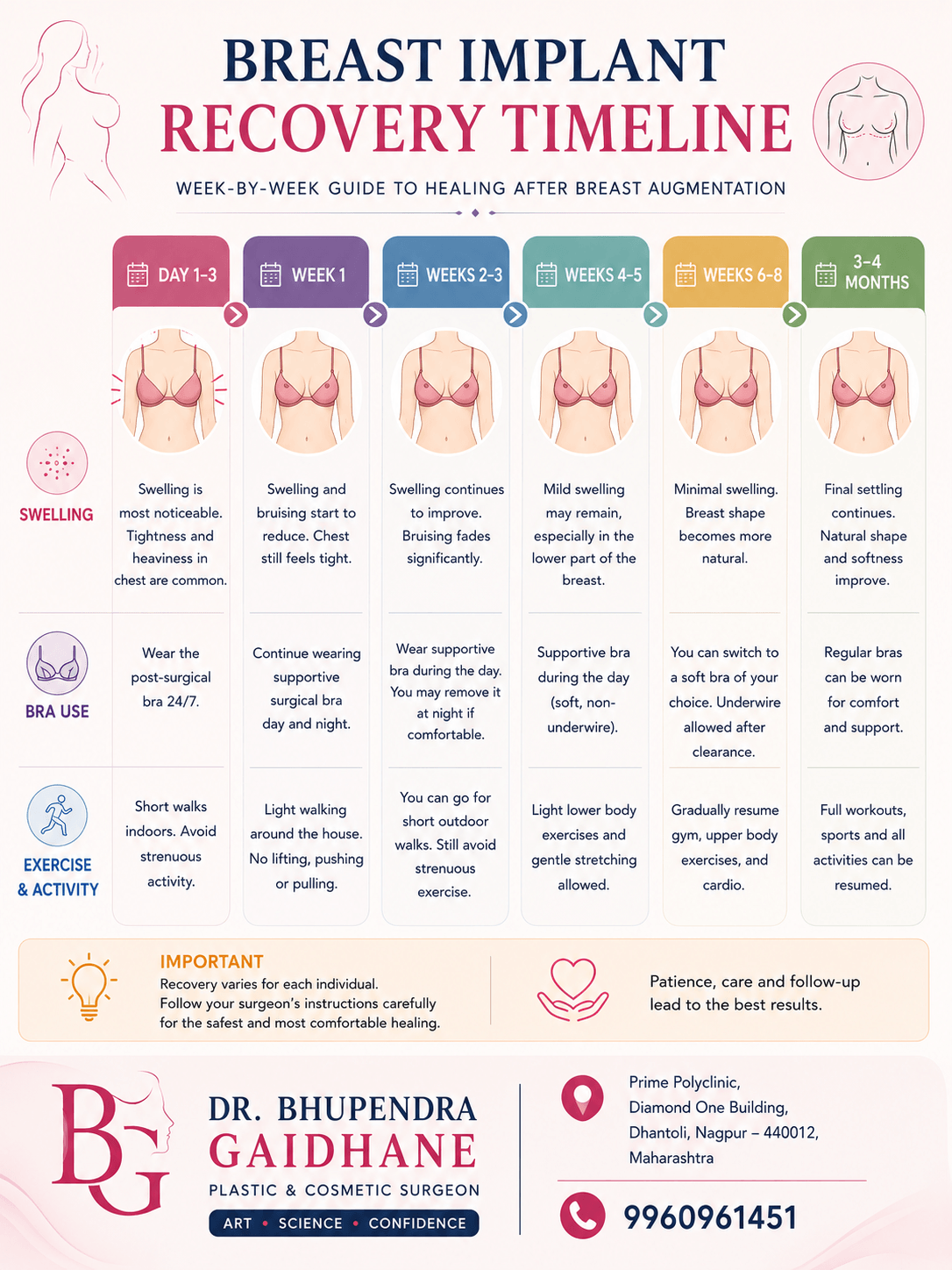
Understanding the breast implant recovery timeline visually often makes the healing process feel far less overwhelming for patients. While every individual heals differently, most women experience a gradual progression from swelling and tightness in the early weeks to softer, more natural implant settling over the following months. During consultations in Nagpur, Dr. Bhupendra Gaidhane explains recovery expectations in detail so patients understand not only the surgery itself, but also the healing process that follows breast augmentation.
Breast augmentation surgery page
My approach to breast implant recovery planning
In my practice, recovery planning starts before surgery itself.
Implant size, implant profile, skin elasticity, existing breast tissue, muscle tightness, lifestyle, exercise habits, and future pregnancy plans all influence recovery and long-term outcomes.
Patients are guided regarding:
- implant selection
- bra support
- sleeping positions
- activity progression
- scar care
- exercise restrictions
- expected implant settling timelines
The goal is not only achieving an aesthetic result, but also helping patients recover in a way that feels structured, predictable, and safe.
Day of surgery and discharge
You will usually leave the clinic wearing a soft post-surgical bra or compression garment over the chest. There will be some tightness — not sharp pain. Most patients describe the sensation as pressure or heaviness across the chest, similar to a very firm stretch or tight gym soreness.
You will need someone to drive you home and ideally stay with you during the first 24 hours after surgery.
What you will have after surgery
- a post-surgical bra
- prescribed medications
- dressing instructions
- sleeping position guidance
- activity restrictions
Following these instructions carefully helps reduce swelling and supports smoother healing.
Sleeping position after surgery
For the first 2–3 weeks, patients are usually advised to sleep on their back with the upper body slightly elevated using pillows or a recliner position. This helps reduce swelling and avoids pressure on the chest.
Is breast implant recovery very painful?
Most patients are surprised that breast implant recovery is more manageable than they expected.
The most common sensation during the first few days is usually:
- chest tightness
- heaviness
- pressure across the chest
rather than severe sharp pain.
Patients with implants placed beneath the chest muscle may experience slightly more tightness during the first 1–2 weeks because the muscle has to adapt to the implant position.
Pain generally improves steadily over the first week, and many patients shift to mild pain medication within a few days.
Week 1 — The most important healing phase
This is when the body performs the heaviest healing work. It is also when patients feel the most physically restricted.
What patients commonly experience
- chest tightness
- swelling and bruising
- fatigue
- limited arm movement
- discomfort while changing position
- temporary numbness or increased nipple sensitivity
These symptoms are expected and gradually improve.
What you can do during week 1
- gentle walking inside the house
- short periods of movement to improve circulation
- regular hydration
- medication as prescribed
- light daily activity without strain
Most patients begin feeling significantly more comfortable by day 4–5.
What should be avoided
- lifting heavy objects
- reaching overhead
- gym activity
- sleeping on the side or stomach
- pushing or pulling movements
- underwire bras
Returning to work
Patients with desk-based jobs may sometimes return to work-from-home activity within 5–7 days.
Physically demanding work usually requires longer recovery.
Why do breast implants look high immediately after surgery?
One of the most common causes of anxiety after breast augmentation is implants appearing “too high” during the first few weeks.
This is completely expected.
Immediately after surgery:
- the chest muscle is tight
- swelling is present
- tissues are firm
- the implant pocket has not yet relaxed
As healing progresses, the implants gradually descend into a more natural position. This process is commonly called “drop and fluff.”
For some patients, noticeable settling occurs within 4–6 weeks. For others, the process continues gradually for several months.
Early appearance should never be judged as the final result.
Weeks 2–3 — Recovery becomes easier
This is the phase when most patients begin feeling noticeably better.
Common changes during this stage
- swelling gradually reduces
- bruising fades
- chest tightness improves
- energy levels return
- movement becomes easier
- implants still appear slightly firm or elevated
Patients often become more confident during this stage because daily activities begin feeling normal again.
What patients can usually resume
- light office work
- short outdoor walks
- gentle routine activity
- driving after surgeon clearance
- side sleeping if comfortable
Activities still avoided
- gym workouts
- upper body exercise
- chest-focused movement
- swimming
- lifting heavier weights
Scar therapy is often started during this period once incisions are fully healed.
Can breast implant surgery be hidden from work or family?
Many patients plan breast augmentation surgery around work schedules, travel, social events, or family responsibilities.
In most cases:
- visible bruising improves significantly within 2–3 weeks
- loose clothing conceals swelling relatively well
- desk work is often resumed within a week
- routine social interaction becomes comfortable early in recovery
However, internal healing still continues even when patients externally appear normal.
Planning recovery properly beforehand usually makes the process significantly less stressful.
Weeks 4–5 — Returning to normal daily life
By this stage, most patients feel significantly more comfortable in daily activities.
What commonly improves
- swelling becomes much less noticeable
- implants begin softening
- breast shape appears more natural
- nipple sensitivity starts normalising
- mobility improves substantially
Activities usually resumed
- routine office work
- lower body exercise
- walking
- light cycling
- routine social activity
Activities still approached cautiously
- chest workouts
- push-ups
- heavy upper body lifting
- intense gym training
Scars may still appear pink or firm at this stage. Scar maturation continues for several months.
Weeks 6–8 — Full activity phase
By week 6, many patients are gradually cleared for most normal activities including gym exercise and sports depending on healing progress.
Common improvements
- implants feel softer
- movement feels more natural
- residual swelling improves further
- breast shape settles more naturally
Activities usually resumed
- swimming
- gym training
- upper body exercise
- travel
- underwire bras after clearance
- unrestricted routine activity
Chest exercises should still be restarted gradually with lower weight initially.
Understanding “drop and fluff” after breast augmentation
The breast shape seen during the first few weeks after surgery is not the final result.
Immediately after surgery:
- implants sit higher
- tissues feel tighter
- the lower breast appears less full
Over the following weeks and months:
- implants descend gradually
- tissues soften
- the lower breast gains more natural fullness
- movement becomes more natural
This process is known as “drop and fluff.”
Some patients experience faster settling while others may continue seeing subtle changes for 3–4 months.
Patience during this phase is extremely important.
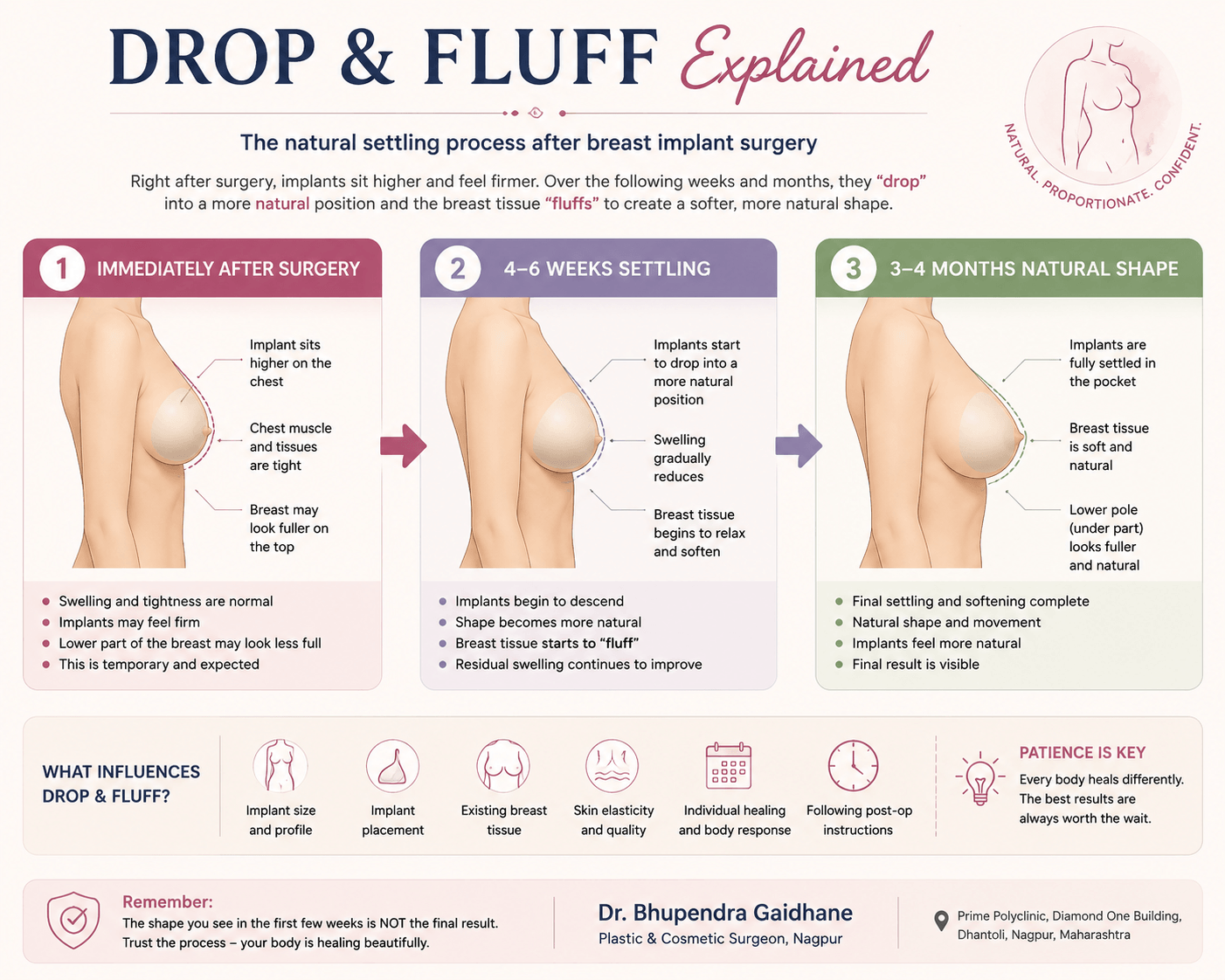
The “drop and fluff” process is one of the most commonly misunderstood stages of breast implant recovery. Immediately after surgery, implants often appear higher, firmer, and less natural due to swelling and tissue tightness. Over time, the implants gradually settle into a softer and more proportionate position. Dr. Bhupendra Gaidhane focuses heavily on educating patients about this normal healing phase during breast augmentation consultations in Nagpur so that temporary early changes are not mistaken for final results.
What is normal during recovery — and when should you contact your surgeon?
Certain physical changes during breast implant recovery are completely expected and temporary.
Usually normal during healing
- swelling
- mild asymmetry
- temporary firmness
- implants sitting high initially
- temporary numbness
- nipple sensitivity changes
- bruising
- itching near the incision
These usually improve gradually as healing progresses.
Contact your surgeon if you notice
- sudden severe swelling
- rapidly increasing pain
- fever or chills
- spreading redness
- significant fluid leakage
- breathing difficulty
- one breast suddenly enlarging rapidly
- severe worsening firmness
Early evaluation is important whenever symptoms feel unusual or progressively worsening.
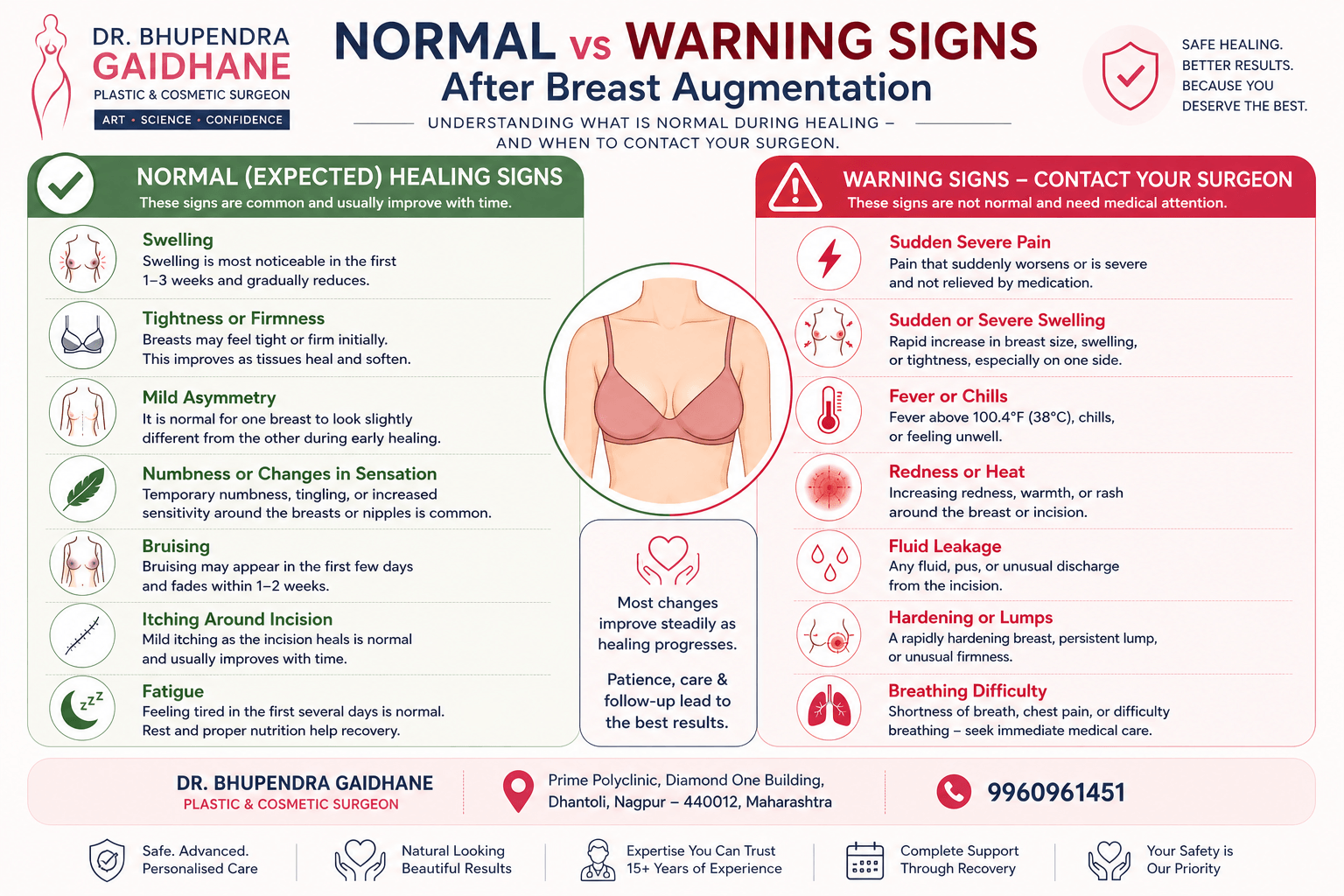
Many temporary symptoms after breast augmentation surgery are completely normal and improve steadily during healing. Swelling, tightness, mild asymmetry, and temporary firmness are expected during the early recovery period. However, symptoms such as sudden swelling, worsening pain, fever, or rapidly increasing redness should always be evaluated promptly. In his Nagpur practice, Dr. Bhupendra Gaidhane emphasizes structured follow-up and patient education so that recovery remains safe, predictable, and well-monitored throughout the healing process.
Understanding realistic expectations after breast augmentation
Modern breast implant surgery can create very natural-looking results, but healing requires patience.
Immediately after surgery:
- implants may look overly prominent
- swelling temporarily changes breast shape
- asymmetry may appear exaggerated
- breasts often feel firmer than expected
This is usually part of normal healing rather than a problem with the surgery itself.
Final outcomes depend on:
- implant size and profile
- skin elasticity
- tissue characteristics
- healing response
- implant settling
Patients who understand the recovery process beforehand usually experience much less anxiety during healing.
Planning your recovery before surgery
Preparing properly before surgery usually makes recovery smoother and less stressful.
Helpful preparation steps include:
- arranging 5–7 days of reduced activity
- preparing loose front-open clothing
- arranging help for childcare or lifting tasks
- creating a comfortable sleeping setup beforehand
- informing employers early if leave is required
- planning transportation after surgery
The more organised the recovery environment is beforehand, the more comfortable the healing process usually becomes.
Planning breast implant surgery in Nagpur
Choosing breast implant surgery is not only about implant size or shape — it is also about understanding recovery properly before making a decision.
During consultation, patients are guided through:
- implant options
- implant positioning
- incision planning
- expected recovery stages
- bra support
- scar care
- activity restrictions
- long-term implant care
Understanding these details beforehand helps patients approach surgery with greater confidence and realistic expectations.
Dr. Bhupendra Gaidhane
Plastic & Cosmetic Surgeon, Nagpur
Prime Polyclinic, Diamond One Building, Dhantoli, Nagpur
Breast Augmentation Surgery in Nagpur
https://www.drbhupendraplasticsurgeon.com/breast-augmentation/
Frequently asked questions — breast implant surgery recovery in Nagpur
How long does it take to recover from breast implant surgery in Nagpur?
Most patients return to desk work within 5–7 days. Physical activity and gym exercises are typically resumed from week 5–6 onward. The final result — with full softening and natural drape — is visible at 3–4 months after surgery.
When can I sleep normally after breast augmentation?
For the first 2–3 weeks, sleeping on your back with your upper body slightly elevated is recommended. Side sleeping is generally comfortable from week 3–4. Sleeping face down should be avoided for at least 6 weeks.
What is “drop and fluff” after breast augmentation?
“Drop and fluff” describes the natural settling process that occurs in the first 6–12 weeks after surgery. Initially, implants sit high on the chest and feel firm. Over weeks, they descend into a more natural position and soften as the surrounding tissue relaxes.
When can I wear an underwire bra after breast implant surgery?
An underwire bra is typically avoided for the first 6–8 weeks. In the early weeks, a soft supportive post-surgical bra or sports bra is recommended. Your surgeon will advise when it is safe to return to regular bras based on your healing progress.
Is it normal for one breast to look different from the other during recovery?
Yes. Asymmetry during the healing phase is very common. Swelling resolves at different rates on each side, and implants settle at different speeds. Most asymmetry resolves by 6–8 weeks. If it persists beyond 3 months, consult your surgeon.
When will my breast implants look and feel normal?
Implants look significantly more natural by 6–8 weeks once swelling resolves. The final settled result — with natural softness, drape, and position — is typically visible at 3–4 months after surgery.
Can I travel by flight after breast augmentation surgery?
Short flights under 2 hours are generally possible after 10–14 days. For longer flights, wait 3–4 weeks and move your arms and walk periodically during the flight to support circulation.
Breast implant recovery timeline — quick overview
| Timeline | Recovery Milestone |
|---|---|
| Day 1–2 | Rest, walking indoors, compression bra |
| Day 3–5 | Reduced pain, light routine activity |
| Week 1 | Desk work possible for some patients |
| Week 2–3 | Swelling improving, driving possible |
| Week 4–5 | Most daily activity comfortable |
| Week 6–8 | Gym, swimming, full exercise gradually resumed |
| 3–4 months | Final implant settling and softening |