• Prime Polyclinic, Cabin no 3, 1st Floor, Dimond One Building, Dhantoli, Nagpur, Maharashtra 440012

All posts by Dr Bhupendra Gaidhane

Multiple Lipoma Removal in Nagpur: A Smarter, Low-Scar Approach Using Liposuction-Assisted Surgery

multiple lipoma removal liposuctionDr. Bhupendra Gaidhane, Plastic Surgery  ·  Plastic, Cosmetic & VASER Liposuction Surgeon  ·  Nagpur, Maharashtra

🔍 Quick Summary — For Patients & Doctors

Key Takeaways from This Page

  • Multiple lipomas in Nagpur can be treated using a combination of liposuction and targeted micro-excision in a single session
  • This hybrid approach significantly reduces the number of scars compared to traditional excision surgery
  • The forearm is one of the most commonly treated areas — thin skin allows better contour feedback and clustered access
  • Most patients prefer fewer scars even if minor touch-ups may rarely be needed later
  • New lipomas can still develop over time regardless of technique — treatment removes what is present, not what may form
  • Dr. Bhupendra Gaidhane uses VASER/Lipovase technology for precise, minimally invasive lipoma removal in Nagpur
  • Ideal for patients with multiple soft, mobile lipomas and cosmetic concerns
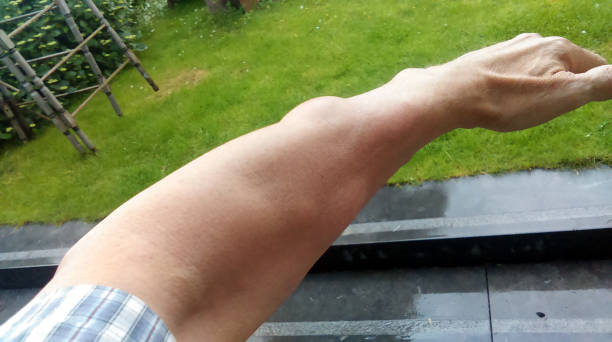
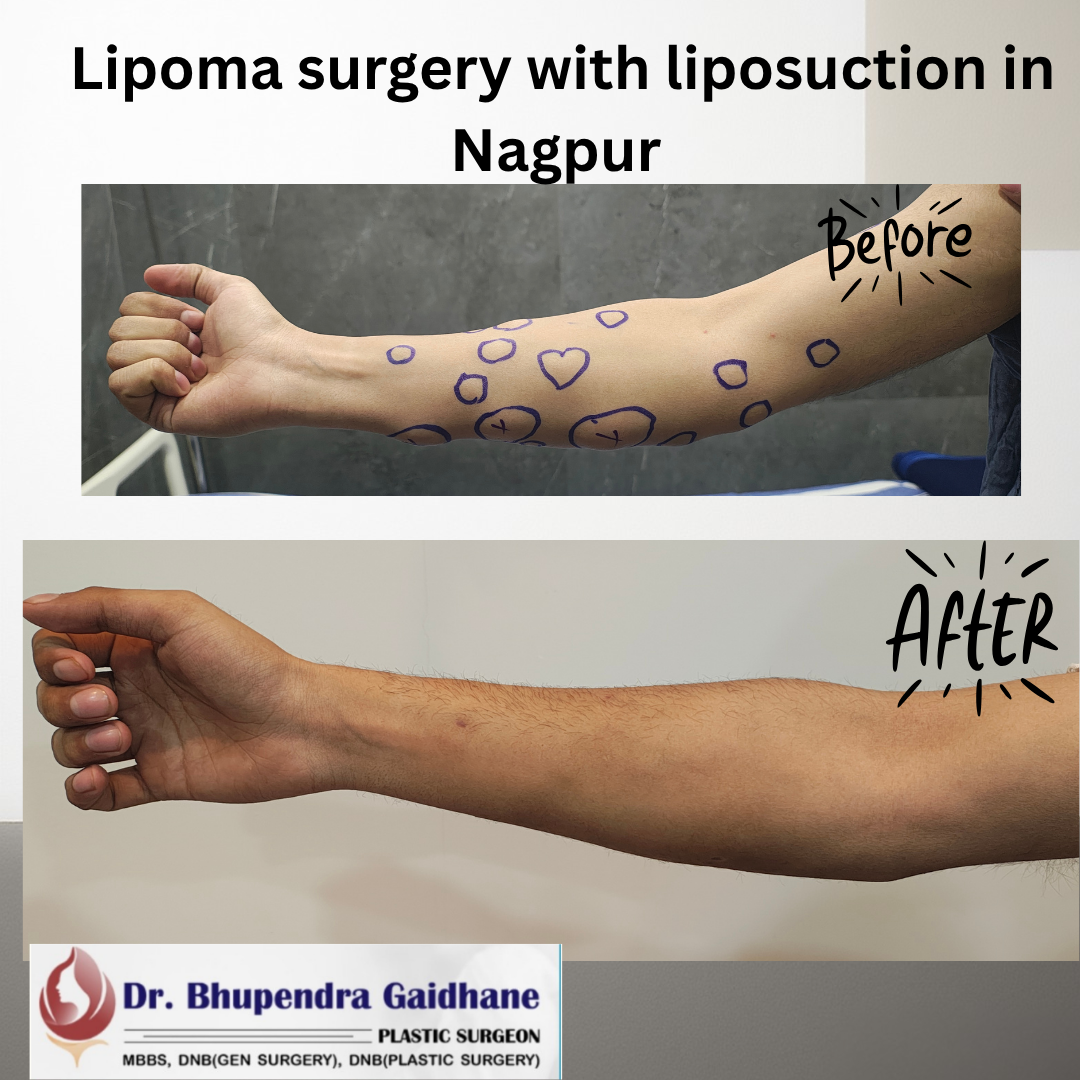
“Multiple forearm lipomas removed using minimal-incision liposuction technique in Nagpur.”
“Several forearm lipomas cleared through tiny entry points using liposuction-assisted extraction, leaving minimal scars and a smooth contour.”

If You Have Multiple Lipomas, Your Real Concern Isn’t Just the Lumps

You are not worried about one lipoma. You are thinking about all of them — the ones on your forearm, the one on your back, the cluster near your shoulder. And more than the lumps themselves, you are thinking:

  • “Will I end up with a scar for every single lipoma?”
  • “Can all of them be removed in one procedure?”
  • “What if they come back?”

In our experience at the clinic in Nagpur, most patients delay treatment not out of fear of surgery — but out of fear of visible scars and the thought of repeated procedures. This guide addresses exactly those concerns, and explains how a structured, technique-based approach can deliver better results with fewer trade-offs.

Understanding Multiple Lipomas: What You Are Dealing With

Lipomas are benign (non-cancerous) fatty growths that develop slowly beneath the skin. They feel soft, rubbery, and move easily when pressed. While medically harmless in the vast majority of cases, they become a genuine concern when:

  • They increase in number — particularly in patients with a genetic tendency (familial multiple lipomatosis)
  • They appear on visible areas like the forearms, neck, or back
  • They grow large enough to cause discomfort, restrict movement, or affect clothing choices
  • They affect body confidence and quality of life

Common locations include the forearms, back, abdomen, shoulders, and thighs. Forearm lipomas in particular are frequently brought to consultation because they are hard to conceal and appear in clusters.

Important: Not all lumps are lipomas. Any new, rapidly growing, firm, or painful lump should be evaluated by a qualified surgeon before treatment. A clinical examination — and sometimes an ultrasound — is always recommended before any procedure.

Traditional Lipoma Excision: The Gold Standard and Its Limitations
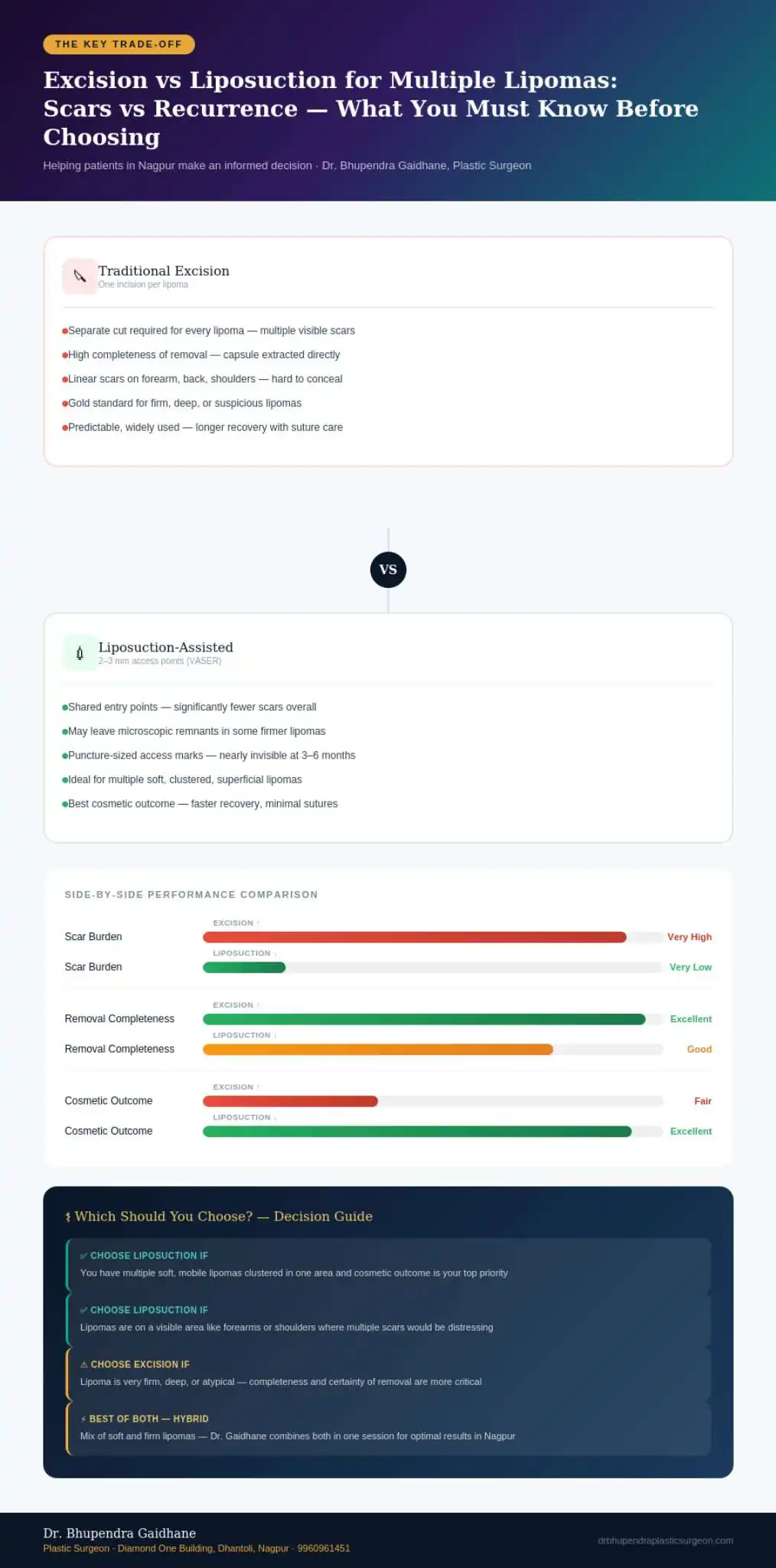
multiple lipoma removal liposuction vs excision comparison

Traditional surgical excision remains the most widely used technique for lipoma removal. It involves:

  • One incision per lipoma, sized to allow complete extraction
  • Direct removal of the lipoma with its capsule
  • Closure with sutures, leaving a linear scar

It is a predictable, reliable, and well-established method. For a single lipoma, it is often the right choice. However, for patients with multiple lipomas across the same area, the limitation becomes clear quickly: multiple lipomas means multiple scars.

A patient with six lipomas on their forearm would require six separate incisions — six scars — using traditional excision alone. This is often more cosmetically disruptive than the lipomas themselves.

Liposuction-Assisted Lipoma Removal: Treating the Area, Not Just Each Lump

This is where a technique-based approach changes the outcome completely. Instead of operating on each lipoma individually, liposuction-assisted removal focuses on treating the entire involved area strategically through a small number of access points.

The core principle is simple: limited access, unlimited reach.

  • 2–3 mm access points are created at key positions in the area
  • A thin cannula is tunnelled under the skin, reaching multiple lipomas from each entry point
  • Multiple lipomas are aspirated or extracted through these minimal ports

At our clinic in Nagpur, Dr. Bhupendra Gaidhane uses VASER (Lipovase) technology for this — an ultrasound-assisted method that emulsifies the fat within the lipoma before removal, making aspiration more precise and tissue trauma significantly lower.

⚡ Why VASER Makes a Difference for Lipoma Removal
  • Ultrasound energy selectively targets fat cells — lipoma tissue breaks down more efficiently
  • Surrounding blood vessels, nerves, and connective tissue are better preserved
  • Less bruising, less swelling, faster recovery compared to traditional liposuction
  • Allows more precise contouring — important for visible areas like the forearm
  • Published literature in the Journal of Cutaneous and Aesthetic Surgery supports liposuction as an effective technique for multiple lipomas with superior cosmetic outcomes

The Most Important Decision: Scars vs Recurrence — Understanding the Real Trade-Off

When patients research lipoma removal, two fears dominate: scarring and recurrence. Here is an honest, evidence-based breakdown of both.

Scarring

Traditional excision leaves one linear scar per lipoma — typically 2–5 cm depending on size. Liposuction-assisted removal leaves access scars of 2–3 mm — the size of a small puncture. The difference, especially across multiple lipomas, is dramatic.

Recurrence

This is where many patients misunderstand something important. There are two types of “recurrence” to understand:

  1. True recurrence at the same site: Published surgical literature reports this at 1–5% for superficial lipomas when removed competently. It is low regardless of technique.
  2. New lipomas forming over time: This is not recurrence — it is a separate biological event. Patients with a genetic tendency will continue to form new lipomas in different locations over years. No surgical technique prevents this. It is important that patients understand this distinction before choosing their approach.
Key truth: Liposuction may occasionally leave microscopic remnants. Excision is more complete. But new lipomas forming elsewhere have nothing to do with the technique used — they are a reflection of the underlying tendency.

Factor Traditional Excision Liposuction-Assisted
Scar per lipoma One linear scar each Shared 2–3 mm access points
Scar visibility High — linear, longer Minimal — puncture-size
Removal completeness High (capsule removed) Good (may leave traces)
Best for Firm, deep, or single lipomas Multiple soft, clustered lipomas
Cosmetic outcome Fair (multiple scars) Excellent (fewer access marks)
Recovery Moderate — suture care required Faster — minimal sutures
VASER-compatible No Yes — used at our Nagpur clinic

The Hybrid Approach: Where Real Expertise Lies
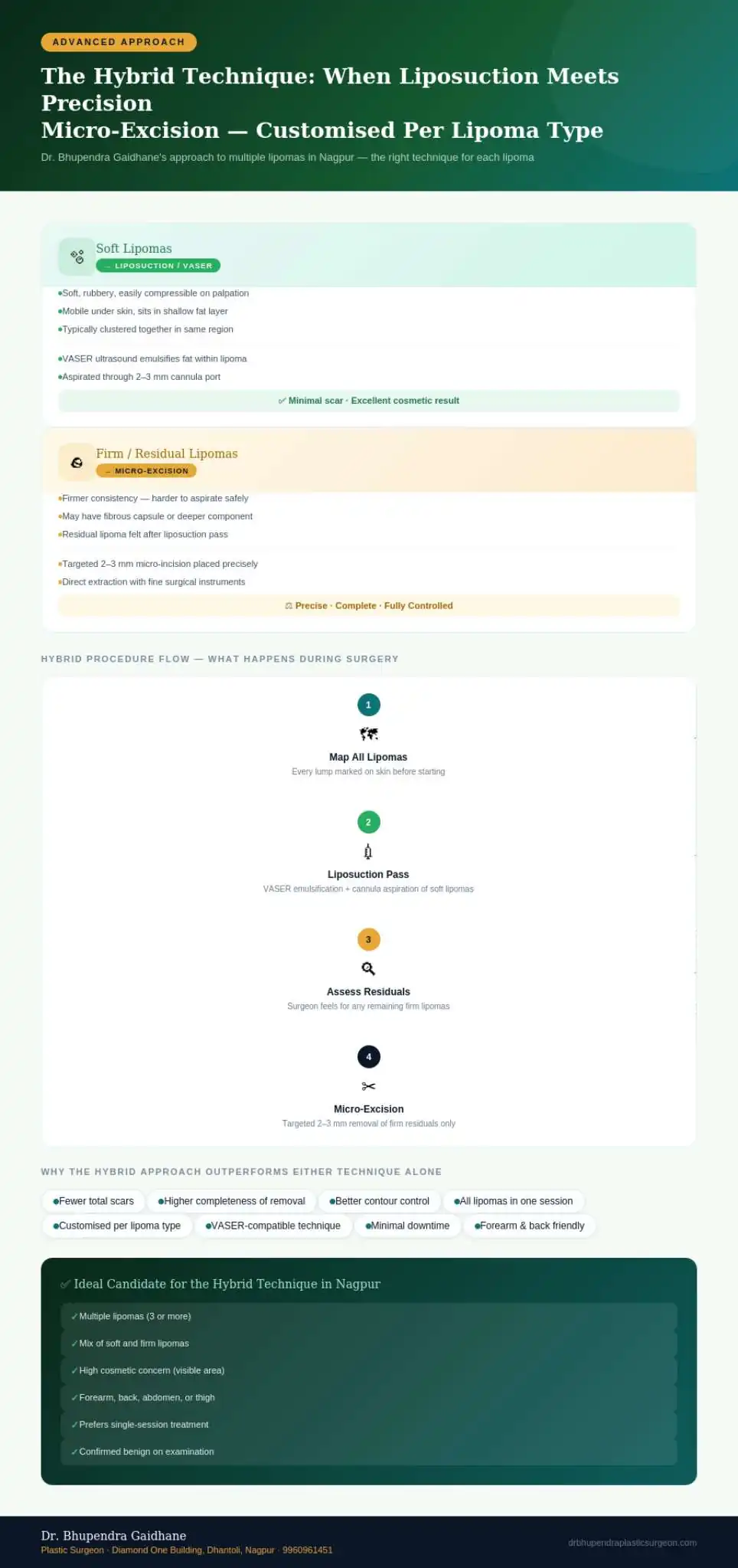
hybrid lipoma removal technique liposuction micro excision

In practice, the best outcomes come not from a single technique but from knowing when to use which one — and combining them intelligently within the same procedure.

Dr. Bhupendra Gaidhane’s approach in Nagpur is not purely liposuction or purely excision. It is a structured hybrid:

🫧 Soft, Mobile Lipomas → Liposuction
  • Soft, compressible, shallow lipomas
  • VASER emulsification + cannula aspiration
  • 2–3 mm access, minimal trauma
  • Ideal for clustered forearm lipomas
🪨 Firm or Residual Lipomas → Micro-Excision
  • Firmer, capsule-containing, or residual lipomas
  • Targeted 2–3 mm micro-incision
  • Direct extraction with fine instruments
  • Used only where liposuction is insufficient

This approach allows better completeness than liposuction alone, significantly fewer scars than excision alone, and a controlled, predictable result for the patient.

How the Procedure Works: Step by Step

1
📍
All lipomas mapped and marked on skin pre-procedure
2
💉
Local or tumescent anesthesia administered to the area
3
🔩
2–3 mm access ports created at strategic positions
4
Cannula tunnels through fat layer — lipomas aspirated or micro-excised

Why Forearm Lipomas Are Particularly Well-Suited for This Approach in Nagpur

The forearm is one of the most commonly treated areas for liposuction-assisted lipoma removal, and for good reason:

  • Thin overlying skin allows the surgeon to feel and assess contour changes in real time during the procedure
  • Lipomas on the forearm are commonly clustered together, making tunnelled access highly efficient
  • The entire forearm can typically be addressed through just 2–4 access points in a single session
  • The forearm is a highly visible area — minimising scar burden here has a significant cosmetic impact on daily life

Most patients who come to our clinic in Nagpur with forearm lipomas prefer to have the entire area treated in one session rather than staged procedures.

Recovery After Liposuction-Assisted Lipoma Removal in Nagpur
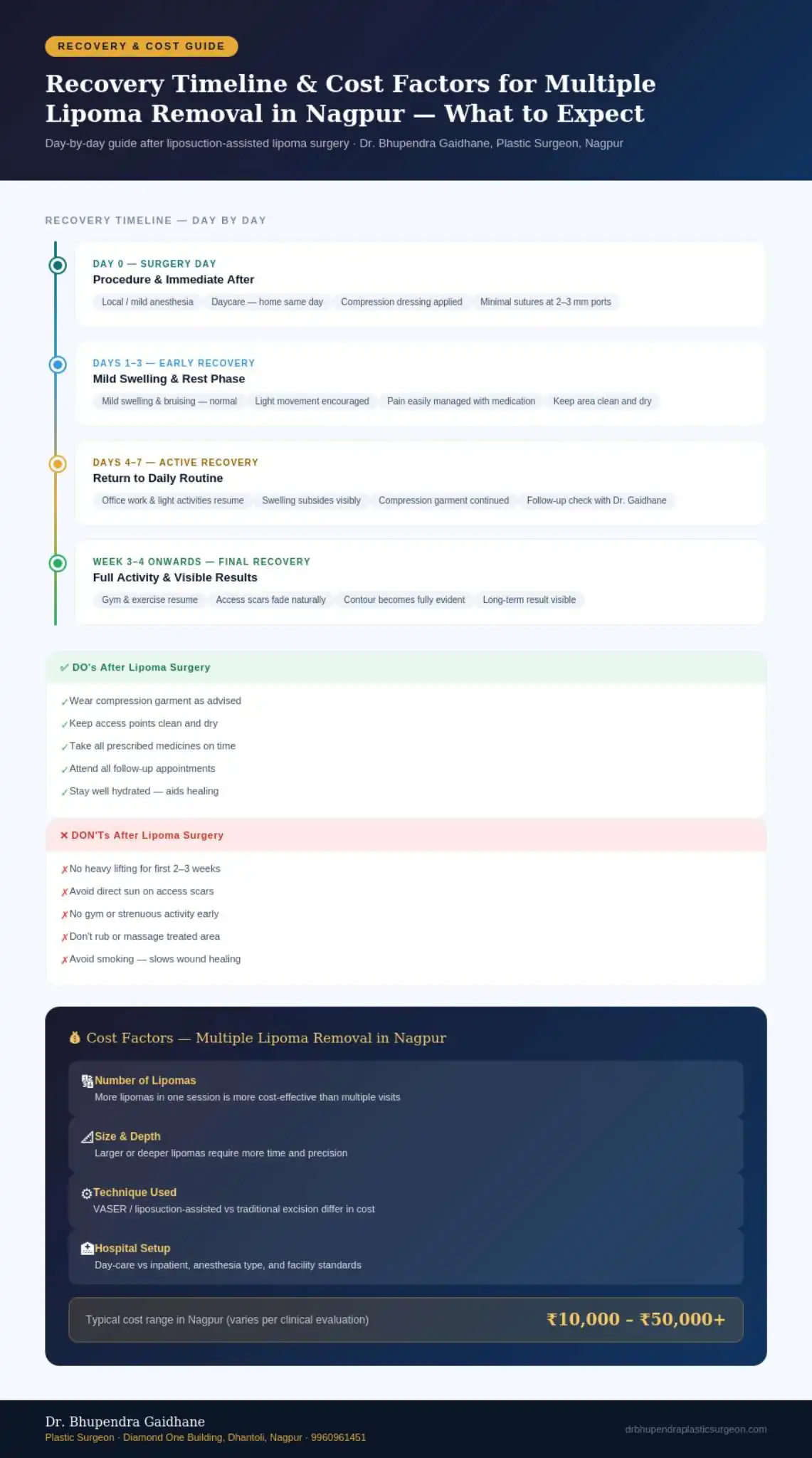
lipoma surgery recovery timeline and cost nagpur

Recovery is generally smooth and manageable. Here is what patients typically experience:

  • Day of procedure: Daycare — patients go home the same day. Compression dressing applied. Minimal sutures at access points.
  • Days 1–3: Mild swelling and bruising are normal. Light movement is encouraged. Discomfort is manageable with standard prescribed medication.
  • Days 4–7: Most patients return to desk work and light daily activity. Swelling begins to subside noticeably.
  • Week 3–4 onwards: Gym and strenuous activity can be resumed. Access point scars fade naturally. Final contour becomes clear.
✅ Recovery Tips
  • Wear compression garment as advised by Dr. Gaidhane — this significantly helps with swelling and contour
  • Keep the access points clean and dry in the first week
  • Attend your follow-up — residual firmness at treated areas is normal and resolves with time
  • Avoid direct sun exposure on access scars for 2–3 months to prevent darkening

Who Is a Good Candidate for Liposuction-Assisted Lipoma Removal?

✅ Ideal Candidates

Multiple soft, mobile lipomas (3 or more)
Clustered distribution in one region
High cosmetic concern — visible area
Forearm, back, abdomen, or thigh lipomas
Preference for minimal scar burden
Confirmed benign on clinical examination
⚠️ Not Ideal — Requires Different Approach
  • Very firm lipomas that cannot be adequately emulsified — excision preferred
  • Suspicious, rapidly growing, or atypical lumps — biopsy and evaluation first
  • Deep intramuscular lipomas — require planned open excision
  • Lipomas adjacent to major nerves or vessels — detailed planning required

What the Medical Literature Says

📚 Clinical Evidence

Published literature supports liposuction as an effective, cosmetically superior technique for multiple lipomas. Studies have demonstrated good outcomes with significantly reduced scar burden, particularly for clustered, superficial lipomas in visible anatomical regions.

A review in the Journal of Cutaneous and Aesthetic Surgery noted liposuction’s effectiveness for multiple lipoma management with lower scar-related morbidity compared to excision. The Dermatologic Surgery Journal has documented combined technique outcomes in selected patients as producing superior overall results.

Combination approaches — using liposuction for soft lipomas and micro-excision for firmer residuals — are increasingly reported as the preferred strategy for patients with multiple lipomas and cosmetic concerns.

Frequently Asked Questions: Multiple Lipoma Removal in Nagpur

1. Can all my lipomas be removed in one surgery in Nagpur?
In many cases — especially for forearm or localised clusters — multiple lipomas can be treated in a single session. A patient with 5–8 forearm lipomas, for example, can often have all of them addressed in one sitting at our Nagpur clinic. Very large numbers or lipomas spread across multiple body areas may require staged procedures, which we discuss in detail at consultation.
2. Will I have scars after liposuction-based lipoma removal?
Yes — but they will be very small. Liposuction-assisted removal leaves access scars of approximately 2–3 mm, significantly fewer and smaller than traditional excision which requires one linear scar per lipoma. These access marks typically fade well over 3–6 months.
3. Do lipomas come back after surgery?

There are two things to understand here:

  • True recurrence at the same site is low — around 1–5% for superficial lipomas removed competently.
  • New lipomas forming elsewhere over time are not recurrence — they reflect an underlying genetic tendency. No surgical technique prevents new lipoma formation. We always discuss this clearly with patients before treatment.
4. Is liposuction better than excision for multiple lipomas?
It depends on the case. Liposuction offers a significantly better cosmetic outcome with far fewer scars. Excision offers more complete removal. A hybrid approach — combining both within the same procedure — often gives the best of both, and is Dr. Gaidhane’s preferred method for suitable patients in Nagpur.
5. What is the cost of multiple lipoma removal in Nagpur?

Cost depends on several factors:

  • Number of lipomas being treated
  • Size, depth, and consistency of each lipoma
  • Technique used — VASER/liposuction vs. excision vs. hybrid
  • Hospital and anesthesia setup

Typical range in Nagpur is ₹20,000 to ₹80,000+. A personalised estimate is given after clinical examination at our clinic. Insurance coverage may apply if lipomas are causing discomfort or functional issues.

6. Is the procedure painful?
The procedure is performed under local or mild sedation anesthesia, making the experience comfortable. Post-procedure discomfort is generally mild and well-managed with standard prescribed medication. Most patients are surprised at how manageable the recovery is.
7. Which body areas can be treated for lipoma removal in one sitting?
Common areas treated effectively in a single session include the forearms, abdomen, back, and thighs. The forearm is one of the most efficient areas due to thin overlying skin and typical clustering of lipomas. Your surgeon will advise whether your distribution is suitable for single-session treatment during consultation.

Final Takeaway: The Goal Is Not Just Removing Lumps

If you have multiple lipomas in Nagpur and are exploring treatment, the right question is not just “How do I get rid of these?” — it is “How do I get rid of these without creating a new set of problems?”

A structured approach means:

  • Minimising the total number of scars across your body
  • Maintaining natural contour — not just removing the lipoma, but restoring the shape of the area
  • Using the right technique for the right lipoma — not a one-size-fits-all method
  • Being honest about long-term expectations — new lipomas may form over time, and you should go into treatment understanding this
The best outcome is not just removing lumps — it is solving the existing problem without creating new ones, with a result that holds up years from now.

Considering Lipoma Removal in Nagpur?

If you are dealing with multiple lipomas and are concerned about scarring, recurrence, or repeated procedures — a structured clinical evaluation can clarify the most suitable approach for your specific case.
📅 Book a Consultation

📞 9960961451  ·  Dhantoli, Nagpur


“Teenage Gynecomastia in Nagpur: When to Wait, When to Treat & Surgery Guide — Dr. Bhupendra Gaidhane

Teenage gynecomastia is a common condition caused by hormonal changes during puberty and affects many adolescent boys. In most cases, it improves naturally within months to a few years without treatment. However, persistent breast enlargement, significant chest asymmetry, psychological distress, or gynecomastia that remains after puberty may warrant evaluation by a plastic surgeon.

Teenage gynecomastia is more common than most people think. Many boys between the ages of 12 and 18 develop some degree of chest enlargement during puberty.

For some, it settles over time. But for many, it doesn’t.

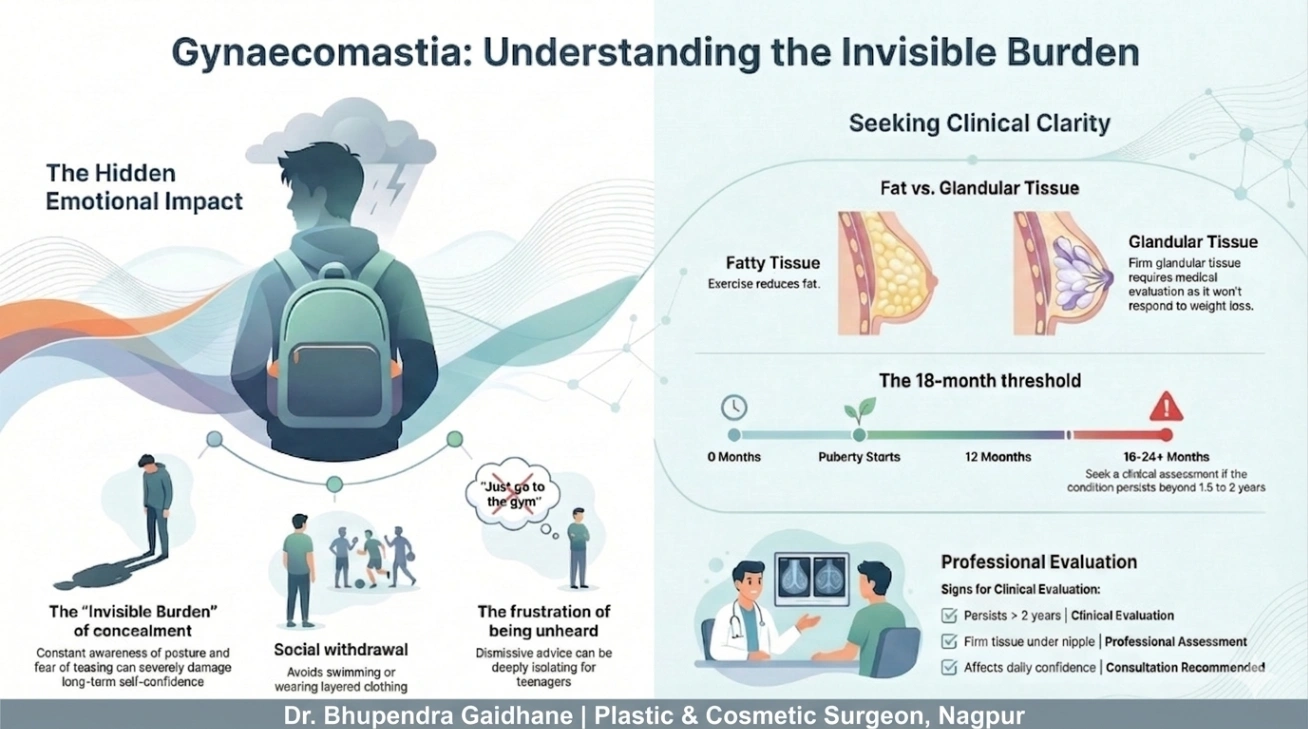
What is often overlooked is not just the physical condition—but the mental and emotional journey that comes with it.

Key Takeaways

  • Teenage gynecomastia is common during puberty.
  • Most cases improve naturally without surgery.
  • Exercise cannot remove true gland tissue.
  • Persistent gynecomastia after puberty is less likely to resolve on its own.
  • Surgery may be considered when the condition causes embarrassment, social withdrawal, or persists despite observation.
  • A proper examination helps distinguish gynecomastia from excess chest fat.

What Is Teenage Gynecomastia?

Gynecomastia refers to the development of glandular breast tissue in males. During puberty, hormonal fluctuations can temporarily increase estrogen activity relative to testosterone.

This can lead to swelling under the nipple area.

In some cases, it is just fat (pseudogynecomastia). In others, it is firm glandular tissue—or a combination of both.

Understanding this difference is important, because not all chest enlargement responds to exercise or weight loss.


Chest Fat or Gynecomastia? Understanding the Difference

Feature Pseudogynecomastia (Fat) True Gynecomastia (Gland)
Cause Weight gain / lifestyle factors Hormonal imbalance during puberty
Texture Soft, diffuse Firm or rubbery tissue under nipple
Response to Gym Often improves with weight loss Usually persists despite exercise
Appearance Reduces as body fat decreases May remain even after weight loss
Management Diet and exercise Depends on persistence and evaluation

This distinction is important because not all chest enlargement responds to exercise alone.

For a full overview of gynecomastia surgery including techniques and cost, see our main gynecomastia page.”


The Reality Most Teenagers Don’t Say Out Loud

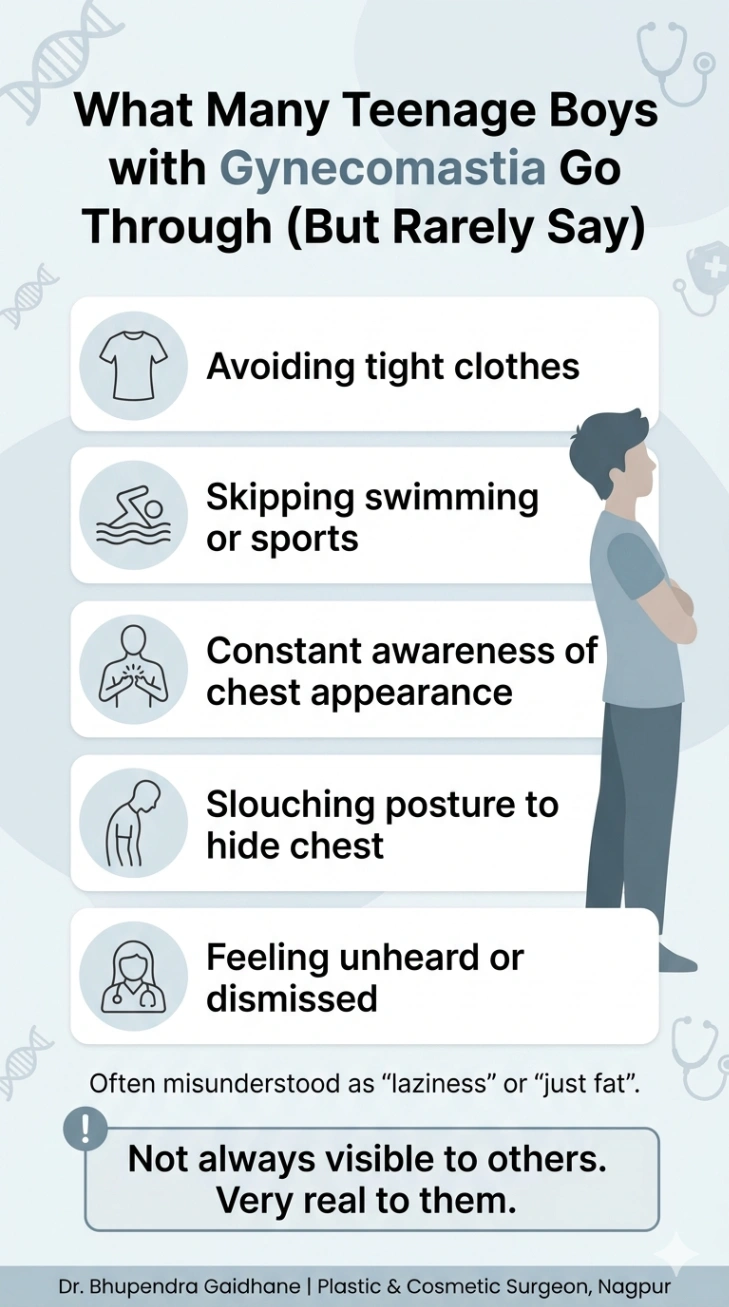
A teenage boy with gynecomastia often goes through:

  • Avoiding tight clothes
  • Wearing loose or layered clothing even in heat
  • Avoiding swimming, sports, or changing rooms
  • Constant awareness of posture and chest appearance
  • Fear of being noticed or teased

Over time, this becomes more than a physical concern. It becomes a confidence issue.

Many teenage boys silently struggle with chest changes during puberty—often hiding it, avoiding activities, and feeling misunderstood.

“It Will Go Away” — And the Frustration That Follows

Many teenagers finally gather the courage to speak to their parents.

But they often hear:

  • “It’s just fat, go to the gym”
  • “You’re lazy, start running”
  • “It’s normal, it will go away”

Even during medical consultations, some are reassured without detailed evaluation.

While this may be appropriate in early cases, it does not help when:

  • The condition has persisted for years
  • There is firm glandular tissue
  • The psychological impact is significant

Not being heard often becomes more frustrating than the condition itself.


A Note to Parents

If your son has brought this up, it likely took courage.

Many teenagers hesitate for months or years before speaking about it. By the time they do, the concern is already affecting their confidence and daily life.

Even if it turns out to be temporary, the emotional impact is real in the present.

Listening without dismissing the concern is the first step.

A clinical evaluation does not mean immediate treatment—it simply provides clarity.


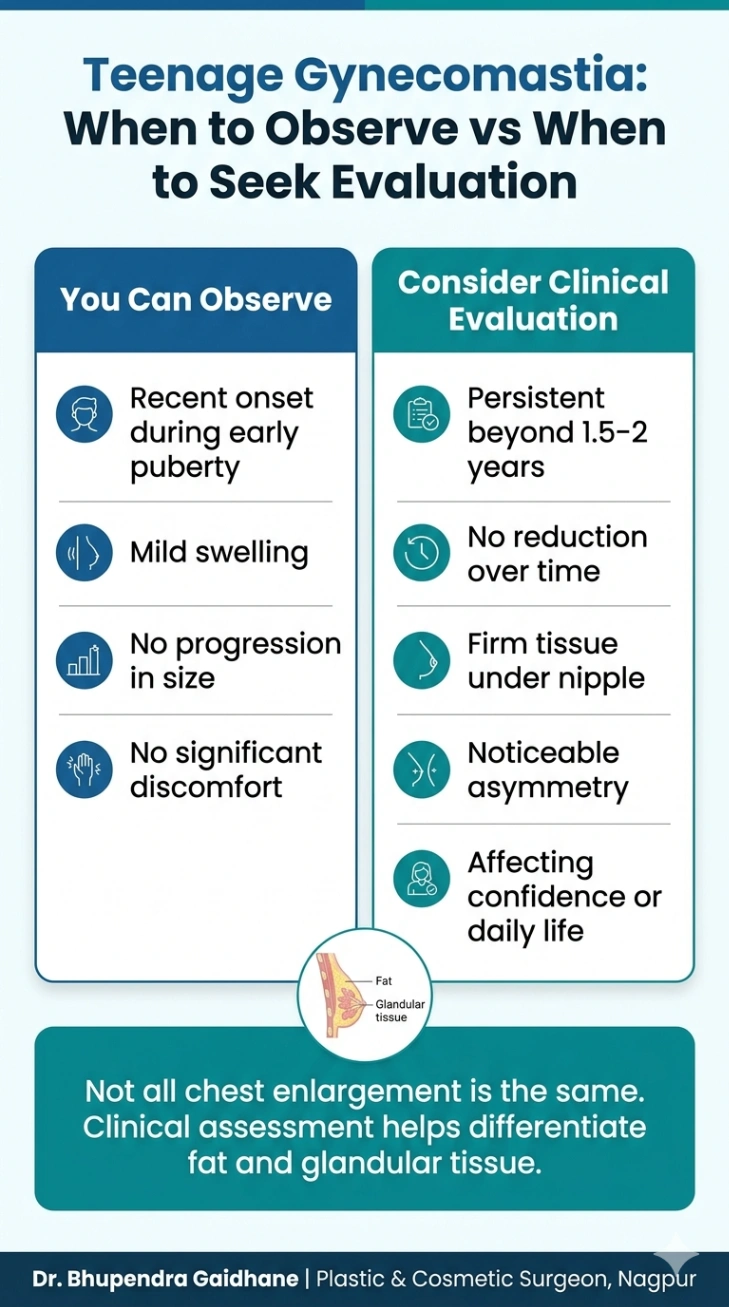
Does Teenage Gynecomastia Go Away?

In early puberty, yes—it often can.

But clinical evaluation becomes important if:

  • Persistence beyond 1.5–2 years
  • No reduction over time
  • Firm tissue under the nipple
  • Noticeable asymmetry
  • Affecting confidence or daily life

Not all cases need immediate treatment. Understanding when to observe and when to seek evaluation helps guide the right decision.

 Why Waiting Too Long Can Backfire

Here’s the thing most parents aren’t told:
Delaying surgery can make things more complex.

What may seem mild now… can progress to:

  • Larger, firmer glands that don’t shrink
  • Stretched or sagging chest skin
  • The need for skin removal surgery later (larger scars, higher cost)
  • More emotional damage — social anxiety, isolation, and low self-esteem

📉 Late intervention = more trauma + more expense + longer healing
📈 Early intervention = minimal scars + lower cost + better results.

Comparison Chart: Early vs Late Gynecomastia Surgery

Factor Early (16–19 yrs) Late (25+ yrs)
Incision Size Minimal Larger
Skin Quality Tight, elastic Loose, stretched
Recovery 3–5 days 1–2 weeks
Cost Lower Higher
Emotional Healing Faster Slower
Need for Skin Removal Rare Often

When Surgery Is Worth Considering

If the glandular tissue has not reduced in 2 or more years, or if the teenager is clearly struggling with body image, a surgical consultation is appropriate. The ideal age window is 16 to 19 years — at this stage, skin elasticity is high, recovery is faster, and results tend to be cleaner with minimal scarring. Surgery done during a school vacation allows teens to return to normal social life without disruption.


Why Exercise Doesn’t Always Help

Exercise can reduce fat. But glandular tissue does not respond to gym or weight loss.

This is why many teenagers improve fitness but still notice chest prominence.


What Many Parents Realize Later

During surgery, when the glandular tissue and fat are shown, many parents are surprised.

A common reaction is:

“We didn’t realize this was the reason… we thought it was just fat.”

This highlights how often the condition is misunderstood.


When to Consider Evaluation

A proper clinical assessment helps determine:

  • Whether it is fat, gland, or both
  • Whether it is likely to resolve
  • What options are appropriate

Gynecomastia in teenage boys is not just physical. Proper evaluation helps guide the right timing for management.

Treatment Approach (Overview)

Management depends on the tissue type and severity.

Options may include:

  • Liposuction for fat component
  • Glandular excision when required
  • Combination approach for contour balance

The goal is a natural chest contour with proper planning.


Internal Resources

For more detailed information, you can also read:


faqs

Q: Is gynecomastia surgery safe for teenagers? Yes. It is a short daycare procedure performed under general anesthesia. Teenagers typically recover faster than adults, with most resuming light activity within 3–5 days.

Q: Will there be visible scars? With VASER-assisted micro-incision technique, incisions are 4–6 mm and placed in hidden areas — the areolar margin or armpit. These typically fade to near-invisible within 6–12 months.

Q: What is the downtime for a teenager? Most teens can return to school within 3–5 days. Sports and gym should be avoided for 3–4 weeks.

Q: Can gynecomastia return after surgery? Once the glandular tissue is removed and body weight remains stable, results are permanent. Recurrence is uncommon when the underlying hormonal cause has resolved.

Conclusion

Teenage gynecomastia is not always a condition that needs immediate treatment.

But it is also not something that should be ignored when it persists.

The right approach lies in:

  • Knowing when to wait
  • Knowing when to evaluate
  • Listening to the patient

Consultation

If you or your child is dealing with persistent chest swelling, a clinical consultation can help clarify the situation.

Prime Polyclinic, Dhantoli, Nagpur
Call: 9960961451

Gynecomastia Surgery Cost in Nagpur (2026 Guide): Price, Factors, and What’s Included

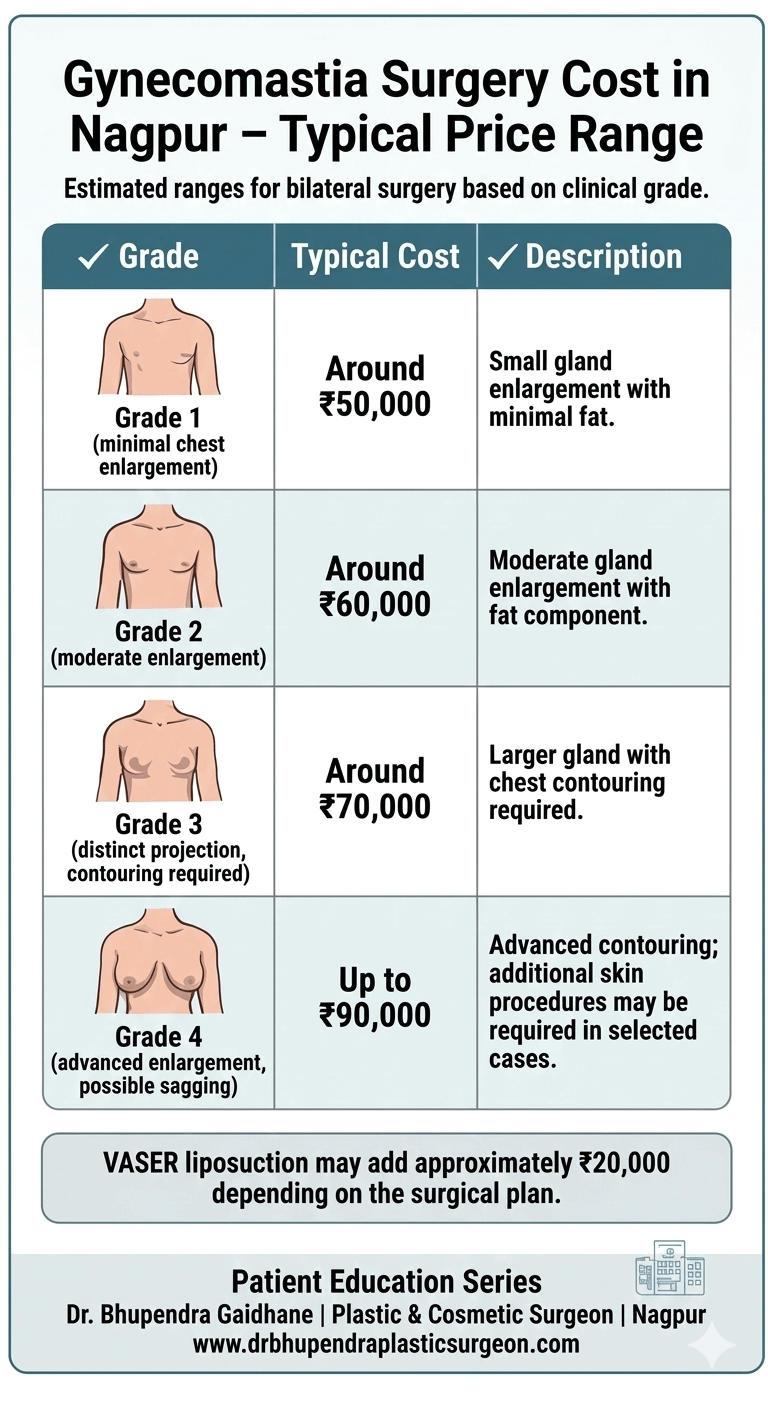
Gynecomastia surgery in Nagpur typically costs between ₹50,000 and ₹90,000 depending on the clinical grade of the condition Gynecomastia surgery in Nagpur typically costs between ₹50,000 and ₹90,000, depending on the grade of gynecomastia, the amount of gland and fat present, and whether advanced technologies such as VASER-assisted liposuction (Lipovase) are used. Grade 1 cases generally start around ₹50,000, while advanced Grade 4 cases may cost up to ₹90,000 or more when additional contouring procedures are required
Advanced technologies such as VASER-assisted liposuction (Lipovase) may add approximately ₹20,000 depending on the surgical plan.Male breast enlargement, medically known as gynecomastia, is a common condition affecting teenagers and adult men. While exercise and weight loss may reduce body fat, true glandular tissue usually requires surgical intervention to achieve a flat, masculine chest contour.Patients across Central India—from Nagpur and nearby districts such as Sambhaji Nagar, Chandrapur, Raipur, Jabalpur, Seoni, Chhindwara, Amravati, and Yavatmal—often seek consultation for gynecomastia surgery without needing to travel to metro cities.

Many patients first try to understand whether the issue is fat or gland before considering cost.
You can read more here → Chest Fat vs Gynecomastia: How to Tell the Difference


Gynecomastia Surgery Cost in Nagpur: Quick Overview

  • Gynecomastia surgery in Nagpur usually costs ₹50,000–₹90,000.
  • Cost depends mainly on the grade of gynecomastia.
  • Dense gland tissue and larger chests require more surgical work.
  • VASER (Lipovase) technology may increase the overall cost.
  • Most packages include surgeon fees, anesthesia, OT charges, compression garment, and follow-up visits.
  • Most patients return home the same day after surgery

Note: Advanced VASER-assisted liposuction (Lipovase technology) may add approximately ₹20,000 depending on patient anatomy and desired contouring.

Gynecomastia surgery cost in Nagpur by clinical grade showing estimated price range for grade 1 to grade 4 male breast enlargement surgery
Typical gynecomastia surgery cost range in Nagpur based on clinical grade of gynecomastia and surgical complexity.

Want to see outcomes before deciding? →
view before and after results.


Chat on WhatsApp

What Is Gynecomastia?

Gynecomastia is the enlargement of male breast tissue caused by glandular growth, fat deposition, or hormonal imbalance. The condition may affect one or both sides of the chest and often persists despite exercise.

When glandular tissue remains despite weight loss or gym training, surgical removal of the gland combined with liposuction is often the most effective treatment.

The cost also depends on the severity of the condition. To understand this better, see → Gynecomastia Grades Explained (Grade 1 to 4)


Why Does Gynecomastia Surgery Cost Vary?

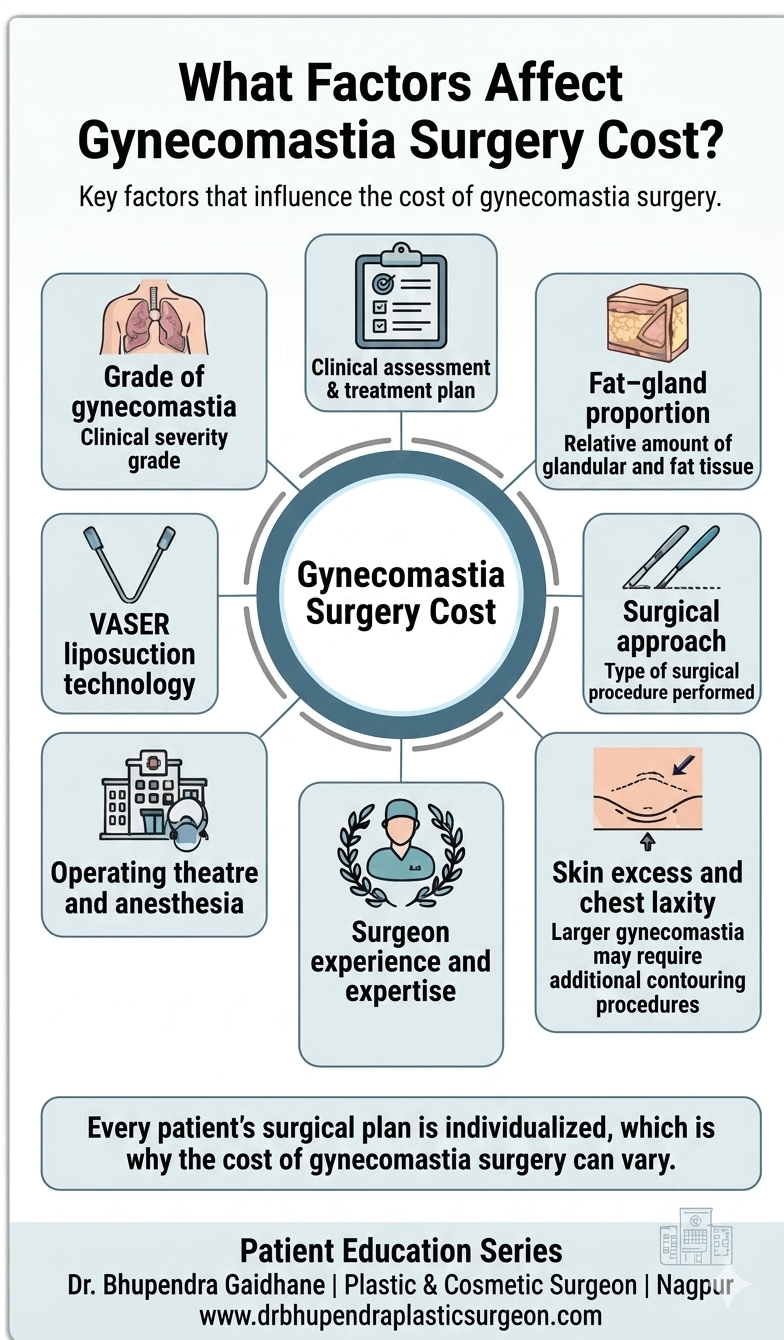
Every patient’s chest anatomy is different. During consultation, surgeons evaluate several factors that influence the final cost.

Each grade requires a different surgical approach, which is why the cost varies accordingly.

Factors affecting gynecomastia surgery cost including gland size fat component surgical technique VASER liposuction and surgeon experience
Key factors that influence the cost of gynecomastia surgery including surgical technique and severity.


1. Grade of Gynecomastia

Higher grades require more surgical work and sometimes additional contouring procedures.

2. Fat–Gland Proportion

Some patients have mainly fatty tissue, while others have dense glandular tissue that requires surgical excision.

3. Surgical Technique

Most procedures involve a combination of:

  • Liposuction for fat removal
  • Gland excision through a small incision around the areola

4. VASER Liposuction Technology (Lipovase)

VASER uses ultrasonic energy to emulsify fat before removal. This may help provide:

  • More precise fat removal
  • Reduced bleeding and bruising
  • Improved skin contraction
  • Smoother chest contour

In clinical practice, higher grades of gynecomastia (Grade 3 and Grade 4) are often treated using VASER-assisted liposuction to improve contouring and safety.


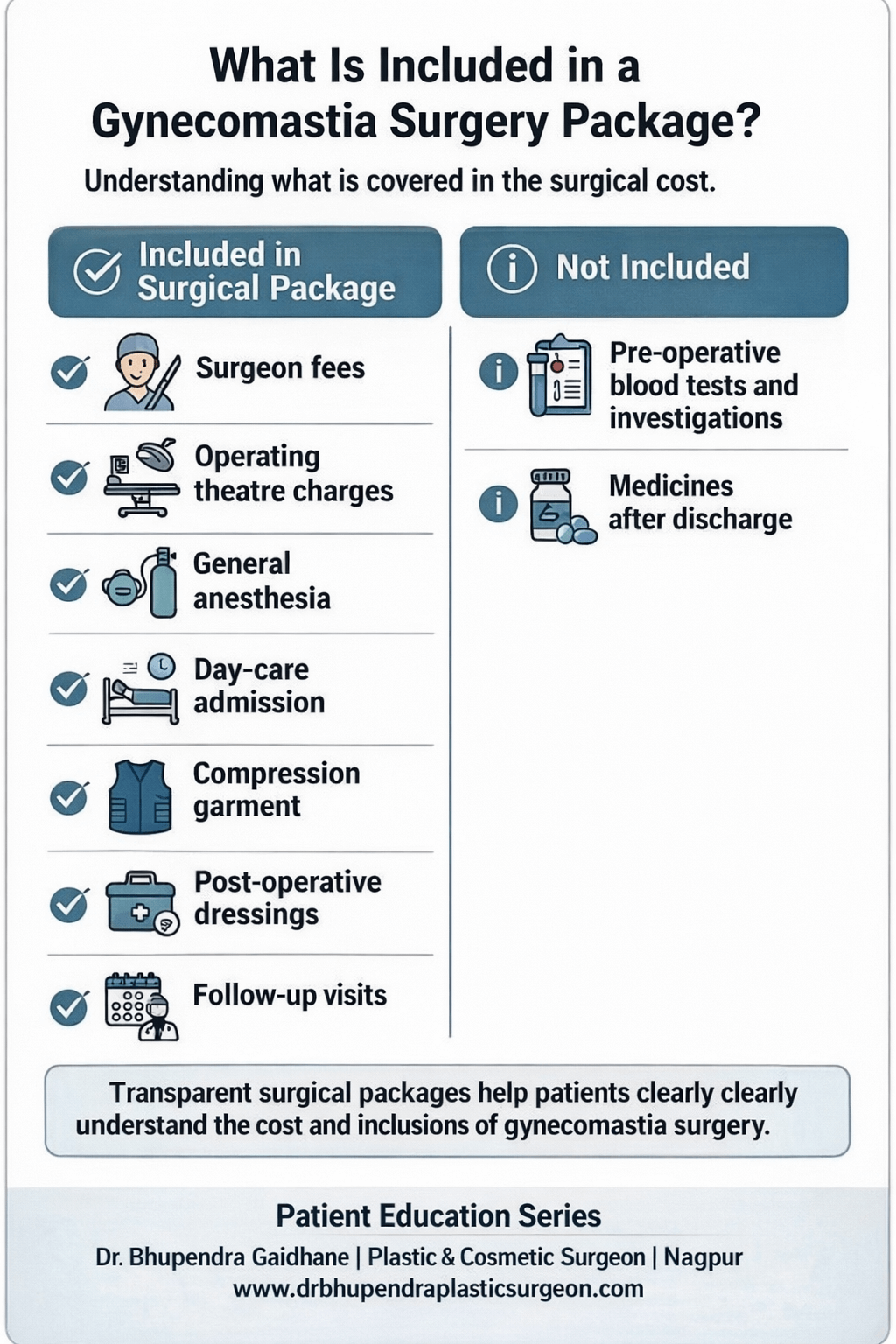
What Is Included in the Gynecomastia Surgery Package?

Transparent surgical packages help patients clearly understand the total cost of treatment.

What is included in gynecomastia surgery package including surgeon fees operating theatre anesthesia compression garment and follow up visits
Typical inclusions and exclusions in a gynecomastia surgery package.

Typically Included

  • Surgeon fees
  • Anesthesia charges
  • Operating theatre and day-care admission
  • Post-operative compression garment
  • Dressings and follow-up visits

Usually Not Included

  • Pre-operative blood investigations
  • Medicines after discharge.

Many patients also ask about recovery and time off work before deciding on surgery


Why Many Patients Choose Nagpur for Gynecomastia Surgery

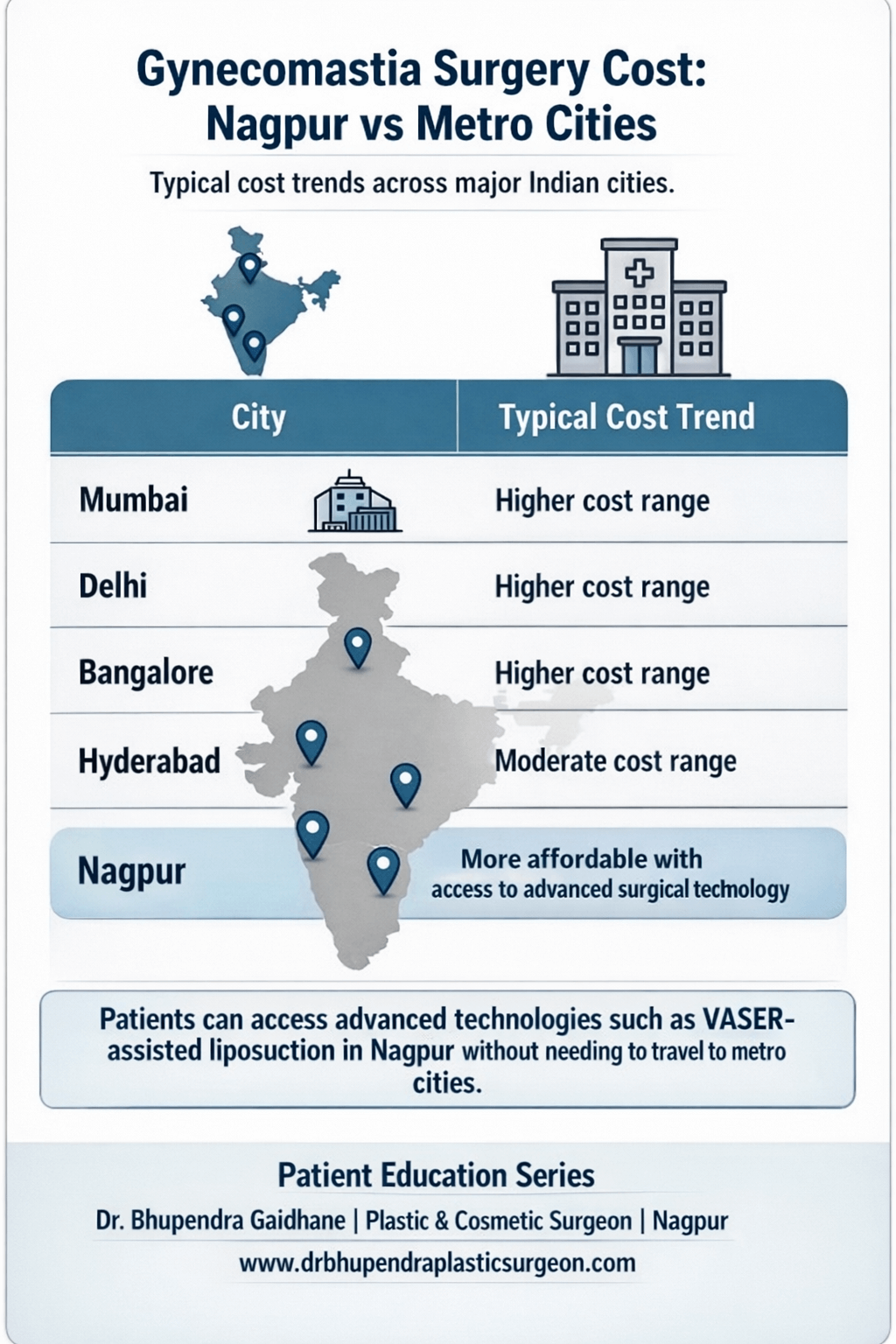
Earlier, patients believed they had to travel to metro cities such as Mumbai or Delhi for advanced cosmetic surgery. Today, Nagpur offers modern technologies such as VASER-assisted liposuction at comparatively lower cost due to lower institutional overheads.

Patients commonly travel from:

  • Sambhaji Nagar
  • Chandrapur
  • Raipur
  • Jabalpur
  • Seoni
  • Chhindwara
  • Amravati
  • Yavatmal
Comparison of gynecomastia surgery cost in Nagpur versus metro cities like Mumbai Delhi Bangalore and Hyderabad
Gynecomastia surgery cost comparison between Nagpur and major metro cities in India.


For younger patients or those with long-standing chest changes since puberty, understanding teenage gynecomastia cases and treatment approach can help clarify when surgery is actually needed.


Frequently Asked Questions About Gynecomastia Surgery Cost

Is gynecomastia surgery performed on one or both sides?

Surgery is usually performed on both sides of the chest to maintain symmetry and achieve a natural chest contour.

Is gynecomastia surgery covered by insurance?

In most cases, gynecomastia surgery is considered a cosmetic procedure and is usually not covered by health insurance. Rare cases related to specific medical conditions may be evaluated individually.

Is the surgery done as a day-care procedure?

Yes. Most patients undergo gynecomastia surgery as a day-care procedure and return home the same evening. Admission is typically for 4–6 hours. Overnight stay is rarely required.

For a detailed explanation of recovery stages, read our guide on
Gynecomastia Recovery Timeline.


About the Author

Dr. Bhupendra Gaidhane is a Plastic and Cosmetic Surgeon practicing in Nagpur. He specializes in male chest contouring using advanced Lipovase (VASER) technology, helping patients achieve natural chest contours with minimal downtime.


Chat on WhatsApp


References

  • American Society of Plastic Surgeons – Gynecomastia Surgery Guide
  • Mayo Clinic – Gynecomastia Causes and Treatment
  • International Society of Aesthetic Plastic Surgery (ISAPS)
  • National Library of Medicine – Gynecomastia Clinical Overview

Gynecomastia Surgery Recovery Timeline – What to Expect Week by Week

Recovery after gynecomastia surgery is usually straightforward. Most patients return to light daily activities within a few days, resume desk work within about a week, and gradually return to gym workouts after approximately six weeks. While swelling improves significantly during the first 4–6 weeks, the final chest contour typically becomes visible around three months after surgery.

Many patients imagine severe pain or long bed rest. In reality, recovery after gynecomastia surgery is usually smooth when proper post-operative instructions are followed.

In this guide, Dr. Bhupendra Gaidhane, plastic surgeon in Nagpur, explains what patients typically experience after surgery, including the recovery timeline, compression garment use, massage techniques, and when it is safe to return to normal activities.

Recovery Timeline at a Glance

  • Surgery Day: Walk the same day, mild tightness expected.
  • Week 1: Light activities and desk work often possible.
  • Week 2: Swelling reduces and massage may begin.
  • Week 6: Most swelling resolved; gradual return to gym.
  • Month 3: Final chest contour becomes visible.
  • Compression garment use is an important part of recovery

If you’re still researching whether surgery is right for you, read our complete guide to gynecomastia surgery in Nagpur.

Download the Complete Gynecomastia Recovery Guide

For patients who prefer a step-by-step visual guide, we have prepared a detailed recovery handbook explaining the recovery timeline, compression garment use, massage techniques, and return-to-activity guidelines after gynecomastia surgery.

You can download the full guide below:


Download the Gynecomastia Surgery Recovery Guide (PDF)


What Happens Immediately After Gynecomastia Surgery

Gynecomastia surgery reshapes the male chest by removing excess gland tissue and fat  by advanced vaser liposuction technology , Lipovase to restore a flatter contour.

Immediately after surgery, patients may feel slightly drowsy from anesthesia.

Common Immediate Post-Operative Experiences

  • Dizziness or mild mental fog for a few hours
  • Tightness in the chest due to surgical dressings
  • Minimal pain because local anesthetic techniques are used

Once the anesthesia wears off, patients gradually become more comfortable. Light walking is usually encouraged on the same day of surgery.

Before discharge, the surgeon ensures that the patient can:

  • Walk independently
  • Drink fluids comfortably
  • Pass urine normally

After these criteria are met, patients can safely return home.

The First Night After Surgery

Recovery is often easier once patients return home because they are in a familiar environment.

Helpful Tips for the First Night

  • Sleep on your back in a slightly elevated position.
  • You can prop yourself up with pillows for comfort.
  • Avoid raising your arms above shoulder level.
  • Keep water, medication, and other essentials within easy reach.

Most patients feel significantly better after the first night of rest.

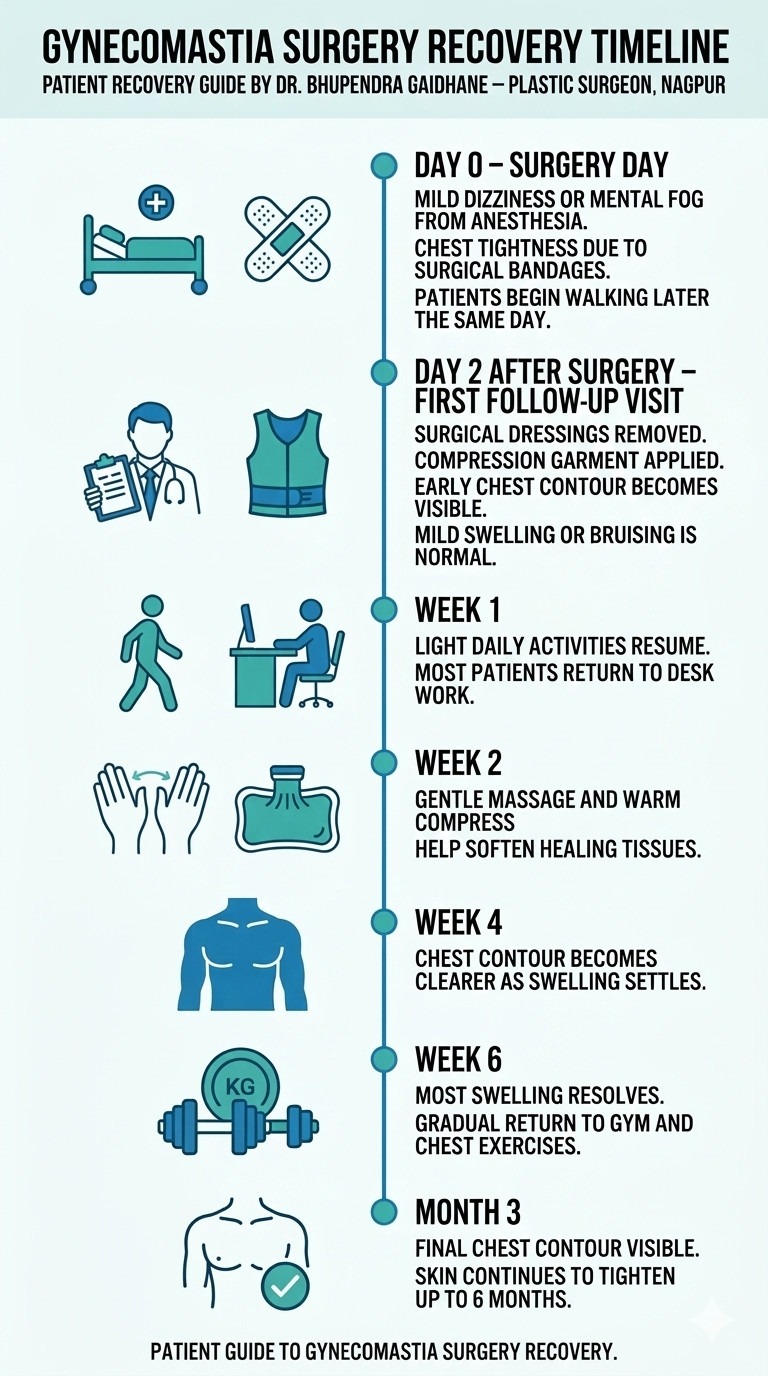
Gynecomastia Surgery Recovery Timeline


Gynecomastia surgery recovery timeline showing stages from surgery day to final results after three months.

The recovery timeline after gynecomastia surgery usually follows predictable stages from the first week to three months as swelling gradually settles.

Surgery Day

  • Mild dizziness from anesthesia
  • Chest tightness due to surgical dressings
  • Light walking encouraged

Day 2 – First Follow-Up Visit

  • Surgical dressings removed
  • Compression garment applied
  • Patients see early improvement in chest contour

Many patients feel much more comfortable once the compression garment replaces the surgical bandages.

Week 1

  • Light daily activities resume
  • Desk work often possible
  • Mild swelling and bruising may still be present

Week 2

  • Swelling continues to reduce
  • Gentle massage may begin
  • Tissues begin softening

Week 6

  • Most swelling has resolved
  • Gradual return to gym workouts
  • Chest exercises introduced slowly

Month 3

  • Final chest contour becomes visible
  • Tissues continue to soften.

See how results evolve visually →
real patient results.

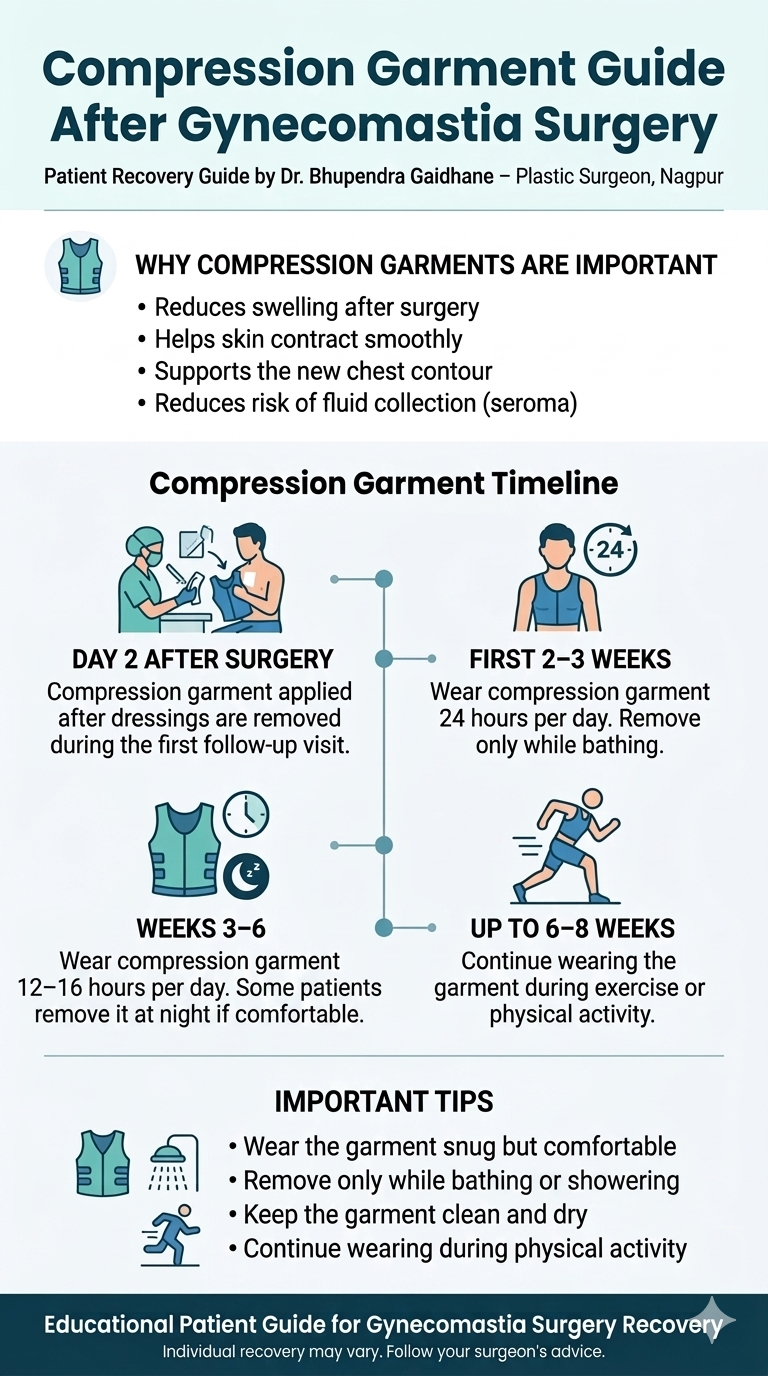
Compression Garment After Gynecomastia Surgery

Compression garment guide after gynecomastia surgery showing recommended duration of use from weeks 1 to 6.


Compression garments are an important part of post-operative recovery.

They help:

  • Reduce swelling
  • Support healing tissues
  • Improve skin contraction
  • Maintain chest contour

Recommended Compression Garment Schedule

Weeks 1–3

Wear the garment continuously day and night, removing it only while showering.

Weeks 3–6

Wear it approximately 12–16 hours per day.

After Week 6

Some patients may continue wearing the garment during physical activity if advised.

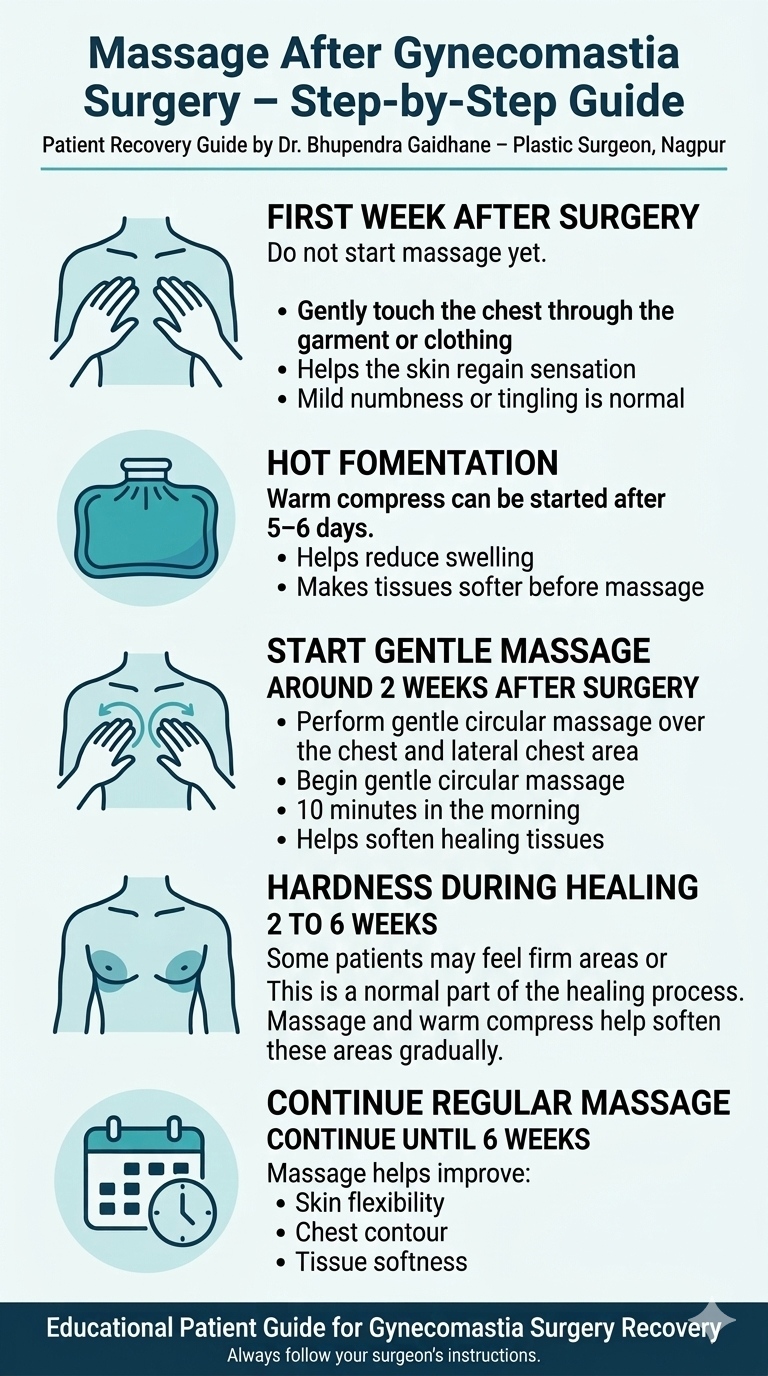
Massage After Gynecomastia Surgery

Massage techniques after gynecomastia surgery showing when to start massage and how it helps soften healing tissue.


Massage helps soften healing tissues and improve the final chest contour.

First Week

During the first week, patients are encouraged to gently touch the chest area through the garment. This helps restore normal skin sensation.

Temporary numbness or tingling is common during this stage.

After 5–6 Days

Warm compresses may be started to help soften tissues and reduce stiffness.

After About Two Weeks

Gentle circular massage can begin.

  • Massage twice daily
  • 5–10 minutes per session
  • Gradually increase pressure as tissues soften

Understanding the Hard Phase (Weeks 2–6)

Some patients notice firm areas or temporary hardness during healing. This phase is common and occurs as the body forms internal scar tissue during recovery.

This firmness typically improves gradually with time, massage, and warm compresses. As swelling reduces and tissues remodel, the chest becomes softer and more natural in contour.

Activity and Exercise After Gynecomastia Surgery

Walking

Walking is encouraged from the same day of surgery.

Desk Work

Many patients return to desk work within 3–4 days.

Driving

Driving is usually comfortable after about 7–8 days.

Light Exercise

Light cardio activities such as brisk walking or gentle jogging can usually begin after about two weeks.

Gym Workouts

Gradual return to gym training is generally allowed after six weeks. Chest workouts should be introduced slowly and intensity increased gradually.

Common Symptoms During Recovery

Several changes are normal during the healing phase.

  • Mild swelling
  • Temporary numbness or tingling
  • Chest tightness
  • Mild bruising
  • Small areas of firmness

These symptoms gradually improve as healing progresses.

Contact Your Surgeon If You Notice

  • Severe pain that is worsening
  • Rapid or asymmetrical swelling
  • Fever
  • Signs of infection

Why Choosing an Experienced Surgeon Matters

Gynecomastia surgery is not only about removing gland tissue. It also requires careful contouring of the chest to achieve a natural masculine shape.

An experienced plastic surgeon evaluates:

  • Gland tissue
  • Fat distribution
  • Skin elasticity
  • Chest symmetry

Careful planning and technique help ensure smoother recovery and better aesthetic results.

Frequently Asked Questions

How long does recovery take after gynecomastia surgery?

Most patients resume light activities within a few days. Swelling improves significantly by about six weeks, while final contour usually becomes visible around three months.

When can I shower after surgery?

Patients can usually shower after the first follow-up visit once surgical dressings are removed.

How long should I wear the compression garment?

Most patients wear it continuously for two to three weeks and then part-time for several additional weeks.

Is chest hardness normal after surgery?

Yes. Temporary firmness during healing is common and usually improves with massage and time.

When can I return to the gym?

Most patients gradually resume gym workouts after about six weeks.

Complete Patient Recovery Guide

This downloadable guide explains the recovery process after gynecomastia surgery in detail, including compression garment instructions, massage techniques, and activity timelines.

Medical Reference

American Society of Plastic Surgeons (ASPS). Gynecomastia surgery recovery and post-operative care guidelines.

https://www.plasticsurgery.org/reconstructive-procedures/gynecomastia-surgery/recovery

Lipoma Removal Surgery in Nagpur — Educational Guide & Scar-Minimising Options

This comprehensive guide is designed for patients in Nagpur who want clear, reliable information about lipoma removal, scarless lipoma surgery, minimally invasive lipoma removal, and lipoma removal costs in Nagpur. Whether you discovered a lump recently or have lived with it for years, this page explains everything—from causes and diagnosis to treatment options and recovery.

Book Consultation   Call: 9960961451

Understanding Lipomas: What They Really Are

A lipoma is a benign tumor of fat cells that develops slowly beneath the skin. It is one of the most common soft‑tissue lumps found in adults. People often discover lipomas accidentally—during a shower, grooming, workouts, or while checking a sore spot. Panic usually follows, driven by fear of cancer. The reassuring fact is: lipomas are non-cancerous, harmless, and treatable.

Lipomas feel soft, rubbery, and mobile because they sit in the natural fat layer between the skin and muscle. They don’t attach to deeper tissues in typical cases, which is why they slide when pressed. These features help distinguish them from more concerning lumps.

Why Do Lipomas Form?

Patients frequently ask what triggered their lipoma—”Did I gym too hard? Was it my diet? Is it cholesterol?” Scientific studies show that lipomas form primarily due to genetic tendencies. If a parent or sibling has lipomas, there’s a higher chance you may develop them too.

Other contributing factors include:

  • Familial Multiple Lipomatosis – a condition where individuals develop numerous lipomas through life.
  • Age – most appear between 30–60 years.
  • Minor trauma – sometimes discussed but not consistently proven.

Importantly, lipomas are not caused by obesity, cholesterol, food choices, protein supplements, heavy lifting, or lifestyle habits. Even extremely fit individuals and athletes commonly develop lipomas.

"Before and after results of lipoma removal surgery performed by Dr. Bhupendra Gaidhane, a skilled plastic surgeon in Nagpur."
“Effective lipoma removal surgery in Nagpur by Dr. Bhupendra Gaidhane. Witness the precise technique and professional care through these before-and-after images.”

Types of Lipomas (and Why the Type Matters)

Understanding the type of lipoma helps determine the safest and least invasive removal method. Common types include:

  • Superficial Lipomas – just beneath the skin; the most common and easiest to treat.
  • Deep Lipomas – under the fascia or close to deeper structures; may require imaging.
  • Intramuscular Lipomas – grow within muscle fibers; often slow-growing but deeper.
  • Fibrolipomas – contain more fibrous tissue, making them firmer.
  • Multiple Lipomas – seen in people genetically predisposed to forming many lumps.

Superficial lipomas are straightforward to remove, while deep and intramuscular lipomas benefit from more structured planning.

Are Lipomas Dangerous?

Typical lipomas are harmless and not considered medically dangerous. However, removal may be recommended when the lipoma is:

  • Growing noticeably in size
  • Causing discomfort or pain
  • Affecting movement or daily activities
  • Cosmetically visible and difficult to hide
  • Located near nerves or vessels
  • Not behaving like a typical soft, mobile lipoma

For atypical cases—such as deep lumps, rapidly enlarging lumps, or firm, fixed masses—imaging such as ultrasound or MRI may be advised.

Diagnosis: What Tests Are Actually Needed?

Most lipomas in Nagpur are diagnosed clinically based on appearance and feel. However, your surgeon may recommend:

  • Ultrasound – useful for confirming depth, size, and consistency.
  • MRI – reserved for deep, intramuscular, or suspicious masses.

Biopsy is not routinely required unless the behavior of the lump is atypical.

When Should You Consider Lipoma Removal?

Many patients in Nagpur opt for lipoma removal surgery for cosmetic confidence, comfort, and peace of mind. Common reasons include:

  • The lump is visible on the arms, neck, shoulders, or back.
  • It has grown large enough to interfere with movement.
  • It becomes uncomfortable during gym workouts or daily activities.
  • The patient wants confirmation of diagnosis.
  • The lipoma causes embarrassment or clothing discomfort.

Treatment Options for Lipoma Removal in Nagpur

1. Scarless / Keyhole Lipoma Removal

For small to medium superficial lipomas, a 3–5 mm incision is used to free the lipoma and remove it with minimal skin disruption. This is commonly called scarless lipoma removal or keyhole lipoma surgery. Patients prefer this technique because healing is fast and the resulting scar is extremely small.

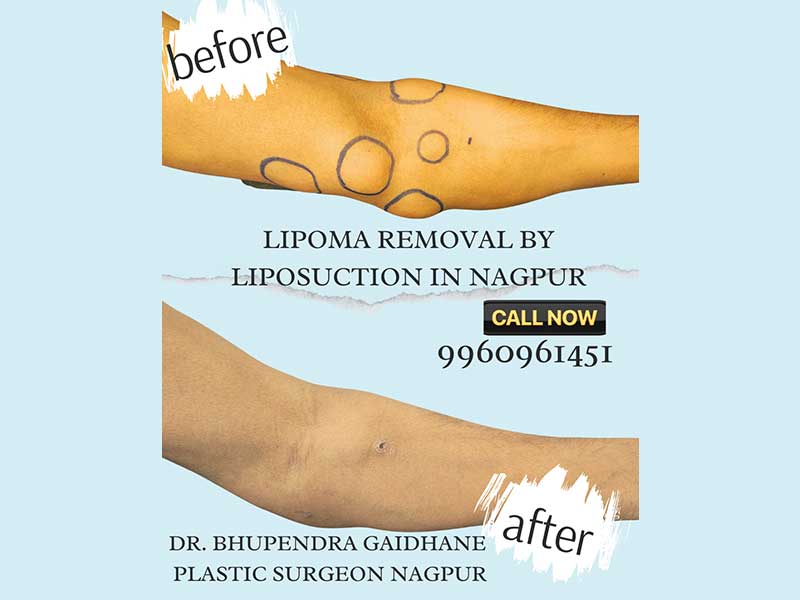
Before and after lipoma removal by liposuction in Nagpur performed by Dr. Bhupendra Gaidhane. Effective treatment for multiple lipomas with minimal scarring.
Before and after results of lipoma removal in Nagpur using advanced liposuction techniques by Dr. Bhupendra Gaidhane. Safe and effective treatment for multiple lipomas

2. Minimal-Incision Excision

For larger or slightly firm lipomas, a small incision is used to remove the lump cleanly. This method remains the gold standard for reliable, predictable removal. Fine sutures help achieve cosmetically pleasing results. This is the most common approach for lipoma removal surgery in Nagpur.

3. Traditional Excision for Deep or Intramuscular Lipomas

Deep-plane or intramuscular lipomas require a carefully planned excision to ensure safe removal around muscles, nerves, and vessels. Although the incision may be slightly larger, healing is predictable, and recurrence rates remain low.

Recurrence: What Does the Research Show?

One of the most common online questions is whether lipomas “come back” after removal. Published surgical literature shows:

  • Superficial lipomas: recurrence 1–5% (very low).
  • Deep / intramuscular lipomas: recurrence 5–19%.

Recurrence depends on the biological nature of the lipoma rather than a single surgical step. Most patients enjoy permanent resolution.

“lipoma removal surgery in Nagpur”

Lipoma Removal Cost in Nagpur

The cost of lipoma removal in Nagpur varies depending on:

  • Size of the lipoma
  • Number of lipomas
  • Depth (superficial vs deep)
  • Technique used
  • Need for imaging

Patients frequently search for terms such as lipoma removal cost Nagpur, scarless lipoma removal cost, and lipoma surgery price in Nagpur. A personalised estimate is provided after examination.

Insurance may cover removal if the lipoma is causing discomfort or functional issues.

Recovery After Lipoma Surgery

Most lipoma procedures are day-care surgeries with excellent recovery:

  • Return to desk work in 24–48 hours
  • Mild soreness for 1–3 days
  • Stitches removed in 7–10 days (if used)
  • Scar fades gradually over months

Patients can resume light exercise soon, while heavy workouts may be delayed briefly depending on the site of surgery.

Frequently Asked Questions (FAQs)

Can lipomas turn into cancer?
No. Lipomas do not transform into cancer. Only atypical lumps require further tests.
Why do I keep getting new lipomas?
Genetics. Some individuals naturally form multiple lipomas through life.
Does liposuction cure lipomas?
It can help reduce incision size in selected cases, but excision is preferred for firm or deep lipomas.
Can lipomas be removed without stitches?
Small lipomas with keyhole techniques sometimes yes; others require fine sutures for best cosmetic healing.
Do lipomas affect gym workouts?
Large lipomas on the arms, shoulders, or back may interfere with exercise or cause discomfort.
Will removing a lipoma prevent new ones?
No. Removal treats the existing lump but does not change your genetic tendency.
Can lipomas come back in the same spot?
Rare for superficial lipomas; slightly higher for deep or intramuscular ones.

Why Choose Dr. Bhupendra for Lipoma Removal in Nagpur?

Patients across Nagpur and nearby districts choose our clinic for:

  • Experience with superficial, deep, and multiple lipomas
  • Scar-minimising and minimally invasive techniques
  • Day-care, walk-in/walk-out procedures
  • Detailed pre- and post-operative guidance
  • Comfortable clinic located in Dhantoli

To consult: 9960961451 • Clinic: No 3, 1st Floor, Diamond One Building, Prime Polyclinic, Dhantoli, Nagpur.

Book Your Lipoma Consultation

For expert evaluation and personalised lipoma removal treatment in Nagpur, book a consultation or call 9960961451.


Minimal Scarring Sebaceous Cyst Removal in Nagpur — The Plastic Surgeon’s Guide

Sebaceous (epidermoid) cysts are common and usually harmless — but they can become painful, infected, or cosmetically bothersome. If your priority is a small scar and minimal recurrence, the technique and the surgeon matter. 👨‍⚕️✨

What is a sebaceous (epidermoid) cyst?

A sebaceous or epidermoid cyst is a slow-growing sac under the skin filled with keratin — a white, paste-like material. They can appear on the scalp, face, neck, back, armpit, or groin. Most are painless until they become infected, inflamed, or large enough to be visible.

Common confusion: Sebaceous cyst vs Lipoma (“Charbi chi Gath”)

Many patients call lumps “sebaceous cysts” when they actually have a lipoma (fatty lump), locally called “Charbi chi Gath.” Accurate diagnosis changes the surgical plan and the expected cosmetic result.

Condition Common Name Contents Feel Best Specialist
Sebaceous / Epidermoid Cyst सिबेशियस सिस्ट Keratin / sebum Firm, fixed Plastic Surgeon
Lipoma Charbi chi Gath Fatty tissue Soft, mobile Plastic Surgeon

Why treat it early? What happens if you wait

Untreated cysts can:

  • Become infected (red, painful, pus-filled)
  • Burst and inflame surrounding tissue
  • Require a larger incision later — leading to a bigger scar
  • Recur if the cyst wall is not fully removed

Short version: early, planned excision = smaller scar and faster recovery. 🕒➡️✨

Minimal-scar treatment options offered

Minimal Excision (Punch / Tiny Incision)

Often done through a 5–7 mm incision. The surgeon removes the whole cyst wall to prevent recurrence. Local anesthesia, quick recovery, usually a 1-day procedure.

Laser-Assisted Excision (Premium Cosmetic Option)

Laser helps make ultra-precise incisions with less bleeding and tissue trauma — ideal for face, neck, or other highly visible areas. Higher cost, but excellent aesthetic outcome.

Staged Treatment for Infected Cysts

If infected, the correct approach is drainage and antibiotics first, then definitive excision after healing — this reduces scars and recurrence risk.

Cost & insurance — what patients should know

Costs vary by size, technique, and whether the cyst is infected. Minimal excision is cost-effective; laser is premium. Insurance commonly covers cyst removal if it is symptomatic (infected, painful, rapidly growing). Purely cosmetic excisions are rarely covered.

At the clinic we assist with documentation and pre-authorization where applicable.

Who comes to us — Nagpur and surrounding districts

Our clinic is based in Nagpur and routinely treats patients from Nagpur and nearby districts. Patients travel for the combination of plastic-surgery expertise and modern, minimal-scar techniques.

Nearby districts / areas served: Bhandara, Gondia, Chandrapur, Wardha, Yavatmal, Amravati. Patients also consult from bordering regions in Chhattisgarh and Madhya Pradesh (for example, Rajnandgaon, Durg, Balaghat, Seoni).

Why choose a Plastic Surgeon for cyst removal?

  • Precision incisions that heal well
  • Removal of the entire cyst lining to prevent recurrence
  • Laser options for best cosmetic outcomes in visible areas
  • Experience with lumps and soft-tissue anatomy

In short: anyone can cut out a cyst, but a plastic surgeon cuts it out beautifully. 🎯

Frequently Asked Questions

Is a sebaceous cyst dangerous?

No — but it can get infected and painful. Treat early for best cosmetic results.

Will the cyst come back after removal?

If the entire cyst wall is removed, recurrence is rare. Proper technique matters.

Does removal leave a scar?

Yes, but with minimal excision or laser the scar is tiny and often barely noticeable.

Is cyst removal covered by insurance?

Often yes when the cyst is symptomatic (infected/painful). Cosmetic-only removals are usually not covered.

How long does the procedure take?

Most procedures are 10–30 minutes under local anesthesia; it’s a same-day, outpatient treatment.

Can multiple cysts be removed in one session?

Yes — depending on size and location, multiple cysts can often be removed together.

Next step: If you want a small scar and reliable result, book a consultation for assessment and a clear plan. 🔍Dr. Bhupendra Gaidhane — Plastic & Cosmetic Surgeon, Nagpur
Phone: 9960961451
Clinic: Prime Polyclinic, Dhantoli, Nagpur
Website: drbhupendraplasticsurgeon.com

Book a confidential consultation 📞

Gynecomastia Surgery Recovery: 4-Week Guide | What to Expect | Nagpur

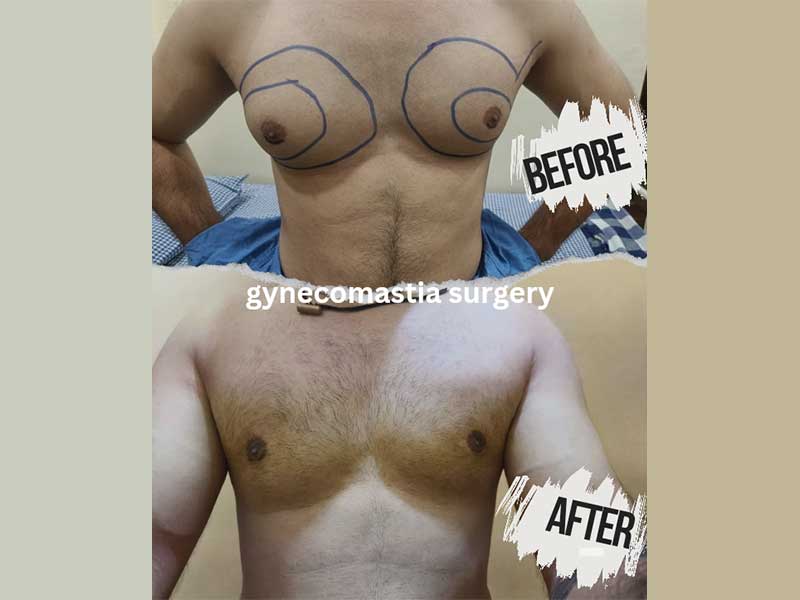
“Before after puffy nipple gynecomastia correction with minimal-incision gland removal.”
“Complete flattening of the areola using tiny-incision gland excision.”

Quick Answer

Gynecomastia surgery recovery is usually progressive and predictable. Most patients return to desk-based work within 3–5 days, feel significantly better by the second week, resume light exercise around week 3, and gradually return to full gym activities between weeks 4–6. Mild swelling, firmness, and temporary asymmetry are normal during the healing process.

4-Week Recovery Snapshot

  • Days 1–7: Swelling, tightness, and bruising are most noticeable.
  • Week 2: Pain decreases and swelling begins to settle.
  • Week 3: Most patients feel 70–80% recovered.
  • Weeks 4–6: Gradual return to chest workouts and sports.
  • Compression garments remain an important part of recovery.
  • Final chest definition continues improving over the following months.

Most men who come in for gynecomastia surgery don’t worry about the procedure itself. The real concern is simple and practical: “How long will I be down for?” “When can I start working again?” “When can I hit the gym?”

Planning surgery? Most patients return to desk work within 3–5 days and resume gym activities within 4–6 weeks, although individual recovery varies.

Fair questions — and you deserve clear, honest answers. This guide gives you a straightforward 4-week recovery roadmap based on modern techniques like the Ultrasonic-Assisted Micro-Incision Protocol and our 3-Day Accelerated Recovery Package. No vague statements. No guessing. Just real expectations.

For a detailed week-by-week explanation of the healing process, read the complete Gynecomastia Surgery Recovery Timeline Guide.

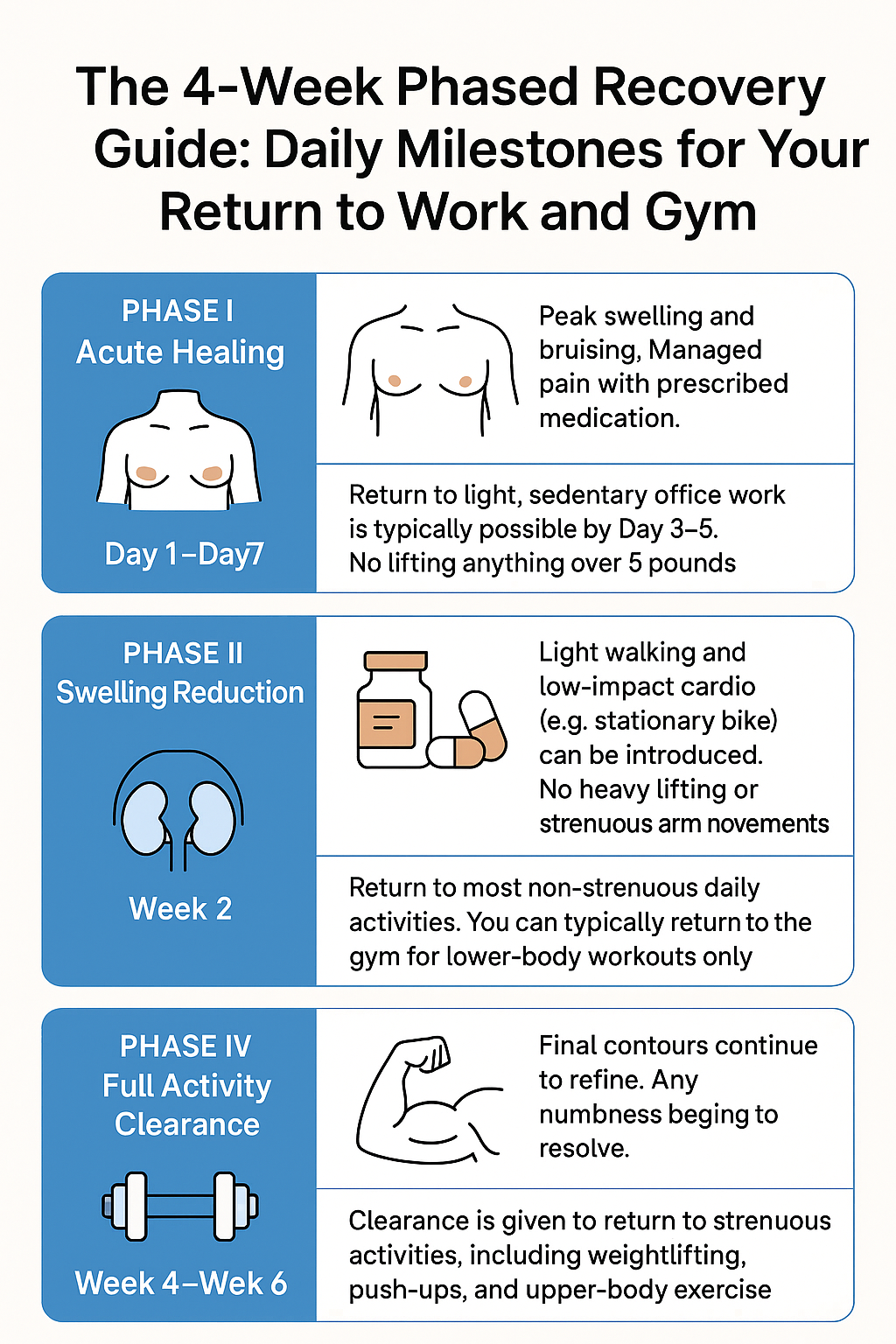
Phase I: Acute Healing (Day 1 to Day 7)

This is the “heavy lifting” week — your body is working hard and you’ll feel it. Expect swelling, tightness, and some bruising. The compression garment stays on 24/7.

  • Swelling is highest during the first 48 hours.
  • Pain is moderate but controlled well with medication.
  • Mild asymmetry, hardness, or uneven swelling is normal.
  • Compression garment is mandatory.

Return to work: Most patients can resume light, desk-based work by Day 3–5.
Avoid lifting anything heavier than 5 kg.


Phase II: Swelling Reduction (Week 2)

This is the week where you start feeling “normal” again. Pain reduces significantly, swelling begins to settle, and bruising fades.

  • OTC pain relief is usually enough.
  • Skin begins to stick smoothly to your new chest contour.
  • Walking and stationary cycling are safe.

Avoid: running, chest exercises, heavy weights, and anything that causes chest bounce.

Phase III: Integration & Light Exercise (Week 3)

Your chest shape becomes clearly visible and most bruising disappears. Most patients feel around 70–80% recovered by this point.

  • Compression garment often shifts to 12 hours/day.
  • Energy levels improve.
  • You can train legs, abs, and do light cardio.

Avoid: bench press, push-ups, dips, pull-ups, chest machines, swimming.

Phase IV: Full Activity Clearance (Week 4 to Week 6)

Now your healing stabilises. Swelling continues to settle and any numbness starts improving.

  • Upper body workouts are usually cleared by Week 4–6.
  • Sports, running, and swimming are back on the table.
  • Final definition improves over the next several weeks.

Most patients feel completely normal by Week 4 or 5.

The Compression Garment: Your Results Depend On It

Compression is not optional. It is a major reason why some patients heal with crisp definition and some don’t.

  • Helps swelling resolve faster.
  • Improves skin tightening.
  • Prevents fluid pockets.
  • Maintains consistent chest contour.

Protocol:
24/7 for the first 14 days → then 12 hours/day for 2–3 more weeks.

Maintaining Your Results Long-Term

The surgery fixes the gland and fat, but long-term results depend on you:

  • Maintain a stable weight.
  • Avoid steroids and hormonal supplements.
  • Stay consistent with workouts after clearance.
  • Follow your follow-up schedule.

Why Our Recovery System Works

Our outcomes stay predictable because our process is disciplined. Using ultrasonic energy for precise fat removal, micro-incisions for minimal scarring, and structured aftercare allows faster recovery without rushing your body.

Thinking About Gynecomastia Surgery?

If you want a transparent, predictable, and patient-first approach to gynecomastia surgery in Nagpur, you’re welcome to book a consultation. Clear recovery planning is part of your treatment — not an afterthought.

Clinic: Prime Polyclinic, Dhantoli, Nagpur

Contact: 9960961451

Website: https://www.drbhupendraplasticsurgeon.com/


The Nagpur Micro-Incision Gyno Protocol: Minimize Scars, Maximize Skin Tightening for a Flatter Silhouette


Quick Answer

Gynecomastia surgery can often be performed through small, strategically placed incisions using a combination of Lipovase (4th-generation VASER liposuction) and gland excision. The Nagpur Micro-Incision Gyno Protocol is designed to minimize visible scarring while achieving effective gland removal, chest contouring, and skin retraction whenever appropriate. The exact technique depends on the grade of gynecomastia, skin quality, and individual anatomy.

Key Takeaways

  • Uses small, strategically placed incisions whenever suitable.
  • Combines Lipovase (4th-generation VASER) with gland excision.
  • Aims to reduce visible scarring on the chest.
  • Helps improve chest contour and definition.
  • Not every patient is a candidate for a purely micro-incision approach.
  • Surgical planning depends on gynecomastia grade and skin laxity.

Ideal Candidates

This approach is often most suitable for:

  • Grade 1 gynecomastia
  • Grade 2 gynecomastia
  • Selected Grade 3 cases
  • Patients with good skin elasticity
  • Patients concerned about visible scars

May Require Additional Techniques

  • Advanced Grade 4 gynecomastia
  • Significant skin excess
  • Major weight-loss patients
  • Severe chest skin laxity

Why choose a micro-incision approach for gynecomastia in Nagpur?

Gynecomastia is common and can cause self-consciousness and avoidance of tight clothing. Traditional approaches that rely on large open excisions often leave wider scars and may not optimally address skin contour. Our Nagpur Micro-Incision Gyno Protocol focuses on three clinical priorities:

  • Complete removal of glandular tissue (so recurrence is unlikely).
  • Precise fat removal and controlled collagen stimulation using 4th-generation VASER ultrasound for improved skin retraction.
  • Minimization of visible scars through tiny, strategically placed micro-incisions.

This protocol is performed as part of our gynecomastia surgery in Nagpur.

Our 3-Phase Protocol (Ultrasonic-Assisted Micro-Incision Protocol)

Phase I — Advanced Lipo-Contouring & Collagen Stimulation

We begin with targeted liposuction using ultra-small cannulas to sculpt the chest. After initial infiltration, a 4th-generation VASER ultrasonic probe is used to selectively emulsify fibrous fat and tough tissue. The ultrasound energy eases removal of stubborn deposits while producing controlled thermal effect in the deep dermis that promotes collagen reorganization and measurable skin tightening over the weeks following surgery.

Benefits of Phase I:

  • More precise contouring and the option for high-definition shaping.
  • Less bleeding and bruising versus blunt mechanical undermining.
  • Enhanced potential for natural skin retraction due to internal collagen stimulation.

Phase II — Micro-Incision Glandular Excision

Firm glandular tissue beneath the nipple is excised through  tiny (≈4–8mm) incisions placed at the areola edge or in the axillary fold. These micro-portals allow full gland removal while keeping external scars minimal and well-concealed. Because we access and remove the gland thoroughly, the chance of residual tissue and re-operation is substantially reduced.

Key points:

  • The combination of VASER liposuction and micro-incision gland excision treats both fat and gland — the complete solution for most grades of gynecomastia.
  • Incisions are small and placed in low-visibility locations so scars typically mature to fine, faint lines.

Phase III — Aesthetic Closure & Skin Contouring (quilting sutures not used)

After tissue removal we refine and secure the skin with layered, tension-free closure techniques tailored to each chest. Instead of internal quilting sutures, we rely on meticulous multi-layer skin closure, conservative trimming where needed, and appropriate contour-preserving maneuvers so the skin sits smoothly over the chest wall. Post-operative compression and a structured recovery plan further assist skin re-adaptation to the newly contoured muscle surface.

What this achieves:

  • A snug chest surface without relying on large surface scars.
  • More predictable contour with minimal surface irregularities.

4th-Generation VASER: Why it matters

Using modern VASER ultrasound provides two practical advantages for gynecomastia:

  1. Selective tissue emulsification for gentler, more precise fat removal and less surrounding tissue trauma.
  2. Thermal stimulation at depth that encourages collagen tightening — improving the chance that skin will retract smoothly after volume removal.

Combined with micro-incision gland excision and careful closure, VASER helps deliver a flatter, more athletic chest with less bruising and a faster functional recovery.

Who is a good candidate?

The Nagpur Micro-Incision Gyno Protocol is suitable for men with:

  • Mixed fatty and glandular gynecomastia (common presentation).
  • Desire to minimize visible scarring and obtain a defined chest contour.
  • Reasonable skin elasticity or moderate excess where internal tightening combined with collagen stimulation is expected to give a satisfactory result.

During a consultation we assess grade, skin quality, chest shape and expectations, then recommend the exact combination of micro-incision excision and targeted VASER liposuction or, in rare cases, additional resurfacing/skin-reduction options if there is severe excess.

Recovery highlights — including our 3-Day Accelerated Recovery Package

Because the procedure minimizes tissue trauma and uses regional anesthesia with light sedation when appropriate, many patients return to light daily activities quickly. We offer a structured 3-Day Accelerated Recovery Package that focuses on early mobility, optimized pain control, and guided compressive support to reduce swelling and speed comfort.

Typical timeline

  • Day 0–3: Rest, compression garment, short walks — most patients are comfortable with light activity.
  • Week 1–2: Decreasing soreness; return to desk work; avoid heavy chest activity.
  • 3–6 weeks: Gradual return to gym with cleared chest exercises; contour settling continues for several months.

Individual recovery varies; the goal of the 3-Day package is faster functional comfort, not rushed healing. Follow-up protocols and graded activity instructions are provided at discharge.

Safety, outcomes & what to expect

Our protocol emphasizes safety and predictability. You can expect:

  • Complete gland removal (reducing recurrence risk).
  • Small, well-concealed scars around the areola or in the axilla that typically fade over months.
  • Progressive improvement in skin firmness over 3–6 months as collagen remodeling occurs.
  • A tailored contour — from flat to subtly defined depending on your goals.

We prioritize clear communication about realistic outcomes, documented before/after expectations and a personalised postoperative plan to maximise results.

Frequently asked questions (FAQ)

Will I have big scars?

No — scars are intentionally tiny (≈4–5 mm) and positioned to be inconspicuous. Proper closure and scar care further reduce visibility as they mature.

Does VASER guarantee skin tightening?

VASER improves the potential for skin retraction by stimulating collagen, but the degree of tightening depends on your baseline skin elasticity and the amount of excess. We design the plan to maximise your chances of good retraction; in rare cases with severe redundancy, additional skin procedures may be discussed.

How soon can I go back to work and gym?

Many patients resume light office work within a few days and return to full gym activity in 3–6 weeks depending on progress. The 3-Day Accelerated Recovery Package helps achieve safe early comfort and mobility.

Is there a high chance of revision?

By combining complete gland excision and precise VASER liposuction we minimise the risk of residual tissue. Careful planning and technique significantly reduce revision rates compared with partial or fat-only approaches.

Schedule a confidential consultation

If you’re concerned about persistent gynecomastia, loose chest skin or visible scars, the Nagpur Micro-Incision Gyno Protocol offers a modern, minimally visible solution. Contact our Nagpur centre for a one-to-one evaluation and a personalised plan.

Clinic: Dr. Bhupendra Gaidhane — Diamond One Building, Prime Polyclinic, Dhantoli, Nagpur, Maharashtra 440012

Phone / WhatsApp: 9960961451

Note: A confidential in-clinic assessment is required to confirm candidacy and to provide a tailored cost estimate and perioperative plan.


Breast Augmentation with Implants in Nagpur – Motiva & Sebbin with Keller Funnel for Natural Results and Minimal Scarring


👩 Every woman deserves to feel confident in her body. For many, breast augmentation surgery is the key to restoring self-esteem, femininity, and balance in body proportions. Whether you’re looking to enhance breast size, correct post-pregnancy changes, or simply feel more confident in your clothes, advanced techniques now make the journey safer, smoother, and almost scarless.At our clinic in Nagpur, we use world-class implants like Motiva and Sebbin, combined with the Keller Funnel technique, to give you natural-looking results with smaller incisions, faster recovery, and minimal scarring.

🌸 What is Breast Augmentation?

Breast augmentation (commonly known as a boob job or breast implant surgery) is a cosmetic procedure where implants are placed to:

  • ✅ Increase breast size
  • ✅ Restore fullness lost after pregnancy, breastfeeding, or weight loss
  • ✅ Correct asymmetry
  • ✅ Improve body shape and confidence

Women in the 20–40 years age group are the most common candidates for this surgery, often choosing it for both aesthetic and emotional reasons.

🌍 Why Choose Motiva or Sebbin Implants?

When it comes to implants, safety and aesthetics matter most.

💎 Motiva Implants

  • Known for MinimalScar technology (tiny incisions)
  • Soft, natural feel
  • Durable shell for long-lasting results
  • Reduced complication rates

🇫🇷 Sebbin Implants

  • Manufactured in France under strict standards
  • Natural softness with a wide variety of shapes
  • Textured shell lowers risk of capsular contracture
Before and after breast augmentation surgery in Nagpur by Dr. Bhupendra Gaidhane. Enhanced breast shape and volume through advanced surgical techniques
Before and after transformation of breast augmentation surgery in Nagpur by Dr. Bhupendra Gaidhane. Specializing in breast implants, augmentation, and cosmetic enhancements.

✂️ Keller Funnel Technique – Smaller Incisions, Bigger Advantages

Traditional breast implant placement requires a 6–8 cm incision. With the Keller Funnel, implants are inserted through a much smaller 4–5 cm incision.

  • ✨ Minimal scarring (discreetly hidden in breast fold)
  • ✨ Reduced infection risk (no hand-touch technique)
  • ✨ Less tissue trauma → faster recovery
  • ✨ Shorter surgery duration

Keller Funnel Technique for Minimal Scar Breast Augmentation

💰 Cost of Breast Augmentation in Nagpur

One of the most asked questions is: “What is the cost of breast implant surgery in Nagpur?” 💵

The cost depends on:

  • Type of implant (Motiva or Sebbin)
  • Hospital/operation setup
  • Anesthesia charges
  • Surgeon’s expertise

On average, breast augmentation in Nagpur costs between ₹1.4L to ₹2.5L. At our clinic, we maintain transparent pricing with no hidden charges.

🛡️ Safety, Recovery & Results

  • Safety – Motiva/Sebbin + Keller Funnel = reduced risks
  • Recovery – Return to work in 5–7 days, full recovery in 4–6 weeks
  • Scarring – 4–5 cm incision, barely visible after healing
  • Results – Natural feel, youthful contour, long-lasting confidence

Breast Implant Surgery Recovery Timeline

❓ Frequently Asked Questions (FAQs)

Q1. How long do breast implants last?

👉 Modern implants last 10–15 years or longer with proper care.

Q2. Can I breastfeed after breast augmentation?

👉 Yes. Most women can breastfeed safely after implant surgery.

Q3. Does breast augmentation leave scars?

👉 With the Keller Funnel, scars are 4–5 cm, discreet, and fade with time.

Q4. What is the best age for breast implants?

👉 After 18 years (once breast development is complete). Women in their 20s–30s are the most common candidates.

Q5. What’s the difference between breast augmentation and breast lift?

👉 Augmentation = adds volume with implants.
👉 Lift = corrects sagging without implants.
👉 Some women may benefit from a combination.

Breast Augmentation vs Breast Lift

🏥 Why Choose Dr. Bhupendra Gaidhane in Nagpur?

  • ✅ Experienced Plastic & Cosmetic Surgeon
  • ✅ Specializes in Motiva and Sebbin implants with Keller Funnel
  • ✅ Expertise in VASER-assisted breast procedures and skin-only lifts
  • ✅ Personalised pre-op and post-op care
  • ✅ Hundreds of happy patients with natural results

Best Breast Implant Surgeon in Nagpur - Dr. Bhupendra Gaidhane

🌟 Conclusion – Your Confidence, Our Commitment

If you’re considering breast augmentation in Nagpur, choose a clinic that offers advanced implants, modern techniques, and compassionate care.

With Motiva or Sebbin implants and the Keller Funnel technique, you can enjoy:

  • ✨ Natural results
  • ✨ Smaller scars (4–5 cm vs 6–8 cm)
  • ✨ Faster recovery
  • ✨ Long-lasting confidence

📞 Call Dr. Bhupendra Gaidhane (9960961451) today to schedule a consultation and take the first step towards the transformation you’ve always wanted.


Teenage Gynecomastia in Nagpur: When to Consider Surgery & Why Early Treatment Matters

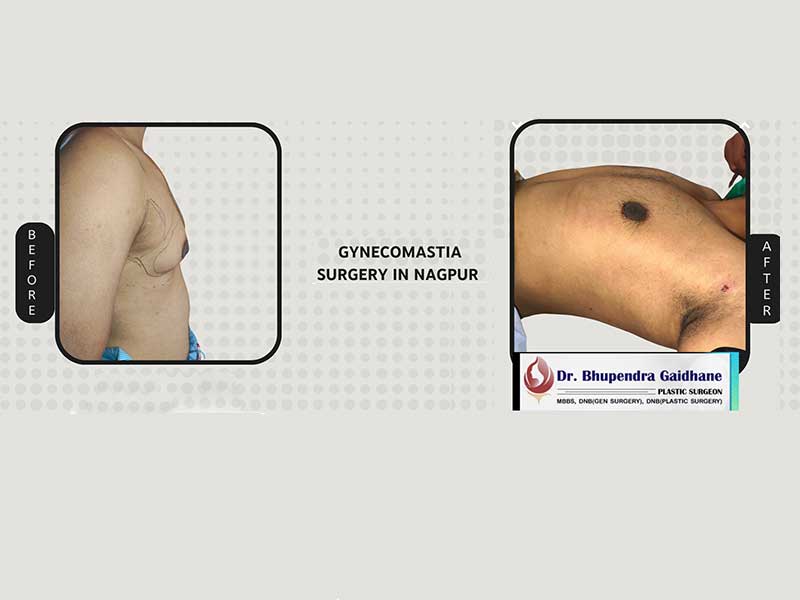
"Before and after gynecomastia surgery performed by Dr. Bhupendra Gaidhane, a leading cosmetic and plastic surgeon in Nagpur."
“Before and After Gynecomastia Surgery by Dr. Bhupendra Gaidhane in Nagpur – Expert treatment for male breast reduction.”

👦 Teenage Gynecomastia in Nagpur: When to Consider Surgery & Why Early Treatment Matters

A Complete, Honest Guide for Parents and Teen Boys

If your teenage son constantly pulls at his shirt, avoids sports, or seems more withdrawn than usual — it might not be “just a phase.” It could be gynecomastia, a condition that’s common, treatable, and easier to fix early.

As a trusted gynecomastia surgeon in Nagpur, I’ve seen how this one issue can quietly impact a teen’s body image, confidence, and quality of life. Let’s talk openly about what it is, when surgery is necessary, and why the right time to act might be now — not later.


🔍 What Is Teenage Gynecomastia?

Gynecomastia is the development of excess glandular breast tissue in boys, usually due to hormonal changes during puberty. It can affect one or both sides of the chest, showing up as:

  • Puffy nipples
  • Rounder or fuller chest
  • Swelling under the areola

👉 Around 60–70% of teen boys will experience some form of it.
✅ For many, it goes away on its own.
⚠️ But for others — especially with Grade 2 or Grade 3 gynecomastia — it can stay, grow, or even worsen.


⚠️ Why Waiting Too Long Can Backfire

Here’s the thing most parents aren’t told:
Delaying surgery can make things more complex.

🟡 What may seem mild now… can progress to:

  • Larger, firmer glands that don’t shrink
  • Stretched or sagging chest skin
  • The need for skin removal surgery later (larger scars, higher cost)
  • More emotional damage — social anxiety, isolation, and low self-esteem

📉 Late intervention = more trauma + more expense + longer healing
📈 Early intervention = minimal scars + lower cost + better results


🧠 Emotional Impact: More Than Just a Chest Issue

Gynecomastia often damages self-image silently. Teens might:

  • Avoid swimming or gym class 🏊‍♂️
  • Wear baggy clothes year-round 👕
  • Face bullying or teasing 😔
  • Shut down socially or become anxious

This affects school life, friendships, and even how they see their future. Early treatment can lift this emotional burden.


✅ When Is the Right Time for Surgery?

💡 If the gland hasn’t reduced in 2+ years, or if the teen is clearly struggling with body image — surgery is worth considering.

📌 Ideal age: 16–19 years
🩺 Why? At this age:

  • Skin is still elastic (great for scarless results)
  • Teens recover faster
  • Social integration is easier — especially if done during vacation

🔬 Why We Use LIPOVASE (4th Gen VASER) for Teen Gynecomastia Surgery

At my clinic in Dhantoli, Nagpur, we use Lipovase (4th-gen VASER) — advanced VASER (Ultrasound) technology for treating male breast enlargement in teens.

🎯 What LIPOVASE Does Better:

  • Breaks down gland + fat precisely
  • Tightens skin without large incisions or cutting
  • Creates a smooth, natural chest contour
  • Leaves tiny, hidden scars
  • Less pain, less swelling, faster healing

🧑‍⚕️ It’s especially effective in teenagers due to higher natural skin elasticity — meaning no need for skin removal in most cases.


📊 Comparison Chart: Early vs Late Gynecomastia Surgery

Factor Early (16–19 yrs) Late (25+ yrs)
Incision Size Minimal Larger
Skin Quality Tight, elastic Loose, stretched
Recovery 3–5 days 1–2 weeks
Cost Lower Higher
Emotional Healing Faster Slower
Need for Skin Removal Rare Often

💬 FAQs: What Parents & Teens Ask Us Most

Is gynecomastia surgery safe in teenagers?
Yes. It’s a short daycare procedure under general anesthesia with rapid recovery. Teens usually bounce back in 3–5 days.
Will there be visible scars?
With Lipovase (4th-gen VASER), we use 1–2 small, hidden incisions. Scars fade to nearly invisible over time.
What’s the downtime?
School: 3–5 days
Sports: 2–3 weeks
Will it return later?
No. Once the gland is removed and weight is stable, results are permanent.
Can insurance help?
Sometimes. In cases with pain, asymmetry, or psychological issues, we can help with documentation for potential claims.

👪 A Message to Concerned Parents

If your son is constantly covering his chest, avoiding mirrors, or losing confidence — it’s not “just fat” or “just puberty.” It’s something he feels deeply, even if he doesn’t say it out loud.

  • 🚫 Exercise won’t shrink gland tissue
  • ⏳ Waiting may only make it harder later
  • 💉 Surgery at the right time can be life-changing — not just body-changing

📍 Why Choose Dr. Bhupendra Gaidhane in Nagpur?

🏥 I’ve helped  teenage boys from in aand around Nagpur and Vidarbha get back their confidence — safely and discreetly.

  • Board-certified Plastic & Cosmetic Surgeon
  • Expert in VASER gynecomastia surgery
  • Compassionate, honest counselling for parents & teens
  • High satisfaction with natural results, minimal scars, and quick return to school

📞 Ready to Talk?

Let’s have a friendly, no-pressure conversation. Your son’s mental and emotional health is just as important as his physical health.

Dr. Bhupendra Gaidhane
Board‑certified Plastic & Cosmetic Surgeon, Nagpur

📍 Cabin No. 3, 1st Floor, Diamond One Building,
Prime Polyclinic, Dhantoli, Nagpur, Maharashtra – 440012

📲 Call/WhatsApp: 9960961451
🌐 Website: www.drbhupendraplasticsurgeon.com


Final Word: Teenage gynecomastia isn’t just about looks. It’s about confidence, freedom, and mental peace. ⏳ The earlier you act, the simpler and more successful the outcome. Your son deserves to feel normal in his own skin. Book a confidential consultation today.


Book an Appointment